
AI prospecting works best as a five-stage research and writing system: define a market, size a territory, identify evidence, build a brief, and draft a human-reviewed approach. It does not create permission to contact someone, verify a stranger's finances, or turn a public record into a personal claim.
The five stages also make failures cheaper. A bad niche can be rejected before anyone buys data. A fuzzy boundary can be corrected before it becomes a household count. An unsupported claim can be removed before it reaches approved copy. The system is deliberately slower at the handoffs and faster everywhere else.
That boundary is the point of this guide. Any current model will produce a prospecting plan on request. What matters is which part of that plan can be checked before an advisor acts on it. Plotbook's property-first prospecting guide explains the underlying research direction; this guide shows where AI belongs in the workflow, stage by stage.
unknown nodeStage 1: define a market that leaves evidence
"Business owners" describes an audience. A workable niche has a bounded population, a recurring planning problem, and at least one lawful source that can help an advisor find or understand the population.
That distinction matters because a model can produce twenty attractive niche labels in a single reply. In our August 19, 2026 test, run from an empty directory with no access to our own files, both Claude Opus 5 and GPT-5.6 proposed plausible Treasure Valley niches. Claude ran with every tool disabled, so its answer came from general knowledge alone. GPT-5.6 ran in OpenAI's Codex, which left its built-in web search on, and it searched six times before answering. Either way, the suggestions sounded local, but the headcounts, employer-plan details, and timing claims still needed verification. We did not test Gemini or Copilot.
So the right output from this stage is a scorecard rather than a list of niche ideas, built on three questions: can you define the population, can you observe a real planning trigger, and can you contribute something specific before asking for a meeting? Our researchable advisor niche test runs ten candidates through that scorecard, including the failures.
Kitces' 2024 marketing survey found that 45% of high-growth practices predominantly targeted at least one niche, compared with 29% of other practices. The report surveyed roughly 1,000 practices, with more than 400 complete responses, and defined a niche narrowly: up to three markets accounting for more than three-quarters of new clients (Kitces Report, 2024, p. 64). That is a correlation; it does not show that picking a niche causes growth.
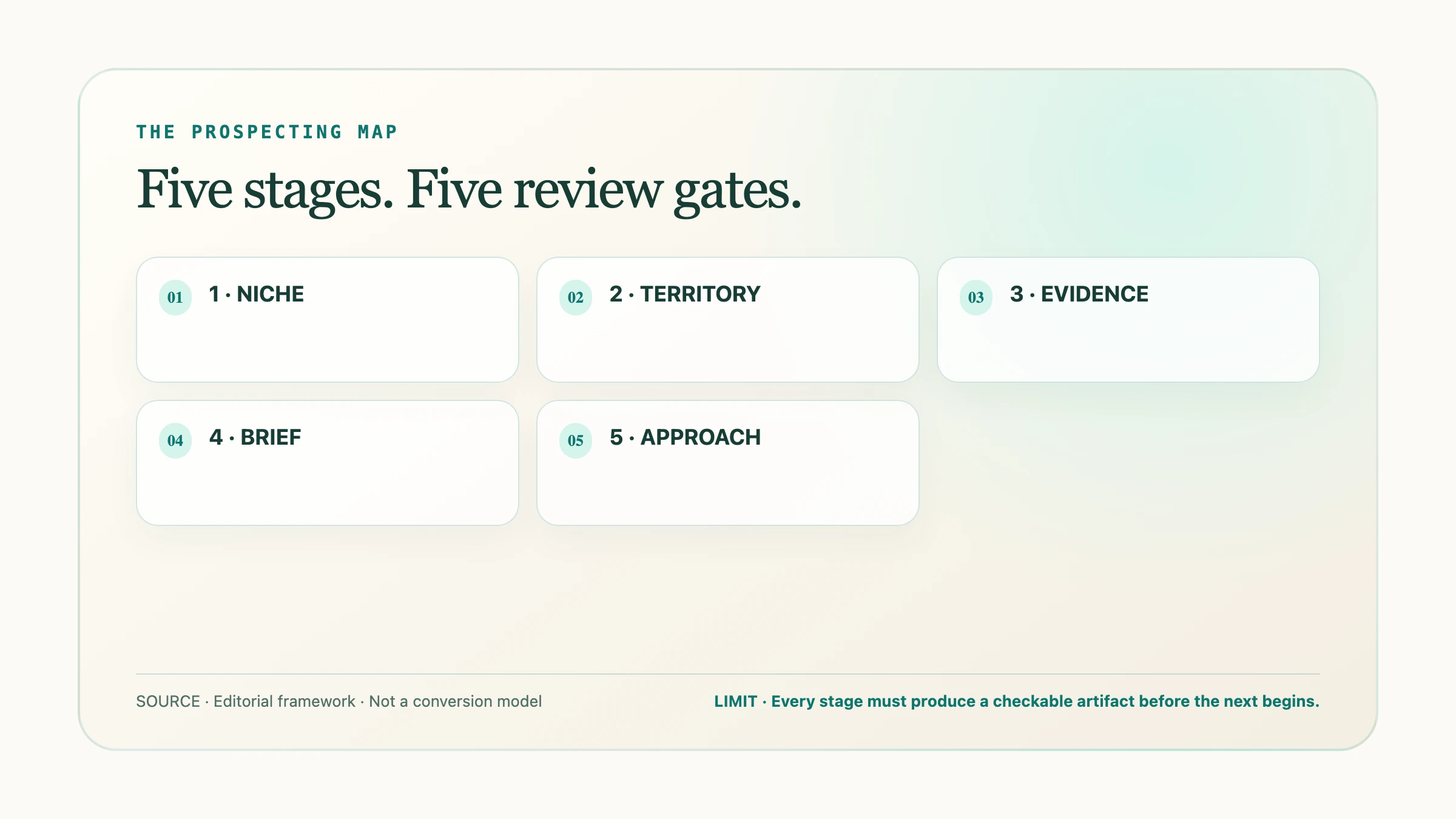
Each stage produces an artifact that can be checked before the next stage begins.
Stage 2: size a territory before naming people
In our worked Arcadia case study, the four census tracts covering the Phoenix neighborhood ranged from 53.4% to 98.6% owner-occupied. Compressing that spread into one neighborhood rate erased the difference an advisor actually needed. That is the danger of a single-number summary, and it is why a territory has to be a defined polygon plus a set of source dates. A ZIP code, colloquial neighborhood, school district, and census tract can describe different populations even when people use the names interchangeably.
Start with aggregate sources. The Census Bureau's American Community Survey can show housing, tenure, income, and household distributions at tract level. IRS Statistics of Income publishes ZIP-level counts and totals for adjusted gross income and other tax items through tax year 2022 (IRS ZIP Code Data). IRS ZIP data describes income-tax returns rather than wealth, so a high-income ZIP is a place to investigate. It does not name a single wealthy household.
Only after the boundary and dates are fixed should anyone ask for counts. The territory and neighborhood profiling case study prints both models' Arcadia answers beside the public record, including one that picked a single tract and called it a conservative count for the whole neighborhood.
For a broader property-data workflow, see how to work a territory by assessed value and how Plotbook handles property data.
Stage 3: identify evidence without pretending it is wealth
Ask what a record actually says before asking what it implies. A deed may identify a grantee. A county assessor may show an owner name, mailing address, and assessed value. SEC Form 4 may show a named insider's transaction, share count, price, and date. FEC records may show itemized federal contributions above the reporting threshold. None of those records reports a household's complete balance sheet.
The strongest workflow records four fields for every observation:
|
Field |
Example |
Why it matters |
|---|---|---|
|
Fact |
A deed names an LLC as grantee |
Says only what the record states |
|
Source |
County recorder, document number, date |
Lets another person retrieve it |
|
Inference |
The property may be held for privacy or liability reasons |
Kept visibly separate from fact |
|
Unknown |
Beneficial owner, debt, investable assets, intent |
Prevents the model filling the gap |
The SEC explains that Form 4 covers directors, officers, and beneficial owners of more than 10% and generally must be filed within two business days of the transaction (SEC Investor Bulletin). That makes it useful evidence for a defined group of insiders and silent about everyone else.
Property held by an entity needs its own method, because the record names the LLC and stops there. The LLC-owned property research guide walks through the state entity filings and mailing-address checks that can, sometimes, connect an entity to a person.
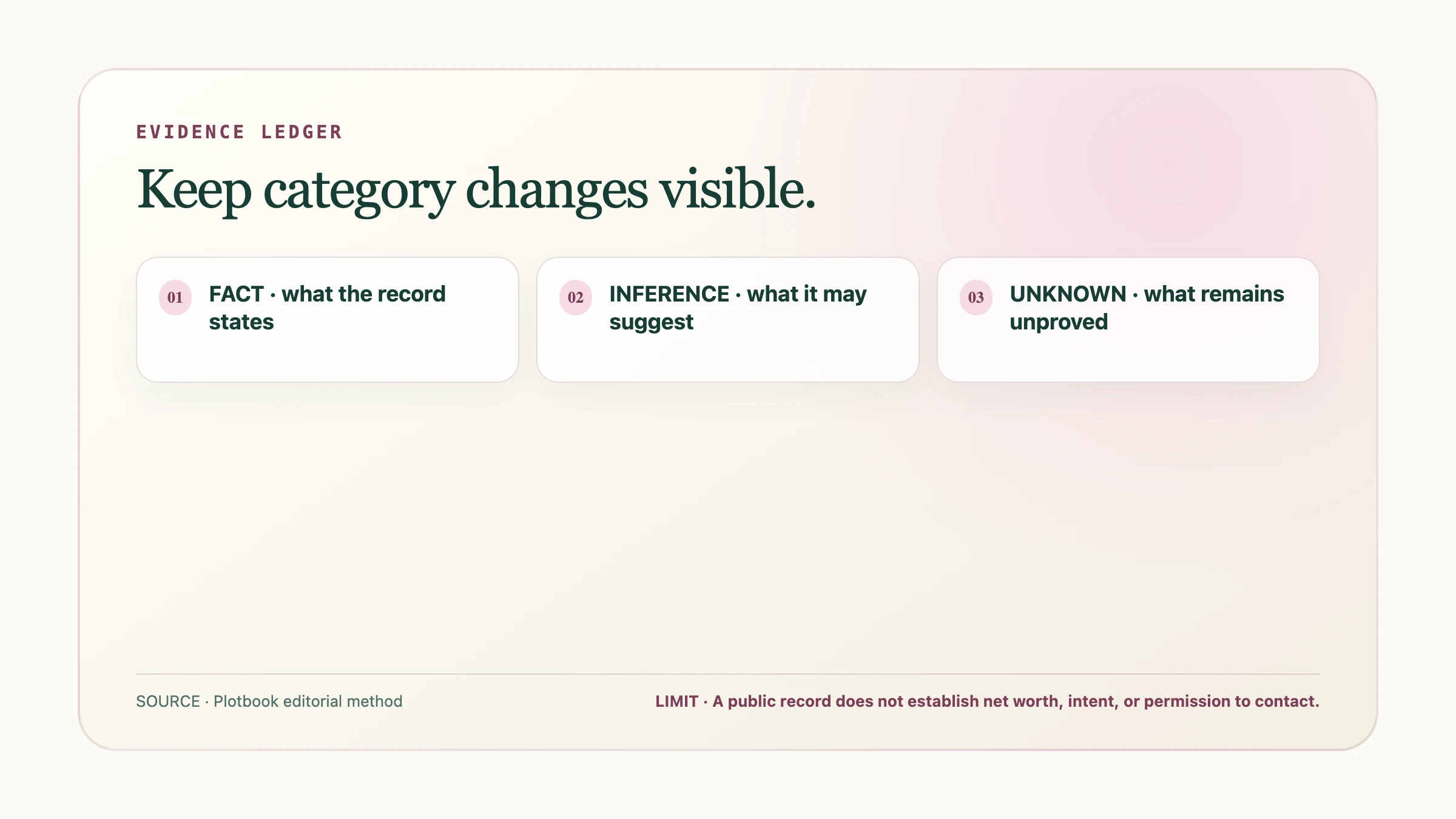
A source can narrow uncertainty without proving net worth or intent.
Stage 4: build a brief that marks inference
Give the model only the facts you have verified. Require a source beside every factual line, a separate inference section, and a question list for everything missing. Then ask for a contradiction pass: which statements rely on mismatched dates, names, entities, or geographies? The aim is a brief that makes uncertainty easier to see, rather than one that makes the person sound more knowable than the evidence allows.
This is the job of the advisor prospecting prompt system. Its five prompts chain from niche definition to a first-touch draft, and each printed example includes its failure mode. The companion prospect research workflow covers the meeting-prep version of the same evidence standard.
A good brief is allowed to be incomplete. "Not established" is more useful than a polished paragraph that quietly blends a deed, a company bio, and a model's guess about why someone might sell.
Stage 5: draft an approach from the safe facts
Here the task is to choose the least intrusive, most relevant fact and explain why a conversation could be useful without exposing the research method. A request to "write a persuasive cold email" skips every part of that.
In our approach test, the thin prompt was told only that a Scottsdale business owner had a $3.2 million assessed home. Claude Opus 5 correctly warned against mentioning the house, but then drafted claims such as "most of the families I work with" and "what I tell people more often than you'd expect" that had never been supplied. The structured prompt banned asset references, supplied the advisor's real positioning, named acceptable sources, limited the message to 120 words, and required unknowns to be flagged. Its output omitted the house entirely and used the business filing as the stated reason for writing.
Treat it as one comparison on one date rather than an accuracy benchmark. What it shows is that useful constraints are factual: "warm and professional" does not tell a model which claims it may make.
For professional referral partners, use a different motion. The COI outreach kit for financial advisors is organized separately for CPAs, estate attorneys, and business brokers because the useful first offer differs for each one.
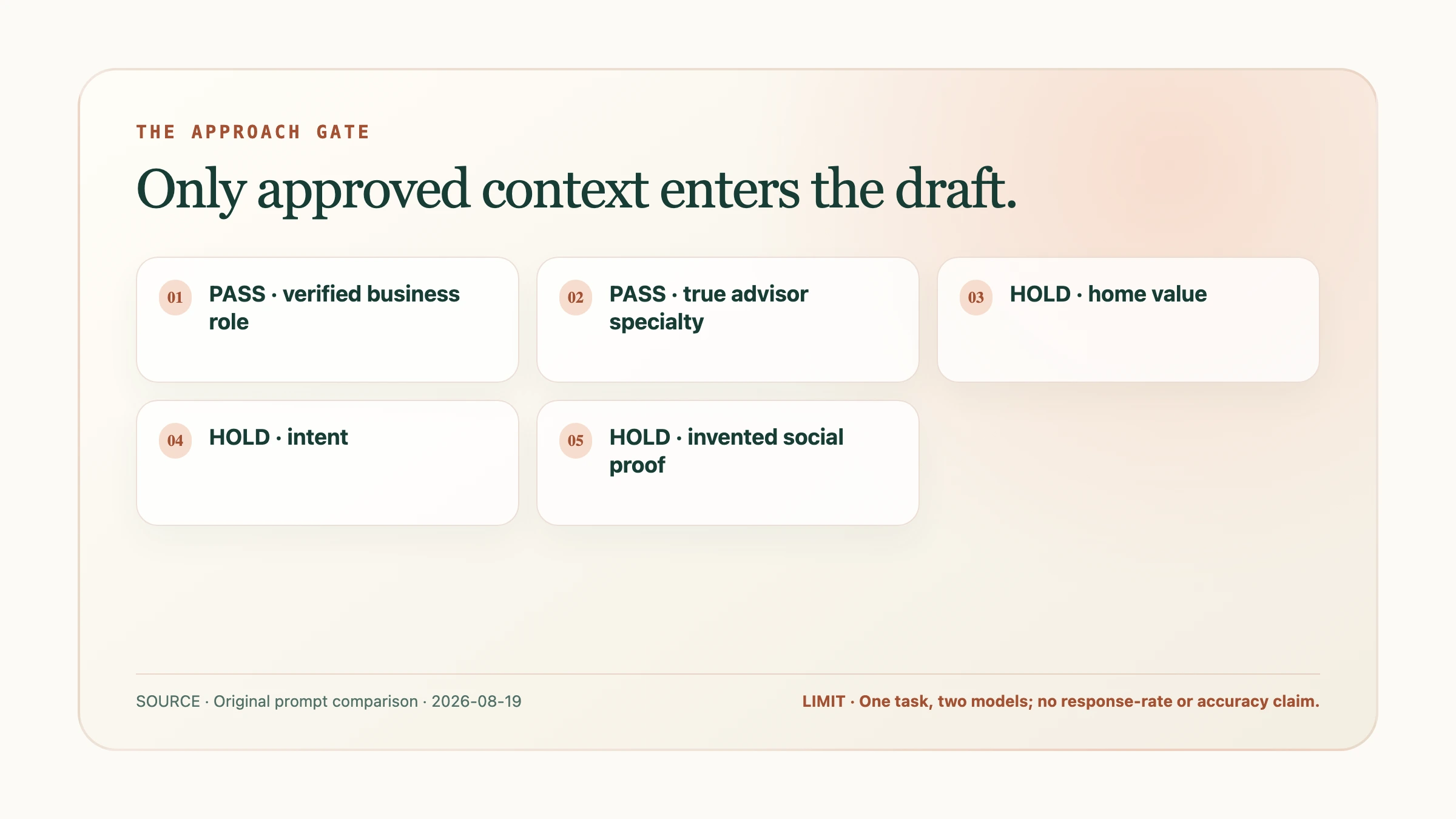
The drafting gate controls which facts may appear; it does not approve the message for use.
Compliance review belongs before distribution
AI does not decide whether a communication is approved. The SEC Marketing Rule applies seven general prohibitions to advertisements, including untrue or misleading statements, unsubstantiated material claims, misleading implications, unbalanced benefit claims, cherry-picked advice, and unfair performance presentation (SEC Small Entity Compliance Guide). Broker-dealer representatives may also have FINRA and firm-specific requirements.
Our financial advisor marketing ideas compliance guide treats review as a gate, not a disclaimer appended at the end. The firm's policies, registration, channel, recordkeeping rules, and reviewer still control. The SEC's September 2024 sweep charged nine RIAs and announced $1.24 million in combined civil penalties involving untrue or unsubstantiated claims and deficient testimonials, endorsements, or ratings (SEC release 2024-121).
Frequently asked questions
Can AI find prospects for a financial advisor?
AI can help define filters, organize public records, compare evidence, and draft from supplied facts. It cannot independently verify a stranger's complete finances or create permission for outreach.
Is public property data enough to identify a high-net-worth prospect?
No. Property can be a useful signal, but assessed value, sale price, equity, household net worth, and investable assets are different measures. Treat any wealth output as an estimate range and review why net worth estimates should not be magic numbers.
Should an advisor let AI send outreach automatically?
No. Keep research, drafting, approval, and sending as separate steps. Plotbook does not send, dial, or sequence outreach.
What should the advisor save from the workflow?
Save the source record, retrieval date, prompt, model output, human corrections, approved final copy, and reviewer under the firm's policy. That creates a reproducible path from evidence to communication.
The operating rule
AI earns a place in prospecting when it makes the work more inspectable. Each stage should leave behind something another person can verify: a bounded market, a dated territory profile, a source ledger, a fact/inference brief, and a draft whose claims trace to supplied evidence.
If a stage instead makes a stranger's life sound more certain than the record allows, stop there. Better prospecting begins with a narrower claim.