Plotbook vs Aidentified
Aidentified maps who knows whom. Plotbook maps who owns what
This is the closest comparison in the category, and the one where we concede the most. Aidentified is purpose-built for wealth management, holds a very large consumer profile set, surfaces warm introduction paths through a relationship graph, and pushes daily alerts when money moves. Those are two of the best prospecting signals in existence and Plotbook has neither. What it does not have is a map. Property is one filter among more than a hundred and fifty, which works if you prospect by attribute and does nothing if you prospect by territory.
Aidentified details from public sources, checked August 2026. Aidentified figures below are theirs, from their published material: 300M+ profiles, 16B+ first-degree connections, and 16 monitored wealth events. They do not publish a rate card, so this page quotes no price. Check the official Aidentified product page. Plotbook is the vendor here, so read this as our argument and check it against theirs.
The short answer
Prospecting by network, or by geography
Advisors tend to be one of two kinds. Some grow through their network: referrals, warm introductions, the second and third degree around existing clients. Others grow through a place: a suburb, a lake, a corridor of neighborhoods they know and can be visibly present in. Aidentified is built extremely well for the first. Plotbook is built for the second. If you genuinely do both, the honest read is that Aidentified is the more complete platform and Plotbook is the cheaper, sharper instrument for the territory half.
Pick Plotbook if you grow through a place
- Your market is a defined geography you could drive in an afternoon.
- You want to see wealth in that geography rather than filter a national list down to it.
- You need the person behind an LLC or trust-held deed, which is an identity problem their model does not take on.
- You start from an address as often as from a name, including addresses you were simply given.
- A four-figure annual seat is not proportionate to your practice, and $79 a month is.
Pick Aidentified if you grow through your network
- Warm introductions are how you actually win business, and you want the paths mapped.
- You want to be told when a prospect's money moves: a liquidity event, a home sale, a job change.
- You want to filter a national population across a very large number of attributes at once.
- You need results in Salesforce and a browser extension while you work LinkedIn.
- Your firm can support a per-seat annual contract and wants a complete platform.
Neutral ground
What each product actually is
Both are built for advisors, which makes this the one comparison where the buyer really is the same person. Here is each product on its own terms.
Plotbook
A map of US property colored by assessed value, with an AI agent that identifies the owner behind a deed and estimates their wealth in ranges.
- Entry point
- A place on a map
- Core signal
- Assessed property value from the county record
- Relationship data
- None
- Alerts
- None. Nothing is monitored over time.
- Delivery
- In-app profiles plus CSV export on Professional and above
- Pricing
- $79 to $499 per month, published, self-serve
Aidentified
A wealth network intelligence platform for advisors, combining a large consumer profile set with relationship mapping and money-in-motion signals.
- Entry point
- A filter set, or a name
- Core signal
- Relationships, life events, and 150+ profile attributes
- Relationship data
- Reported at 16B+ first-degree connections
- Alerts
- Daily money-in-motion notifications
- Delivery
- Platform, Salesforce integration, browser extension
- Pricing
- Not published; request current pricing from Aidentified
Side by side
Capability by capability, including where we lose
Phrases rather than checkmarks. Rows favouring Aidentified are set in darker type on their side, and there are several that matter a great deal.
| Capability | Plotbook | Aidentified |
|---|---|---|
| Relationship and warm introduction paths | PlotbookNone. Plotbook does not model connections between people. | AidentifiedThe signature capability, across a very large graph |
| Money-in-motion alerts | PlotbookNone. Nothing is monitored after a research run. | AidentifiedDaily alerts on liquidity events, home sales, job changes |
| Geographic discovery | PlotbookBrowse any US market on a parcel map colored across six value bands | AidentifiedList and filter based; no map interface |
| Starting from an address | PlotbookA first-class entry point: reverse address lookup, then research if the deed is entity-held | AidentifiedNot an offered workflow |
| Property data | PlotbookThe interface itself, at parcel level, nationwide from Regrid | AidentifiedReal estate ownership and home value among 150+ list filters |
| Identifying the person behind an LLC or trust deed | PlotbookEntity classification, then registry, county record, and open-web research | AidentifiedNot an offered workflow |
| Population coverage | PlotbookAnyone who owns US property, researched one at a time on demand | AidentifiedReported at 300M+ profiles, queryable at once |
| CRM integration | PlotbookCSV export only, on Professional and Enterprise | AidentifiedSalesforce integration plus a browser extension |
| Filtering a national population | PlotbookValue bands on the map only. No national attribute filtering. | Aidentified150+ filters, combinable |
| Wealth figures | PlotbookFour AI-generated ranges with a confidence score, per researched person | AidentifiedWealth and asset attributes across the profile set |
| Showing its work | PlotbookA live timeline of every search and source, kept on the profile | AidentifiedProfile attributes rather than a per-answer research trail |
| Annual cost | Plotbook$948 at Starter, $2,388 at Professional, or $1,910 billed annually | AidentifiedNot publicly listed; request a quote |
Aidentified figures are theirs, from published material and industry reporting as of August 2026, including seat pricing which they do not publish as a rate card. If any of it has moved, tell us and we will correct the page.
The filter that should be a map
Property as filter 87, or property as the interface
Aidentified holds real estate ownership and home value among more than a hundred and fifty attributes you can filter on. That is genuinely useful: you can ask for households in a metro above a home value threshold and get a list back. If you know the query you want, it answers it.
The limit is that a filter can only return what you thought to ask for. It cannot show you that the eastern shore of one lake is assessed two bands higher than the western, that a single street holds six properties over five million dollars, or that a neighborhood you had written off has quietly repriced. Those are things you notice by looking, and there is nothing to look at in a list.
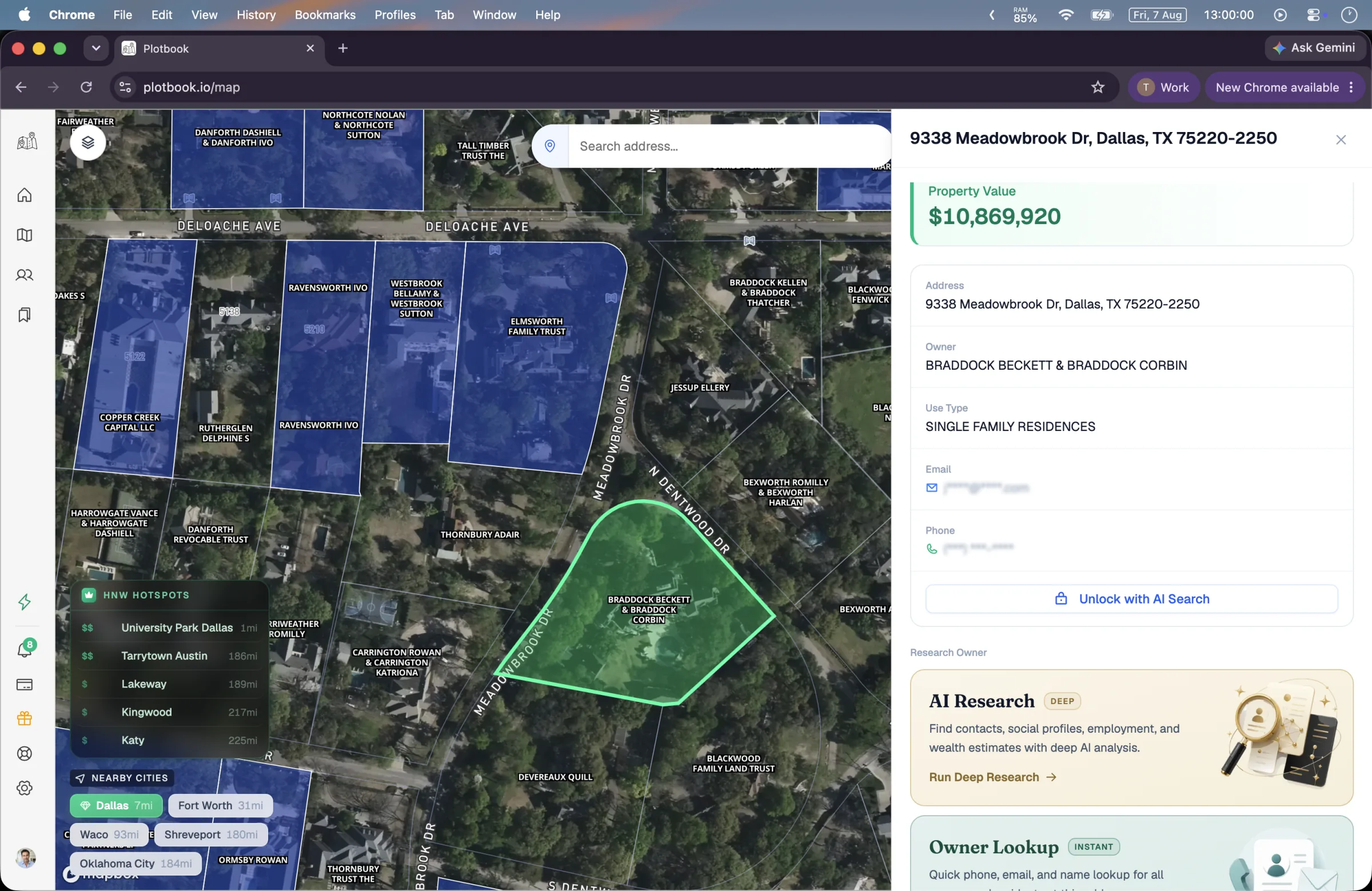
Plotbook is the looking. Nationwide parcel data from Regrid, covering 150M+ parcels, painted across six assessed-value bands, with deed owner names printed on the parcels once you pass zoom 16. You pan a market and read it. Reading costs no credits on any plan, including the trial, so the exploratory half of prospecting is free and only the answers cost anything.
- Six assessed-value bands from under $500K to over $10M, usable as filters
- Deed owner names read straight off the parcel tiles
- 232 hand-curated high-net-worth ZIP codes as a heatmap for orientation at country zoom
- Panning, filtering, and reading owner labels cost nothing on any plan
Starting from an address
Sometimes all you have is a house
A person-first platform assumes you begin with a person. Often you do not. You have an address from a referral, a property you drove past, a parcel in a neighborhood you are trying to break into. Aidentified has no workflow that accepts an address as the question.
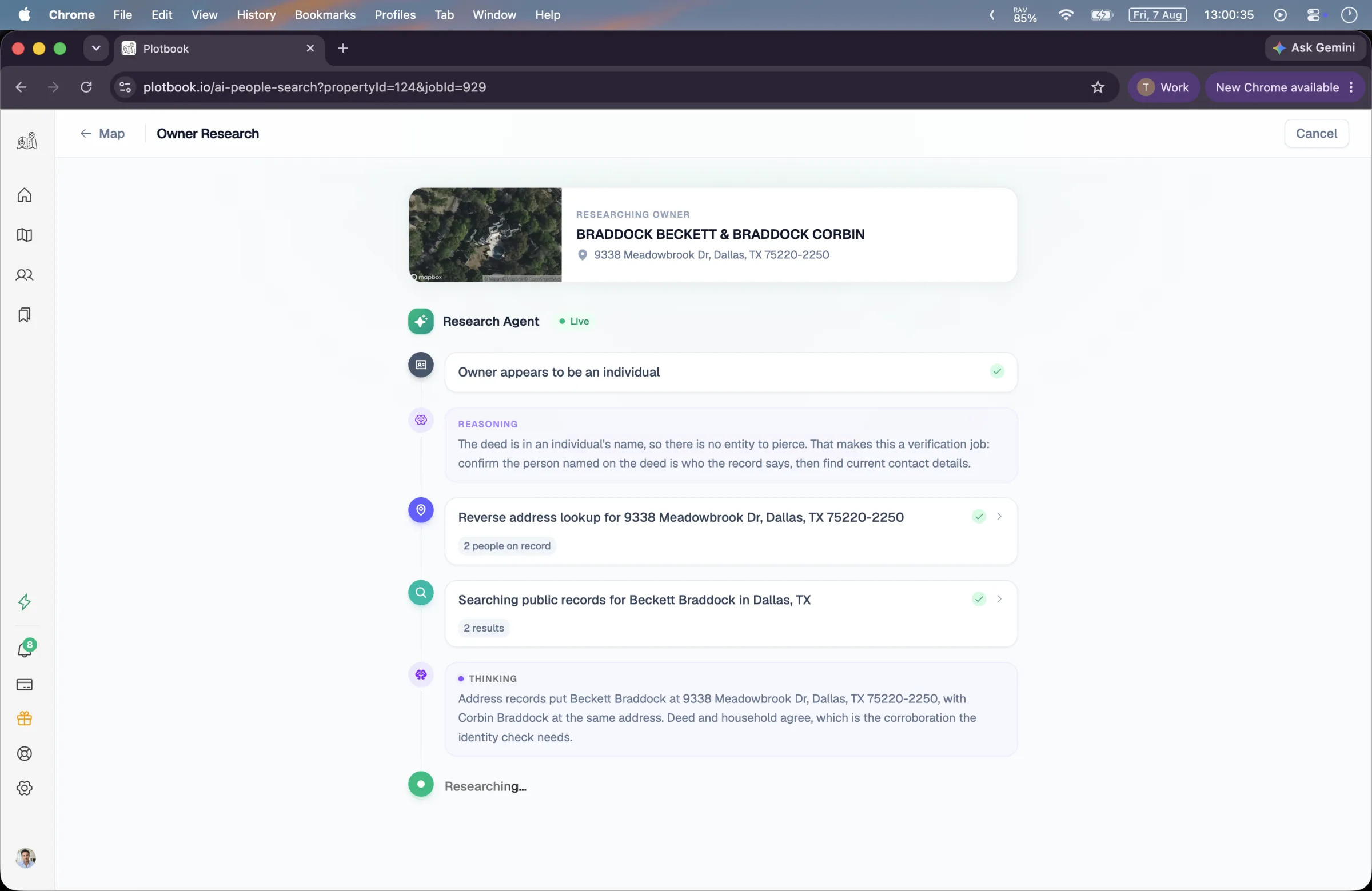
Plotbook has two, and which one runs depends on the deed. If the owner is a person, a reverse address lookup against residential records answers it directly at 5 credits. If the deed is held by an LLC, a trust, a partnership, or an estate, it goes to the research agent instead, which is where the harder work happens.
That agent classifies the entity deterministically before any AI runs, and institutions such as banks, government bodies, and HOAs short circuit with no research and no charge. LLCs go to business registry aggregators for members, managers, officers, and organizers, with explicit handling for Wyoming, Delaware, New Mexico, and Nevada so a commercial registered agent is never reported as the owner. Trusts go to county records for the trustee, then to the open web for the beneficial owner. Absentee properties get a second reverse lookup against the tax mailing address. A disambiguation gate requires corroboration on city, age, address, or employer before anyone is named, every run states the tier it reached, and the 25 credits are charged only on success.
The other side
What Aidentified does better than us
This is the competitor we take most seriously, and the list below is why. Several of these are capabilities we have no plan to build.
The relationship graph
Mapping who knows whom, at a reported 16B+ first-degree connections, and surfacing a warm path to a prospect. Plotbook models no connections between people at all.
Money-in-motion alerts
Daily signals on liquidity events, home sales, job changes, and other triggers. Timing is most of prospecting. Plotbook monitors nothing: a profile is a snapshot of the run that produced it and nothing updates on its own.
Population you can query at once
A reported 300M+ profiles filterable across a wide set of attributes in a single query. Plotbook researches one prospect per run at 25 credits and has no national attribute filtering of any kind.
Salesforce and the browser extension
Results where advisors already work, including alongside LinkedIn. Plotbook has CSV export, on Professional and Enterprise only, and no direct integrations.
Depth in wealth management specifically
A large client base concentrated in wealth management, with the workflow assumptions and enterprise adoption that come from serving it for years. We are new to this and it shows in places.
Coverage of people who do not own property
Plotbook reads the world through real estate. A high-earning renter, a young executive pre-purchase, or someone whose wealth is entirely in a private business is close to invisible to us and perfectly visible to them.
If warm introductions and event timing are how you actually win business, Aidentified is the better platform and the price difference should not talk you out of it. Plotbook is the sharper tool if your growth comes from a place, and it is roughly a third of the annual cost, which makes running both more reasonable than it sounds.
Running both
The two halves of one territory
These compose better than most pairs in this category, because they answer different questions about the same market. Aidentified tells you which people in your orbit are worth approaching and when. Plotbook tells you what the geography actually contains, including people who are in nobody's orbit.
A workable split: use the relationship graph for anyone connected to your existing book, and use the map for the neighborhoods where you have no connections at all. The second group is the one a network-based tool structurally cannot reach, because the graph has no edge to them.
Plotbook's Professional plan at $199 per month, or $159 billed annually, is roughly half a reported Aidentified seat. That matters when deciding whether this is an either-or. Export is CSV, carrying the parcel, the four wealth ranges, the confidence score, and the research summary, and it requires Professional or Enterprise.
- Work your connected orbit through the relationship graph, work the unconnected geography on the map
- Use Plotbook when the starting point is an address rather than a name
- Use Plotbook when a deed is entity-held and a person-first platform returns nothing
- CSV export requires Professional ($199/month) or Enterprise ($499/month)
What it costs
A month of territory work
Plotbook bills a subscription plus credits, and credits are spent only when a paid source is called for you. The comparison worth making is annual: a Professional plan billed yearly against a reported per-seat contract.
- Browsing the map and filtering by value band
- included
- Opening a parcel Plotbook has not seen before
- 1 credits
- Instant owner lookup on a residential address
- 15 credits
- Full research run on an entity-held deed
- 25 credits
- Keeping the result as a profile
- 10 credits
- Exporting to CSV
- 5 credits
Panning, zooming, the six value-band filters, and the deed owner names printed on parcels. Free on every plan, including the trial.
First lookup of a given parcel. Cached afterwards, so returning is free.
Reverse address lookup against residential records. The fast path when the deed is in a person's name.
Classification, registry and county records, contact databases, disambiguation. Charged only if it succeeds.
Enrichment and permanent storage in your prospect book, with the research trail attached.
Professional and Enterprise only. Starter cannot export.
Professional is $199 per month for 2,500 credits, or $1,910 billed annually, which works out around $159 a month and covers roughly 60 full research runs per month plus the map work around them. Aidentified does not publish a rate card, so request a current quote before comparing annual cost. New Plotbook subscribers get 7 days and 100 credits; the trial takes a card and converts on day 8, and we email you before it does.
Questions
Plotbook and Aidentified, asked directly
Keep comparing
Plotbook vs Finny
The other advisor prospecting platform, built around intent signals and automated outreach.
Plotbook vs Catchlight
Lead enrichment and conversion scoring, from a product that cannot discover prospects.
For wealth advisors
What a territory-first prospecting week actually looks like in Plotbook.
Reverse address lookup
Starting from a house rather than a name, and what each path costs.
Test it on the streets you drive
Open the neighborhoods you already prospect and see whether the map shows you something a filtered list did not. If it does not, Aidentified is the better platform and we would rather you knew quickly.
New subscribers start with 7 days and 100 credits. We email you before the trial ends.