Plotbook vs Catchlight
Catchlight scores your leads. Plotbook creates them
Catchlight is refreshingly clear about what it is: an enrichment and scoring layer for leads an advisor already has. Upload the list, get back estimated assets, life events, a conversion score trained on a large body of real advisor conversions, and projected client revenue. It is good at that. What it cannot do, by its own description, is produce a lead that was not in the file. Plotbook only does that, which makes this less a rivalry than a division of labour.
Catchlight details from public sources, checked August 2026. Catchlight figures below are theirs or from industry reporting: incubated at Fidelity Labs, enrichment across 2,000+ data points, conversion scoring trained on 100K+ advisor and investor conversions, CRM integrations including Salesforce, Redtail, and Wealthbox, and pricing from $1,999 per year for individual advisors. Check the official Catchlight product page. Plotbook is the vendor here, so read this as our argument and check it against theirs.
The short answer
Which half of the funnel is empty
This one resolves quickly if you are honest about where the pipeline is stuck. If leads arrive and you cannot tell which deserve your time, Catchlight is aimed exactly at that and its conversion model is trained on something we cannot replicate. If leads do not arrive at all, no amount of scoring helps, because there is nothing to score. Plotbook is for that second problem and is not a scoring tool.
Pick Plotbook if the top of the funnel is empty
- You do not have enough leads for scoring to be the constraint.
- You prospect a defined geography and want to see it rather than filter into it.
- You want to start from an address, including one you were simply given.
- You need the person behind an LLC or trust-held deed, which is an identity problem rather than a scoring one.
- You want the sources behind an answer rather than a score you have to trust.
Pick Catchlight if leads arrive but do not convert
- You have inbound leads, referrals, or an existing list and need them prioritised.
- You want a conversion score built from a large body of real advisor outcomes.
- Projected client revenue is a number your process would actually act on.
- You want enrichment landing in Salesforce, Redtail, or Wealthbox rather than a spreadsheet.
- Your firm already has demand generation and needs qualification, not discovery.
Neutral ground
What each product actually is
The two descriptions barely intersect, which is the most useful fact on this page.
Plotbook
A map of US property colored by assessed value, with an AI agent that identifies the owner behind a deed and estimates their wealth in ranges.
- Entry point
- A place on a map
- Needs leads
- No. It produces them from the property record.
- Scoring
- None. No conversion or fit model.
- Wealth output
- Four AI-generated ranges with a confidence score, per researched person
- CRM
- CSV export only, on Professional and above
- Pricing
- $79 to $499 per month, published, self-serve
Catchlight
An AI lead optimization platform for advisors, incubated at Fidelity Labs, enriching and scoring leads a firm already holds.
- Entry point
- A list of leads you upload
- Needs leads
- Yes. It cannot discover prospects.
- Scoring
- Conversion likelihood, trained on a reported 100K+ advisor and investor conversions
- Wealth output
- Estimated assets and income, plus projected client revenue
- CRM
- Integrations including Salesforce, Redtail, and Wealthbox
- Pricing
- From a reported $1,999 per year
Side by side
Capability by capability, including where we lose
Phrases rather than checkmarks. Rows favouring Catchlight are set in darker type on their side. Notice how few rows either product contests, which is the real conclusion here.
| Capability | Plotbook | Catchlight |
|---|---|---|
| Producing prospects that are not in a list | PlotbookThe core function. Starts from a parcel. | CatchlightNot offered. Leads must come from you. |
| Scoring conversion likelihood | PlotbookNone. No conversion or fit model of any kind. | CatchlightThe core function, trained on a reported 100K+ real conversions |
| Enriching a list at scale | PlotbookNo upload. One research run per prospect at 25 credits. | CatchlightBatch enrichment across a reported 2,000+ data points |
| Geographic discovery | PlotbookBrowse any US market on a parcel map colored across six value bands | CatchlightNo map or spatial interface |
| Starting from an address | PlotbookA first-class entry point, with reverse lookup or full research depending on the deed | CatchlightNot an offered workflow |
| Identifying the person behind an LLC or trust deed | PlotbookEntity classification, then registry, county record, and open-web research | CatchlightNot an offered workflow |
| Projected revenue per client | PlotbookNone. Plotbook makes no revenue projection. | CatchlightPart of the scoring output |
| CRM integration | PlotbookCSV export only, on Professional and Enterprise | CatchlightSalesforce, Redtail, and Wealthbox integrations |
| Wealth figures | PlotbookFour ranges with a confidence score, from a visible research trail | CatchlightEstimated assets and income across the enriched record |
| Showing its work | PlotbookA live timeline of every search and source, kept on the profile | CatchlightA score; the model is proprietary |
| Entry price | Plotbook$79 per month, or $948 a year | CatchlightFrom a reported $1,999 per year |
Catchlight figures are theirs or from industry reporting as of August 2026. On the CRM row: Plotbook has no direct CRM integrations at all. Earlier versions of our marketing implied otherwise, and that was wrong. CSV export, on Professional and Enterprise, is the only way data leaves the product.
The empty funnel
Scoring an empty list returns an empty list
Enrichment products are worth their price when leads are arriving faster than you can qualify them. That is a genuine and common problem, and Catchlight is well built for it, with a conversion model trained on a body of real advisor outcomes that is not easy to assemble.
But a large share of independent advisors have the opposite problem. Leads are not arriving. The referral flow is thin, the marketing is not producing, and there is nothing sitting in a file waiting to be prioritised. Enrichment cannot help, because it operates on records and there are none.
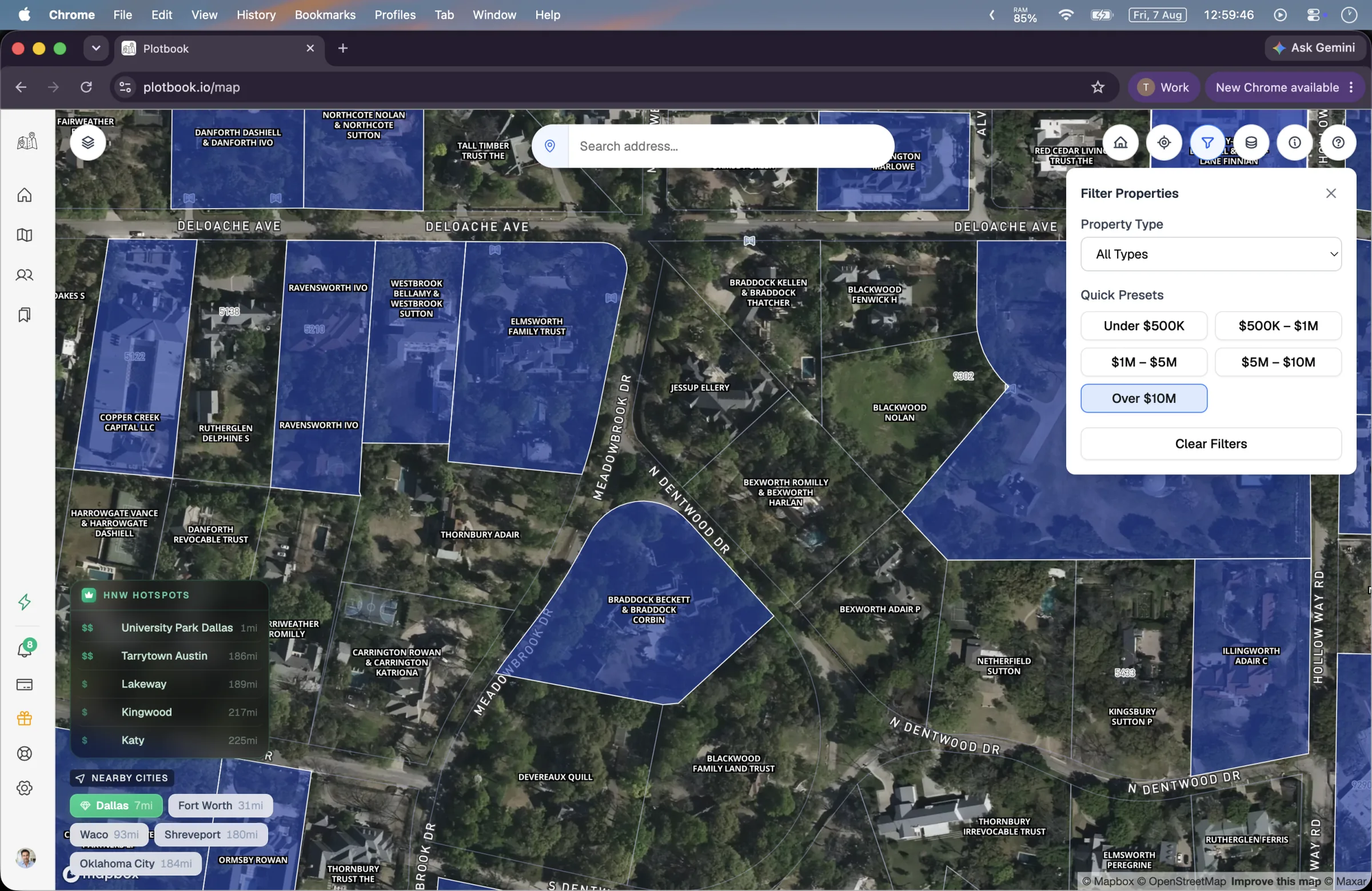
Plotbook starts before there is a record. Nationwide parcel data from Regrid, covering 150M+ parcels, painted across six assessed-value bands, with deed owner names printed on parcels once you pass zoom 16. You choose a market, look at what is in it, and pick the properties worth investigating. Reading the map costs no credits on any plan, including the trial, so the browsing that produces the shortlist is free and only the answers cost anything.
- Six assessed-value bands from under $500K to over $10M, usable as filters
- Deed owner names read straight off the parcel tiles at close zoom
- 232 hand-curated high-net-worth ZIP codes as a heatmap for orientation
- No list to upload, and no minimum volume before the product is useful
From parcel to person
A property is not a lead until you know who owns it
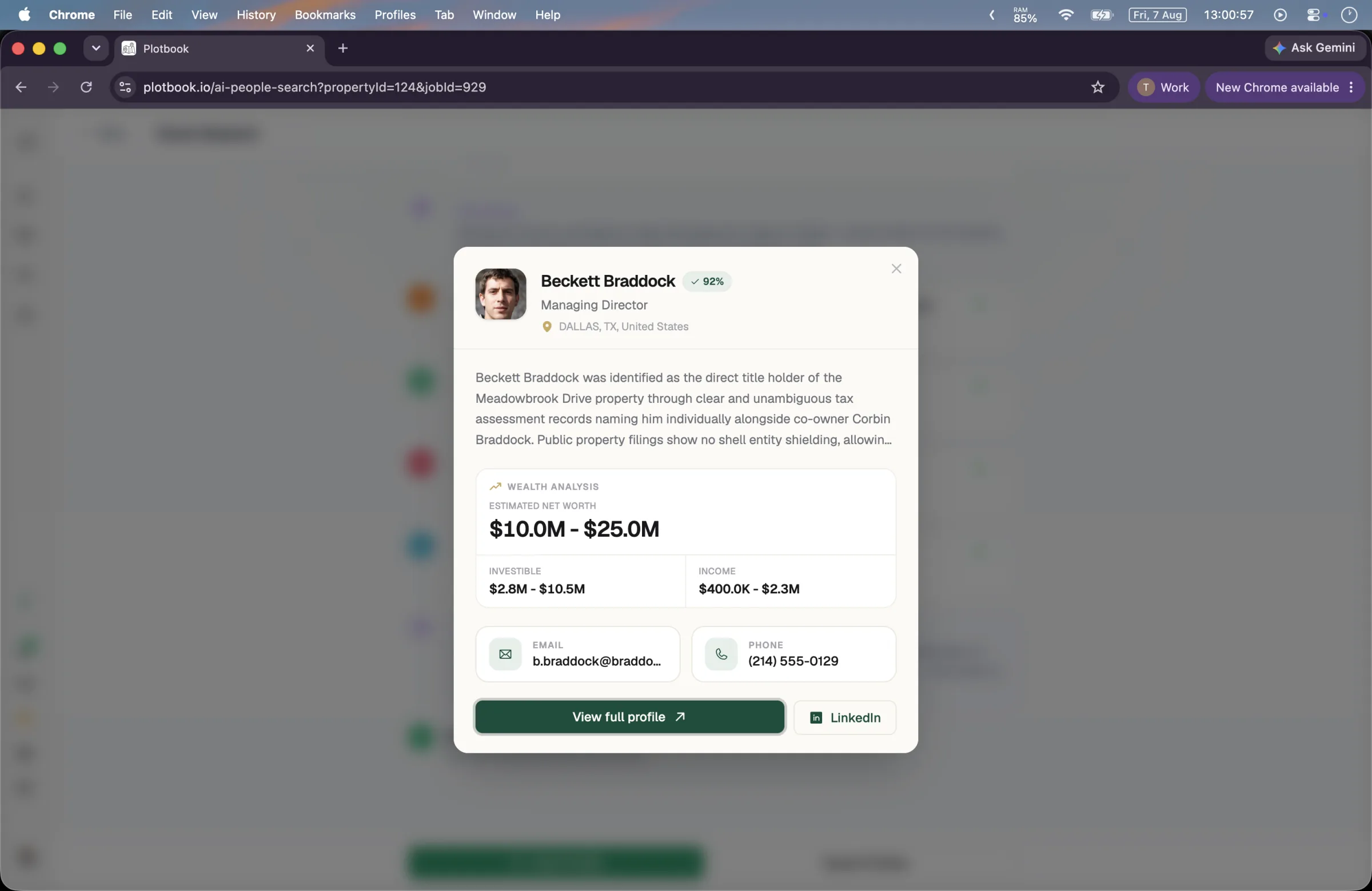
Turning a parcel into a person is the part that is actually hard, and it is where most of Plotbook sits. There are two paths and the deed decides which one runs. A deed in a person's name resolves through a reverse address lookup against residential records, at 5 credits. A deed held by an entity goes to the research agent.
That agent classifies the owner deterministically before any AI runs, into person, LLC, corporation, trust, estate, partnership, or institution. Institutions such as banks, government bodies, and HOAs short circuit immediately with no research and no charge. LLCs go to business registry aggregators for members, managers, officers, and organizers, with explicit handling for Wyoming, Delaware, New Mexico, and Nevada so a commercial registered agent is never mistaken for the owner. Trusts go to county records for the trustee and then to the open web for the beneficial owner, with the two roles labeled separately. Absentee properties get a second reverse lookup against the tax mailing address.
What comes out is a lead in the sense Catchlight means: a named person with emails and phone numbers from licensed contact providers, an employer and role, four wealth ranges, and a confidence score. It also comes with the full timeline of what was searched and what corroborated the identity, which is the part a score cannot give you. The 25 credits are charged only if the run succeeds.
The other side
What Catchlight does better than us
On qualification, Catchlight is doing something we have no equivalent for and no realistic path to.
Conversion scoring from real outcomes
A model trained on a reported 100K+ advisor and investor conversions is a genuine asset, and it is the kind of training data you cannot buy or infer. Plotbook has no conversion model and no outcome data to build one from.
Batch enrichment
Upload a list and get it back enriched across a reported 2,000+ data points. Plotbook researches one prospect at a time at 25 credits, with no upload, which is the wrong shape entirely for list work.
CRM integrations that actually exist
Salesforce, Redtail, and Wealthbox. Plotbook has CSV export on Professional and Enterprise and nothing else. Some of our older marketing implied direct integrations, which was not true, and this is the page to correct it on.
Projected client revenue
An estimate of what a given client would actually be worth to your practice. That is a business question, not a wealth question, and Plotbook does not attempt it.
Fidelity Labs provenance
Incubation inside a major institution brings credibility and a security posture that matters to compliance reviewers at larger firms. We are a small company and that is a fair thing to weigh.
Reaching people who do not own property
Plotbook reads the world through real estate. A high-earning renter or a young professional pre-purchase is close to invisible to us and perfectly readable by an enrichment layer working from a lead record.
If leads are arriving and you cannot tell which matter, buy Catchlight and do not let a map distract you. If leads are not arriving, scoring is the wrong purchase at any price, because it has nothing to operate on.
Running both
The most natural pairing in this category
Of every comparison we publish, this is the one where running both makes the most sense, because the products genuinely do not overlap. Plotbook manufactures leads from geography. Catchlight scores and enriches leads. One feeds the other in an obvious direction.
A workable loop: map the territory, shortlist the parcels above the value band you care about, research the owners, then push the resulting names through your enrichment and scoring layer to decide who gets your time first. Plotbook tells you the person exists and what they own. The scoring model tells you whether they are likely to hire you.
The connection is CSV, carrying the identified owner, contacts, linked parcel, four wealth ranges, confidence score, and research summary. There is no direct integration, and export requires Professional or Enterprise. On the $79 Starter plan you can research and keep profiles but not export them.
- Produce names from the map in Plotbook, prioritise them wherever you already score leads
- Use Plotbook when the starting point is an address rather than a lead record
- Use Plotbook when a deed is entity-held and there is no person on the record yet
- CSV export requires Professional ($199/month) or Enterprise ($499/month)
What it costs
Both published, which makes this comparable
Catchlight has been reported from $1,999 a year for individual advisors. Plotbook publishes its own pricing, and here is what each action costs once you are inside.
- Browsing the map and filtering by value band
- included
- Opening a parcel Plotbook has not seen before
- 1 credits
- Instant owner lookup on a residential address
- 15 credits
- Full research run on an entity-held deed
- 25 credits
- Keeping the result as a profile
- 10 credits
- Exporting to CSV
- 5 credits
Panning, zooming, the six value-band filters, and the deed owner names printed on parcels. Free on every plan, including the trial.
First lookup of a given parcel. Cached afterwards, so returning is free.
Reverse address lookup against residential records, for deeds held in a person's name.
Classification, registry and county records, contact databases, disambiguation. Charged only if it succeeds.
Enrichment and permanent storage in your prospect book, with the research trail attached.
Professional and Enterprise only. Starter cannot export.
Starter is $79 per month, which is $948 a year, or $758 billed annually. Professional is $199 for 2,500 credits, or $1,910 annually. That puts a Plotbook Starter seat well under a reported Catchlight entry price and a Professional seat around the same, for a product doing a different job. New subscribers get 7 days and 100 credits; the trial takes a card and converts on day 8.
Questions
Plotbook and Catchlight, asked directly
Keep comparing
Plotbook vs Aidentified
The closest comparison in the category: relationship mapping and money-in-motion alerts.
Plotbook vs Windfall
The other enrichment-first comparison, built on precise household net worth.
Saved Profiles
Where researched prospects live, with the research trail and CSV export.
For wealth advisors
What a territory-first prospecting week actually looks like in Plotbook.
Fill the funnel first
Scoring works beautifully once there is something to score. If your list is thin, start on the map and see how many names a single neighborhood produces.
New subscribers start with 7 days and 100 credits. We email you before the trial ends.