For real estate investors
The best deals are not listed. The owners are still findable.
Off-market acquisition is a research problem before it is a negotiation problem. You can see the parcel you want from the street. What you cannot see is who controls it, whether they live two thousand miles away, and how to reach them without a broker in the middle. Plotbook reads the county record for the whole country and then goes and finds the person.
The job today
A county portal answers one parcel at a time
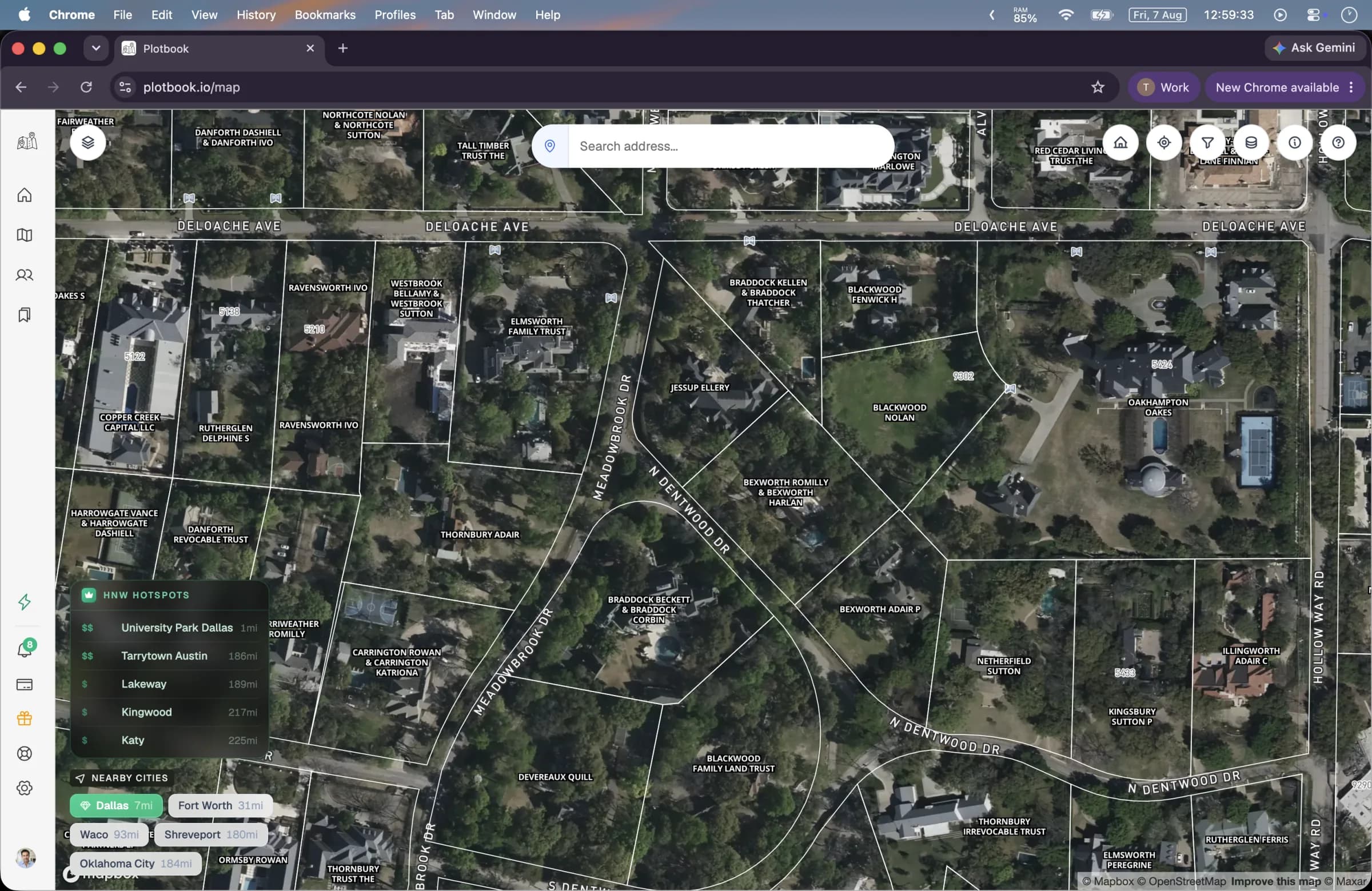
Every assessor site in the country will tell you who owns a property. What none of them will do is let you read a submarket: forty parcels along a corridor, sorted by what they are worth, with the owner name visible on each one and the large holdings standing out from the small. That is the view acquisition actually needs, and it does not exist at the county level because counties are not in the market intelligence business.
Then there is the second wall. In commercial and in anything above a certain price band, the deed almost never names a human. It names an LLC, a family land trust, a partnership. The mailing address on the tax bill goes to a registered agent, or to an address in a state where the owner has not lived for years. A skip trace on the entity name produces nothing, because there is nothing there to trace.
So most off-market outreach ends up being either a mailer campaign to whatever name the assessor printed, or a broker relationship you pay for. Both work. Neither tells you who you are actually talking to before you spend the money.
How investors work it
From a corridor to a decision maker
The loop is short on purpose. Read the submarket, pick the parcels, find out who controls them, and keep only the ones worth a call.
- 01
Read the submarket, not one record
Search a city, ZIP, or address and parcels draw in from zoom 14, each colored across six assessed-value bands. Between zoom 14 and 16 the large holdings get labeled first, sorted so the highest-value parcels win the label collisions, which is how a big lot stands out before you have zoomed all the way in.
- 02
Filter to the band you buy in
Five value presets match the legend, from under $500K to over $10M. Parcels outside the band paint out but keep their outlines and stay clickable, so you can still check something that falls just outside your criteria without resetting the filter.
- 03
Open the record
From zoom 16 every parcel carries the deed owner name off the county record. Clicking one shows the assessed value, the full address, the owner of record, and the use type, so you can tell a single family from a multi-unit or a raw lot before spending anything.
- 04
Find out who actually controls it
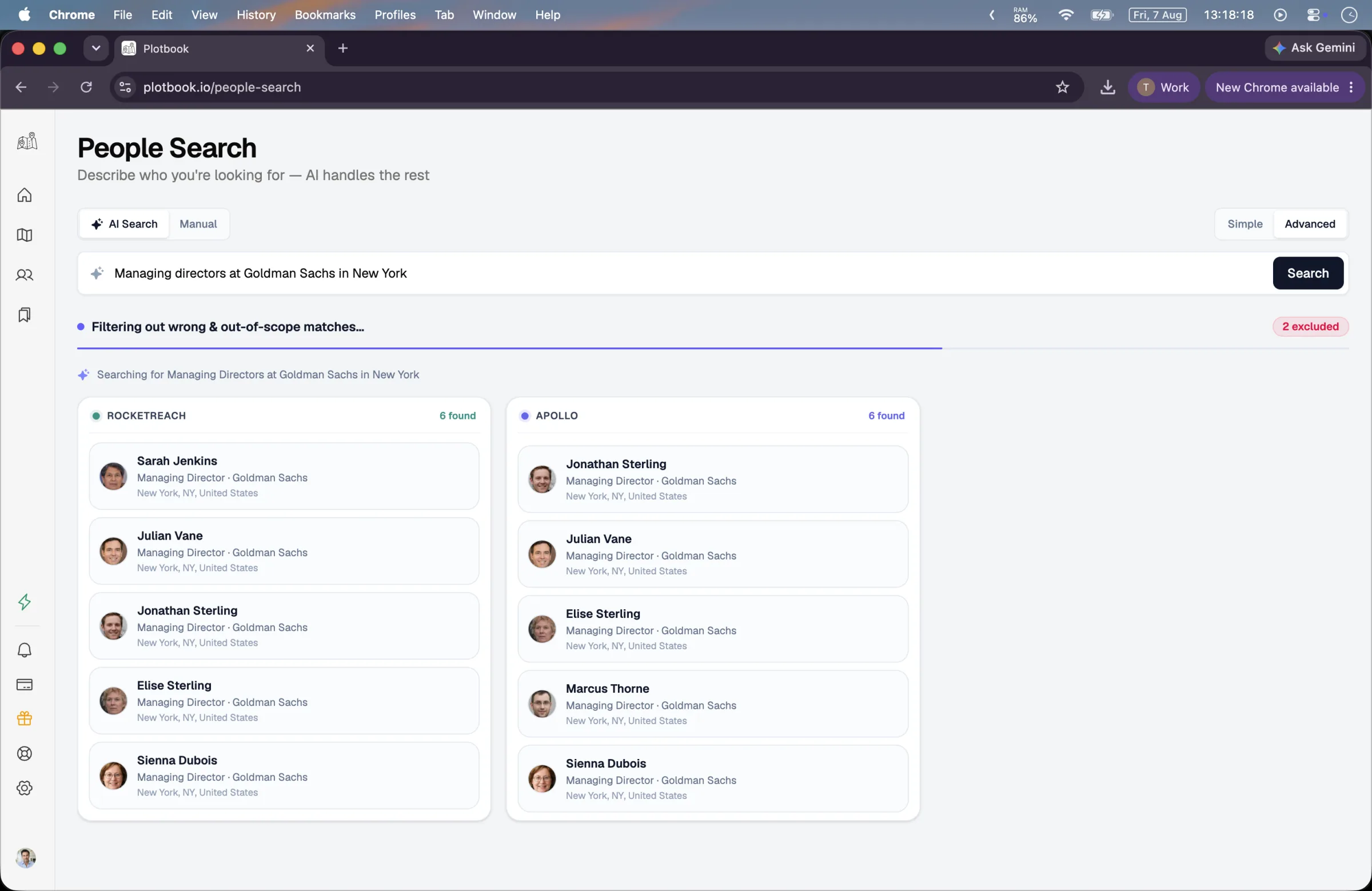
If the deed names a person, an instant lookup returns the owners and residents at that address with phones and emails. If it names an entity, the research agent takes it: business registry filings for members and managers, county appraisal records, and a pivot through the tax-bill mailing address, which is also how absentee ownership gets detected.
- 05
Keep the shortlist, then work it
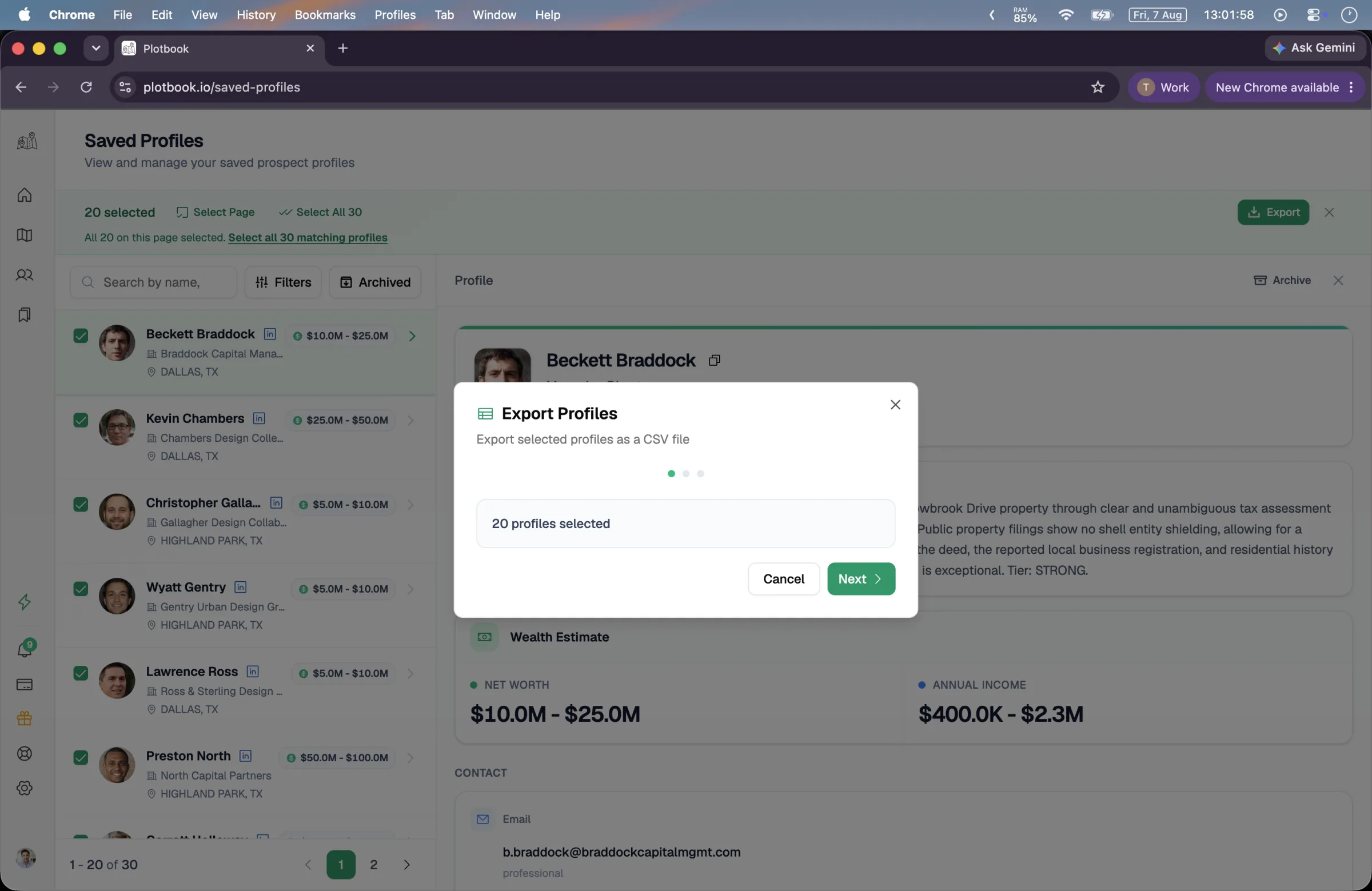
Saved properties show as markers on the map so a worked corridor stays visibly worked. Each profile carries contacts, the linked parcel, and your notes, and the shortlist exports as a CSV when you are ready to run outreach from your own system.
Absentee ownership
When the tax bill goes somewhere else
The single most useful field on a parcel record for an acquisitions team is the address the tax bill is mailed to, because when it differs from the property itself you are looking at an owner who does not live there. Plotbook treats that as a first-class signal: absentee ownership is detected automatically during research, and the mailing address becomes its own lead to work rather than a footnote.
That pivot does double duty. It flags the out-of-state landlord, the inherited property nobody is living in, and the second-home owner, and it is frequently the thread that identifies the human behind an entity deed, because the place a holding company receives its mail is very often somebody's actual house.
- Mailing address compared against the property address on every run
- A reverse lookup runs against the mailing address as well as the property
- Large holdings labeled early, from zoom 14, sorted by value
- Saved properties render as markers so a worked corridor stays visible
The shortlist
A worked list you own, not a feed you rent
Everything you identify saves into one book: the person, their contact details, the parcel it came from, the research summary that explains how the identification was made, and a confidence score. Your notes live on the record, which is what makes a second pass three months later worth anything.
When you want it out, the export produces a CSV with 26 columns across 8 selectable groups, including the linked property address, and the download link stays live for 48 hours. It goes into your own outreach stack. There is no proprietary dialer, no built-in mailer, and no lock-in on the list you built.
- Contacts merged deterministically by code, never written by a model
- Search across name, title, company, city, and email
- 26 columns across 8 groups, including the linked property address
- Up to 5,000 profiles per export, on Professional and Enterprise
What you get
Ownership intelligence, at parcel resolution
The pieces that matter when the target is a specific building on a specific corner rather than a demographic segment.
Nationwide parcel layer
Regrid parcel data across 150M+ US parcels, with boundaries, assessed value, use type, and the deed owner name from the county record.
Large holdings surfaced early
Between zoom 14 and 16 an overlay labels big parcels first, sorted so the highest-value holdings win label collisions. Useful for land and assemblage.
Absentee detection
The tax-bill mailing address is compared against the property on every research run, and gets its own reverse lookup when the two differ.
Entity research
For LLC, trust, and partnership deeds, an agent works registry filings, appraisal records, and mailing addresses to a named person, showing its sources.
Search from the other direction
Describe a person in plain English, such as principals at development firms in a metro, and the search runs professional and residential databases in parallel.
Export to your own stack
A 26-column CSV with selectable groups and a 48-hour download link, on Professional and Enterprise. No dialer, no mailer, no lock-in.
What a corridor costs
You pay for answers, not for looking
Reading the map, the assessed values, and the deed owner names is included in the subscription. Credits are only spent when a paid source is queried, and failed operations refund automatically.
- Deed owner and assessed value on any parcel
- included
- Instant lookup on a person-owned deed
- 15 credits
- Entity research on an LLC or trust deed
- 25 credits
- People search for a principal by description
- 2 to 14 credits
Included with map browsing on an active subscription.
Owners and residents at the address, with phones and emails.
Charged only on success. A dead end costs nothing.
2 for a single database, 4 for the multi-source pass, 10 more when residential records run.
Professional is $199 a month with 2,500 credits, roughly 40 entity research runs or 160 household lookups, and is the first tier with CSV export. Plans license 1 state on Starter, 2 on Professional, and 5 on Enterprise, with more available as an add-on, which suits an investor working a defined set of markets. New subscribers get a 7-day free trial with 100 credits.
Where Plotbook stops
Not a distressed list product
This category is full of tools that promise every data layer at once. Plotbook does one thing, and the honest boundary is worth stating before you subscribe.
No distress or lien data
There are no pre-foreclosure, tax-delinquent, probate, code-violation, or lien lists. If your acquisition strategy is driven by distress triggers, Plotbook is not the source for the trigger.
No mortgage, equity, or comps data
No loan balances, no estimated equity, no MLS, no listing status, no days on market, and no ARV or comps engine. Assessed value from the county record is the value layer.
No bulk list pull
You cannot select a polygon and export ten thousand owners with contacts. Identification happens per property, deliberately, because that is what keeps the contact data accurate. The CSV export covers the profiles you have actually saved.
No property type filter
The map filters on assessed value, not on use class. Use type is shown on each parcel when you open it, but you cannot filter a whole area down to just multifamily or just land.
Plotbook is the ownership and contact layer. Distress lists, comps, underwriting, and outreach automation stay wherever you run them today.
See it run
See a parcel become a phone number
The full walkthrough: reading a submarket on the map, running research against an entity deed, and exporting the shortlist.
Full walkthrough, 3 min. All people, contacts and wealth estimates shown are fictional demo data; property records are real public data.
Questions
What real estate investors ask first
Pick the building you keep driving past
Open it on the map, read the deed, and see how far the trail goes. Research runs are charged only when they deliver a profile.
New subscribers start with 7 days and 100 credits. We email you before the trial ends.