Plotbook vs DonorSearch
DonorSearch knows who gives. Plotbook knows who owns the house
We will start by conceding the important point: past philanthropic giving is the strongest predictor of future giving, DonorSearch has built the largest database of it, and Plotbook has nothing remotely comparable. If a prospect has a giving record, DonorSearch will find it and we will not. The question this page is about is the other half of the problem, the household in your service area that has never given to anything you can see, and is therefore invisible to every screening tool including that one.
DonorSearch details from public sources, checked August 2026. DonorSearch figures below are theirs, from their published material: a database of more than a billion data points, used by more than 13,000 nonprofits. Check the official DonorSearch product page. Plotbook is the vendor here, so read this as our argument and check it against theirs.
The short answer
Two different questions
DonorSearch answers 'which of these people is likely to give, and how much'. Plotbook answers 'who lives in the houses in my service area, and what are they worth'. A mature development programme needs both answers, and if it can only afford one, it should almost always be the first. Giving history qualifies. Property discovery expands. Buying the second before the first is putting volume ahead of quality, which is the wrong order.
Pick Plotbook when you have run out of names
- Your file has been screened and worked, and the constraint is now new prospects rather than better ranking.
- You fundraise for a place with a defined catchment: a hospital, a school, a land trust, a regional arts organisation.
- You want to see wealth in your service area geographically rather than as a ranked export.
- You need the person behind a property held by an LLC or a family trust.
- Your shop is too small to justify a full prospect research contract.
Pick DonorSearch for qualification
- You need to screen an existing constituent, alumni, or patient file at scale.
- Philanthropic giving history is how you qualify, which is how you should qualify.
- You want foundation affiliations, board seats, and stock ownership signals alongside real estate.
- You need ratings that a gift officer and a board are already trained to read.
- You want the results inside your donor CRM rather than in a spreadsheet.
Neutral ground
What each product actually is
Each described the way its own team would. Everything after this is our argument, and there is a lot of it we are conceding.
Plotbook
A map of US property colored by assessed value, with an AI agent that identifies the owner behind a deed and estimates their wealth in ranges.
- Entry point
- A geography, browsed on a map
- Core signal
- Assessed property value from the county record
- Giving data
- None
- Needs a list
- No. There is nothing to upload.
- Output
- A named person with contacts and four AI-generated wealth ranges
- Pricing
- $79 to $499 per month, published, self-serve
DonorSearch
A prospect research database built on philanthropic giving, reported at more than a billion data points and used by more than 13,000 nonprofits.
- Entry point
- A constituent file or a person's name
- Core signal
- Charitable giving history, plus foundation and business data
- Giving data
- The largest database of it in the category
- Needs a list
- Yes, for the screening workflow
- Output
- Ratings and research profiles across a screened file
- Pricing
- Quoted per organisation; not published
Side by side
Capability by capability, including where we lose
Phrases rather than checkmarks. Rows where the honest answer favours DonorSearch are set in darker type on their side, and there are more of them here than on any other comparison we publish.
| Capability | Plotbook | DonorSearch |
|---|---|---|
| Philanthropic giving history | PlotbookNone | DonorSearchThe largest database in the category, and the core product |
| Screening a constituent file | PlotbookNot offered. No upload, no batch rating. | DonorSearchThe primary workflow |
| Finding households in no donor database | PlotbookThe core function. Starts from the parcel record. | DonorSearchOutside the screening model |
| Real estate data | PlotbookThe interface: parcels colored across six assessed-value bands, nationwide | DonorSearchA screening attribute inside a giving-centred model |
| Foundation affiliations and board seats | PlotbookNone | DonorSearchPart of the research profile |
| Identifying the person behind an LLC or trust deed | PlotbookEntity classification, then registry, county record, and open-web research | DonorSearchNot a published workflow |
| Wealth figures | PlotbookFour AI-generated ranges with a confidence score, per researched person | DonorSearchCapacity ratings grounded in giving and asset signals |
| Donor CRM integration | PlotbookCSV export only, on Professional and Enterprise | DonorSearchIntegrations across common donor management systems |
| Track record in the sector | PlotbookNew, and unfamiliar to most development offices | DonorSearchReported at more than 13,000 nonprofit customers |
| Contact details | PlotbookEmails and phones per person from contact data providers, masked until you spend a credit | DonorSearchContact information within research profiles |
| Getting started | PlotbookCard, 7 day trial with 100 credits, no call required | DonorSearchQuoted per organisation |
DonorSearch figures are theirs, from their published material as of August 2026. We do not quote a price for them because they quote per organisation rather than publishing a rate card.
The blind spot
Giving history says nothing about someone who has never given
A screening database is a record of what people have already done. That is exactly why it predicts so well, and it is also the shape of its blind spot. The household that has quietly held a large property portfolio for thirty years, given only to their church in cash, and never appeared on a public donor roll returns nothing. Not a low rating. Nothing.
For an organisation tied to a place, that gap is most of the addressable pool. A regional hospital foundation, an independent school, a community foundation, a land trust: each serves a catchment containing far more wealthy households than have ever given to it, and screening can only sort the ones who already have.
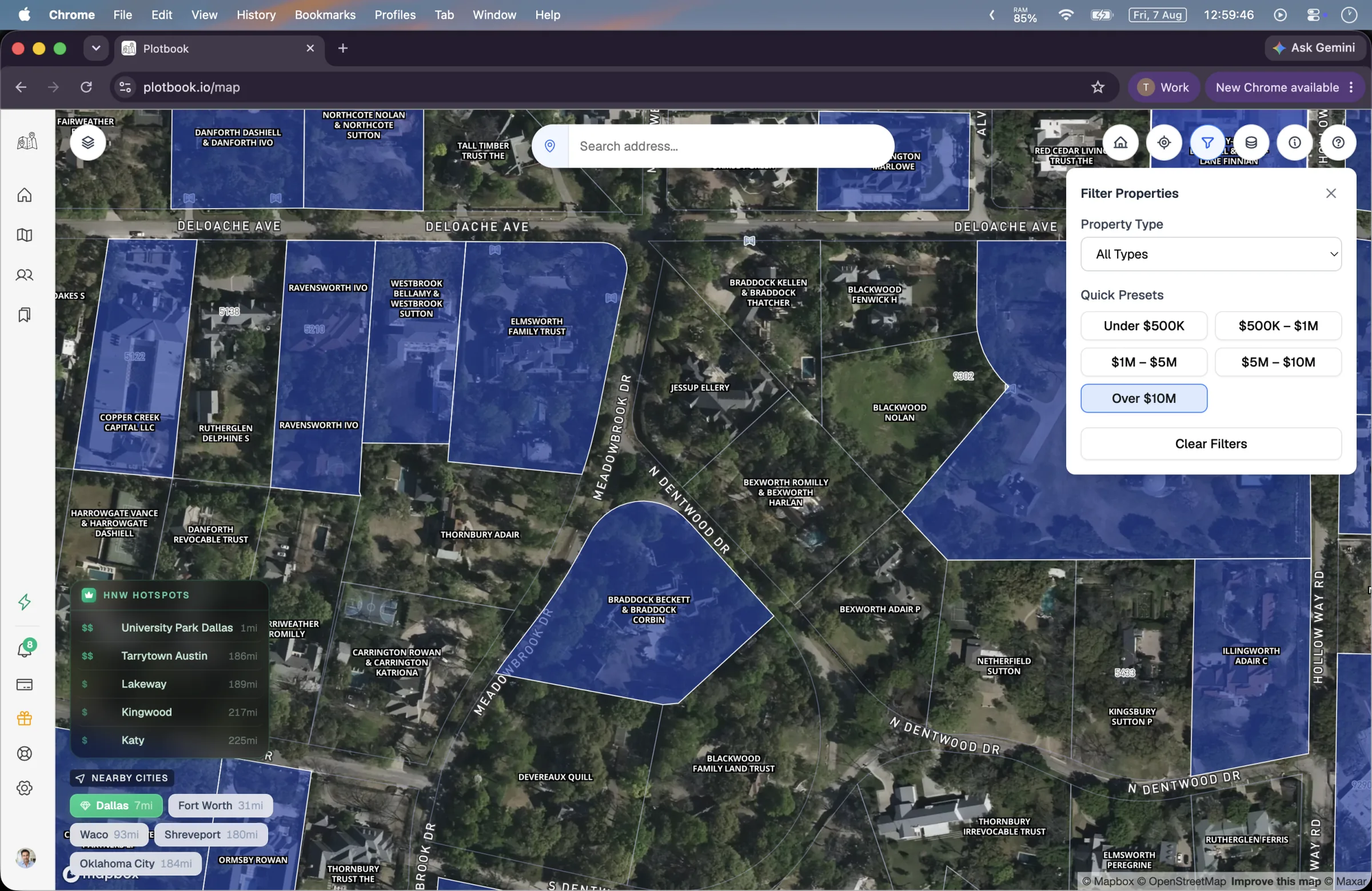
Plotbook works the other side. Nationwide parcel data from Regrid, covering 150M+ parcels, painted across six assessed-value bands, with deed owner names printed on the parcels once you zoom past 16. Draw your catchment, filter to the band that matches where your gift table starts, and you are looking at a pool assembled from the county record rather than from anyone's donor history. Reading the map costs no credits on any plan, including the trial, so the first pass over your service area is free.
- Six assessed-value bands, from under $500K to over $10M, usable as filters
- Deed owner names read straight off the parcel tiles at close zoom
- 232 hand-curated high-net-worth ZIP codes as a heatmap for orientation
- Panning, filtering, and reading owner names cost nothing on any plan
Behind the entity
The largest gift in your county might be behind an LLC
At the top of a local market, deeds are frequently held by entities rather than people: an LLC registered in Wyoming or Delaware, a revocable trust, a family partnership. A prospect research tool starts from a person's name, so an entity on a deed is simply not a query it can accept.
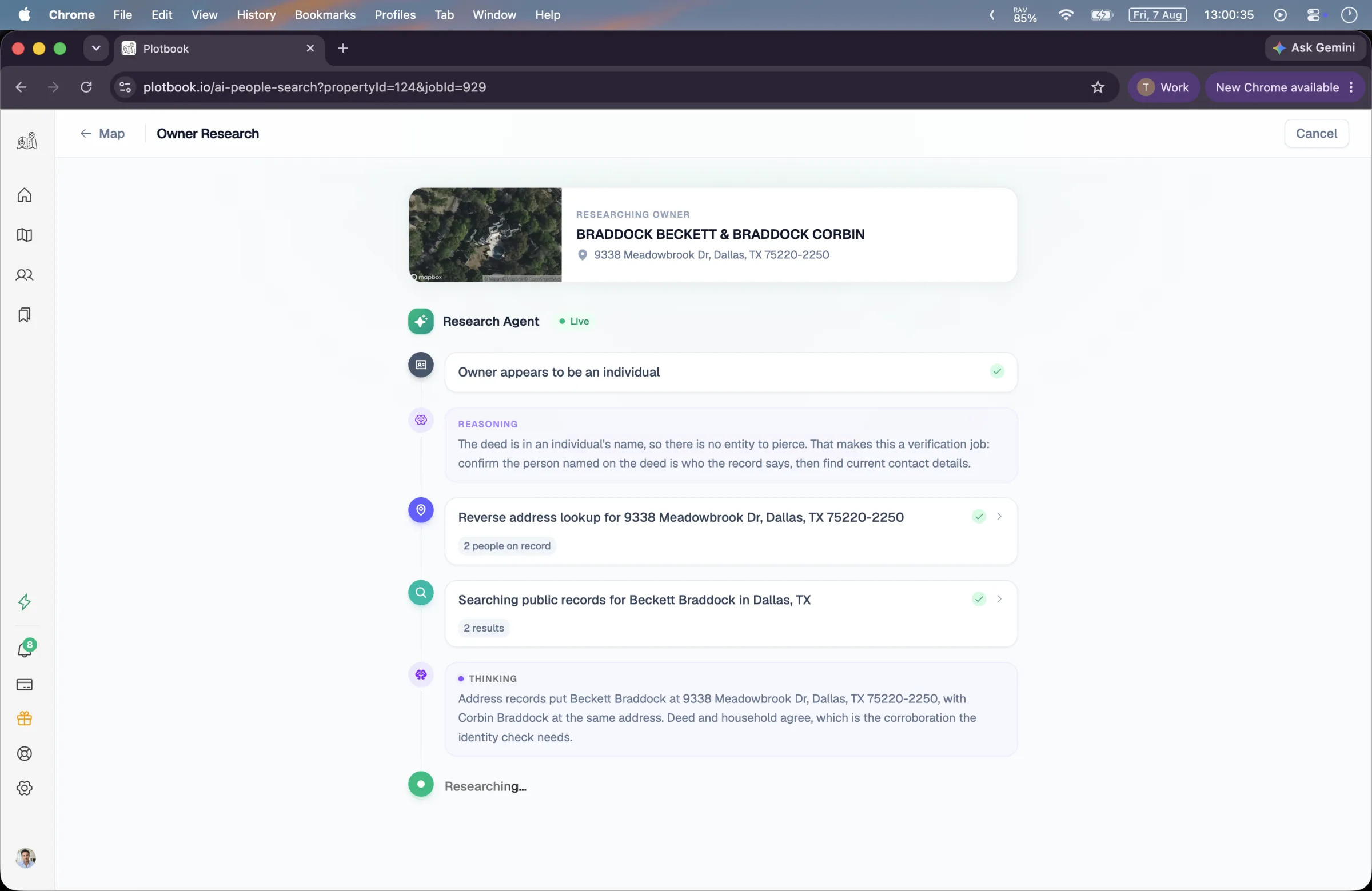
Plotbook treats it as the actual job. A deterministic classifier sorts the owner into person, LLC, corporation, trust, estate, partnership, or institution before any AI runs, and institutions such as banks, government bodies, and HOAs short circuit with no research and no charge. LLCs go to business registry aggregators for members, managers, officers, and organizers, with explicit handling for anonymity states so a commercial registered agent is never reported as the owner. Trusts go to county records for the trustee, then to the open web for the beneficial owner, with trustee and principal roles labeled separately.
Two safeguards keep it usable in a development office, where a wrong name in front of a board is worse than no name. A disambiguation gate requires independent corroboration on city, age, address, or employer before anyone is named. And every run reports the tier it actually reached, from a full profile down to entity only, so a thin result reads as thin. The 25 credit charge only lands when a run succeeds.
The other side
What DonorSearch does better than us
This is the longest version of this section we publish, because on the questions a fundraiser asks most often, DonorSearch is simply the better tool.
The signal that actually predicts a gift
Past giving beats every other predictor, and they hold the largest database of it. Plotbook has no giving data at all. On qualification, this is not close and we are not going to pretend it is.
Screening at file scale
Run an entire constituent, alumni, or patient file and get every record rated. Plotbook researches one prospect at a time at 25 credits, with no upload and no batch mode.
Foundation and affiliation data
Board seats, foundation involvement, and business affiliations give a gift officer a way in. Plotbook produces an employer and a role, and nothing about how someone is connected to your cause.
Ratings your team already reads
Capacity and inclination ratings fit an existing moves management process. Wealth ranges from a property record do not slot into that vocabulary without translation.
Donor CRM integration
Screening results land where your team works. Plotbook has CSV export on Professional and Enterprise, and no direct integrations whatsoever.
Non-property wealth
Plotbook reads the world through real estate. A major donor whose wealth sits in a private business or a portfolio, and who rents, is close to invisible to us and perfectly visible to DonorSearch.
If your development office does not have a screening tool, buy one before you buy this. Plotbook earns its place at the point where the file is worked and the honest question is where the next hundred names come from, because that is a question giving history cannot answer.
Running both
Discovery feeds qualification
The sequence that works is discovery then qualification, in that order, with each tool doing the half it is good at. Plotbook produces names from the catchment. Your screening tool tells you which of those names has a giving record worth acting on.
Concretely: map the service area, filter to the assessed-value band where your gift table starts, and read the owner names off the parcels, which costs nothing. Check each against your database first, because paying to research a donor you already have is the most common way to waste credits. Research the ones you do not recognise, then push the resulting names back through screening to see whether they give anywhere.
A name that comes back with both a high-value parcel and a real giving history somewhere else is the strongest prospect either tool can produce, and neither one finds it alone. Export is CSV, on Professional and Enterprise, carrying the parcel, the four wealth ranges, the confidence score, and the research summary.
- Map the catchment and read owner names off the parcels at no credit cost
- Check names against your own database before spending research credits
- Screen the new names for giving history, which is the qualification step Plotbook cannot do
- CSV export requires Professional ($199/month) or Enterprise ($499/month)
What it costs
Working a catchment for a month
Plotbook bills a subscription plus credits, and credits are spent only when a paid source is called for you. The expensive-looking part, mapping your whole service area, is the part that is free.
- Mapping the catchment and filtering by value band
- included
- Opening a parcel Plotbook has not seen before
- 1 credits
- Instant owner lookup on a residential address
- 15 credits
- Full research run on an entity-held deed
- 25 credits
- Keeping the result as a profile
- 10 credits
- Exporting to CSV
- 5 credits
Panning, zooming, the six value-band filters, and the deed owner names printed on parcels. Free on every plan, including the trial.
First lookup of a given parcel. Cached afterwards, so returning is free.
Reverse address lookup against residential records, for deeds held in a person's name.
Classification, registry and county records, contact databases, disambiguation. Charged only if it succeeds.
Enrichment and permanent storage in your prospect book, with the research trail attached.
Professional and Enterprise only. Starter cannot export.
Professional is $199 per month for 2,500 credits, or $159 per month billed annually, which covers roughly 60 full research runs plus the map work around them. New subscribers get 7 days and 100 credits, enough to map a catchment and research a handful of owners properly. The trial takes a card and converts on day 8, and we email you before it does.
Questions
Plotbook and DonorSearch, asked directly
Keep comparing
Plotbook vs iWave
The other prospect research platform development offices evaluate alongside this one.
Plotbook vs Windfall
Precise household net worth across the country, against research on one person at a time.
For nonprofits
How development teams work a catchment on the map alongside their screening process.
How the estimates are built
What goes into the four ranges, and where inference starts and record stops.
Count the owners you do not know
Filter your catchment to the value band where your gift table starts, read the owner names off the parcels, and check them against your database. Whatever is left over is the case for this.
New subscribers start with 7 days and 100 credits. We email you before the trial ends.