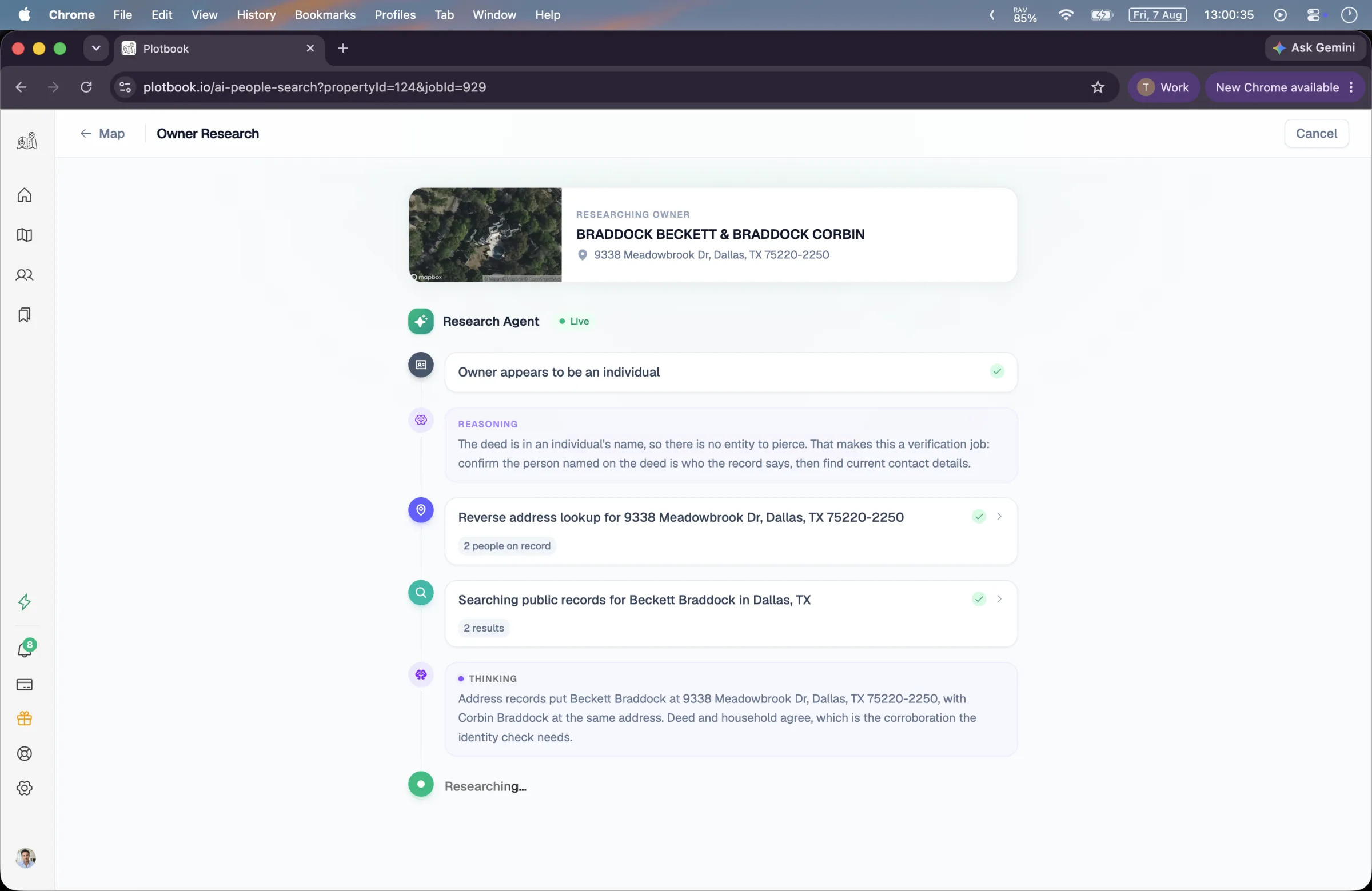
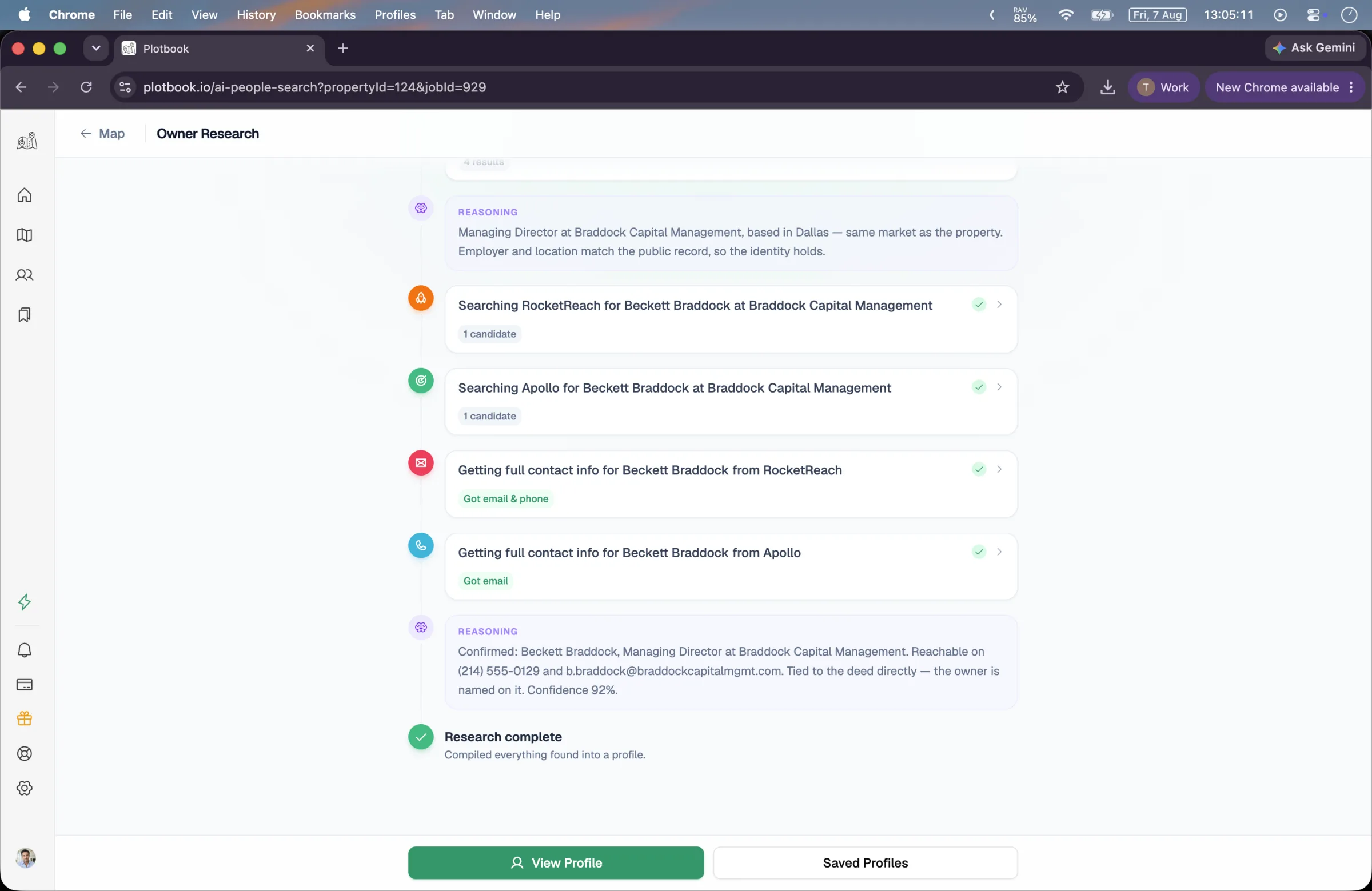
The interesting research problem is not finding a name, it is finding a person when the name is a Delaware LLC whose registered agent serves ten thousand other companies. Plotbook's agent runs that as a repeatable procedure: deterministic lookups establish ground truth, a classifier picks a playbook, and eleven tools work registries, records, and databases until something corroborates. Every step is on screen while it happens.
A research run is a durable background workflow, not a single model call. Before any AI reasons about anything, a deterministic classifier types the deed owner and reverse lookups run against the property address and, when the tax bill goes somewhere else, the mailing address too. Those verified results seed the run. The model then works with eleven tools across business registries, county records, professional and residential databases, the open web, and federal campaign filings, following a different playbook depending on whether the deed named a person, an LLC, a trust, or an estate. It has to corroborate an identity across independent sources before it will name anyone, and it labels how far it actually got.
Deterministic classification and reverse lookups run before any AI spend
Eleven tools, including business registry search, county property records, and FEC filings
Separate playbooks per entity type, with explicit handling for the anonymity states
A disambiguation gate: corroborate city, age, address, or employer before naming anyone
Runs durably in the background and survives closing the tab
25 credits, charged only when a run succeeds
The higher the value, the thinner the trail
Ordinary property research is a lookup. Someone owns a house, their name is on the deed, a residential database has their phone number, and the whole thing takes fifteen seconds. That case is real and it is common, and Plotbook handles it with an instant lookup rather than with an agent.
The case that needs an agent is the one where the deed reads 1420 OCEAN HOLDINGS LLC, or THE HARLAN FAMILY TRUST DTD 03/14/2011, or a partnership named after the street it sits on. Entity ownership is not an oversight some vendor forgot to cover. It is the point of the structure, it works, and it becomes more common precisely as properties get more valuable, which means the households most worth identifying are the ones least visible to any name-first tool.
Done by hand, the work is a known sequence with known dead ends: pull the state filing, notice the registered agent is a service company, check where the tax bill goes, cross-reference the appraisal roll in that other county, search the press for the family name. It takes an afternoon per property. A procedure with known dead ends is exactly the kind of work worth automating, provided the automation shows its workings and refuses to guess.
The first two steps involve no AI at all
Every run opens with work that cannot hallucinate. A classifier reads the deed owner string and types it: person, LLC, corporation, trust, estate, partnership, or institution. That is pattern matching, not inference, and it decides which playbook the run follows before a single token is spent.
Institutions short-circuit there. When the owner is a bank, a government body, a homeowners association, or a REIT, the run stops, because there is no household behind it worth researching. Nothing is charged for those. It is a small detail that matters in practice: prospecting a coastline means clicking a lot of parcels that turn out to belong to a municipality.
Then the property context is read out of the parcel record, including the address the tax bill is mailed to, and owner occupancy is computed from it. A reverse lookup runs against the property address. If the property is absentee, a second reverse lookup runs against the mailing address, because that is where the human actually is and it is the single highest-yield move a researcher makes by hand. Only after those verified results are on the board does the model start reasoning, and it starts from evidence rather than from a blank page.
Deterministic owner-type classification, before any model call
Institutions detected and skipped without charge
Owner occupancy computed from the parcel's mailing address fields
Reverse lookup on the property, plus the mailing address when absentee
Eleven ways to ask
The agent's capability is its tools, and the set is chosen for entity work rather than for generic people search. Four are web tools: broad people search, a LinkedIn-restricted search, a deep research pass for company, industry, and news context, and a public-records pass that queries ten residential people-search sites at once.
Four are database tools: search and full enrichment against RocketReach and against Apollo, which cover professional identity, work history, and contact details from different angles and corroborate each other when they agree.
The last three are the ones that do the actual piercing. A business entity search works registry aggregators for members, managers, officers, organizers, and registered agents. A property records tool queries county appraisal and assessor sources for trustees, grantors, and mailing addresses, and can also run an open-web pass for press that names a beneficial owner. And a federal campaign-finance tool searches FEC contribution filings, which are unusually useful because a political donation record carries a name, a city, an employer, and an occupation together, which is close to ideal for confirming that the person you found is the person who owns the house.
Web: people search, LinkedIn search, deep research, and ten-site public records
Databases: RocketReach and Apollo, search plus full enrichment on each
County records: trustees, grantors, and mailing addresses
FEC filings: name, city, employer, and occupation in one record
A different route for every structure
Searching an LLC name broadly produces noise. So the classification from step one selects an approach. For an LLC or a corporation, the agent works state filings for the people named in them and treats the anonymity jurisdictions as their own problem: a Wyoming, Delaware, New Mexico, or Nevada shell that lists only a commercial registered agent is never reported as the owner, and the run pivots to the mailing address and county records instead. That single rule is the difference between an answer and a plausible-looking dead end.
For a trust, county records are worked for the trustee first, then an open-web pass looks for the person the trust serves, and the profile is required to label which relationship is which, because a trustee at a bank is not the household you want to call. For an estate, the target is the executor and the likely heirs, which is often the most time-sensitive record in the whole product.
And when the deed already names a person, the job inverts. There is no piercing to do, so the entire run becomes disambiguation: establishing that this particular holder of a common name, in this city, at this age, with this employer, is the one who owns this house, before any contact details are attached to them.
Built to say I could not
The failure mode that matters in this category is not an empty result, it is a confident wrong one. A research tool that returns a plausible same-name stranger with a real phone number is worse than useless, because you cannot tell it apart from a correct answer and you will act on it.
Two mechanisms exist against that. A disambiguation gate requires the agent to corroborate identity across independent signals, city, age, address, or employer, before it commits to naming anybody. And every run declares how far it actually got, from a full profile with contact details, through an identified person without them, down to entity-only when the structure did not open, and nothing at all when it did not. That tier is stated inside the written research summary rather than buried, so a thin result reads as thin.
The same principle governs what the run refuses to do. It will not invent a contact detail to fill a field. It will not present a registered agent as an owner. Where it made an inference, the summary says so.
Corroboration required across independent sources before naming anyone
Every run labels its outcome tier inside the research summary
A commercial registered agent is never reported as the owner
Unfilled fields stay empty rather than being filled plausibly
You watch it work
The run is not a spinner. A single chronological rail shows the property being read, the owner being classified, each tool being called, and what came back, interleaved with the agent's own reasoning about what to try next. Tool cards expand into their payloads: the source links with favicons, the people rows, the FEC contributions with amounts, the contact previews.
This is an audit trail, not a progress animation, and that is the point. When the profile says a person is the principal behind an entity, you can scroll back and see which registry filing said so and which record corroborated it. Wealth research that cannot be traced is not usable in a regulated firm, and a summary you cannot check is a summary you have to take on faith.
Delivery is database-backed and polled, which means the timeline survives a reload or a navigation. Come back to a run an hour later and the whole history is still there rather than having existed only in a dropped connection.
Close the tab. It keeps going.
Research runs as a durable background workflow rather than inside your browser session. You can close the tab, work on something else, or open another property. In-flight runs surface in the notification bell, coming back re-attaches to the same run instead of starting a second one, and completion arrives as an in-app notification plus a mobile push with a deep link into the finished profile. A run can also be cancelled mid-flight.
The budget is generous rather than fixed: the workflow proceeds in durable chunks, each capped at twelve model calls or three minutes, up to eight rounds, before a separate extraction step turns the accumulated evidence into a structured profile. There is deliberately no advertised duration on this page, because there is no honest one. A person-owned deed in a well-covered county can finish quickly. An entity in an anonymity state genuinely takes minutes.
A run costs 25 credits and is charged only when it succeeds. Failures, cancellations, no-result runs, and institution short-circuits are never charged, and the failure notification says so explicitly. Re-researching a property you already researched returns the profile you already own rather than billing you twice, and a short in-flight window prevents a double click from starting two runs.
A profile, and the reasoning behind it
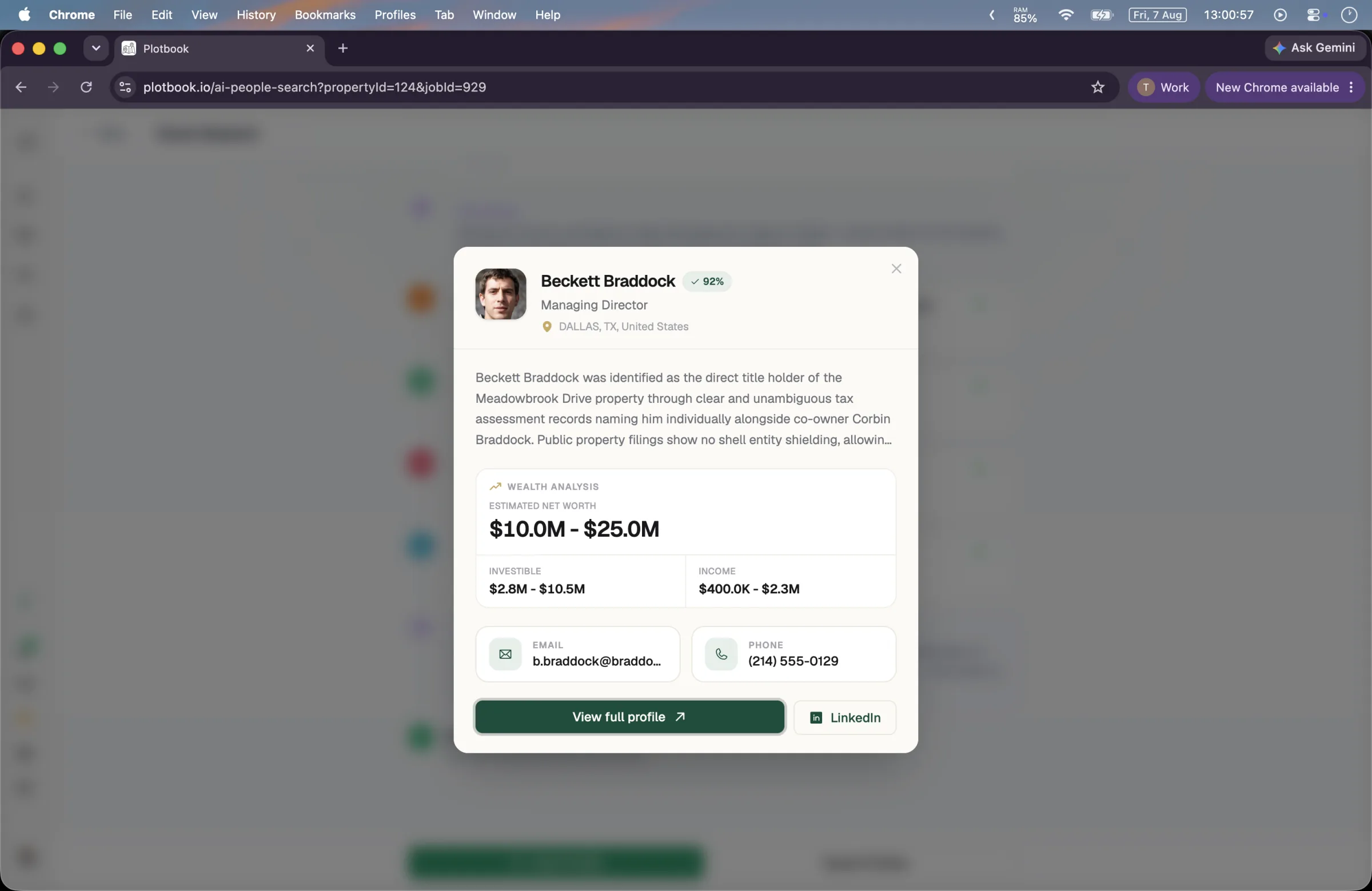
The finished profile carries the person's name and title, their best email and phone plus every other address and number found, their photo and LinkedIn, their city and state, their organization with website and industry, and their employment and education history. Alongside that sits a confidence score from 0 to 100, a written research summary explaining the trail and stating the outcome tier, and, once a follow-on step completes, a four-band wealth estimate covering net worth, income, investible assets, and total assets.
It saves itself. The profile lands in your prospect book automatically, linked to the parcel it came from, which is what puts a green marker back on the map and unmasks the contact rows in that property's drawer. From there it exports with everything else as CSV.
In order
What happens after you press research
Six stages, in the order they run. The first two involve no AI, which is the design decision the rest of the pipeline depends on.
01
Read the deed record
The run starts from the county record for that parcel: the exact owner string, the situs address, the assessed value, and the address the tax bill is mailed to. Owner occupancy is computed from those fields.
02
Classify the owner
A deterministic classifier types the owner as a person, LLC, corporation, trust, estate, partnership, or institution and selects the playbook. Institutions stop here and are never charged.
03
Run the verified lookups
Reverse lookups run against the property address and, when the property is absentee, against the mailing address as well. These are real records, not inferences, and they seed the run before the model reasons.
04
Work the sources
Following the playbook for that entity type, the agent uses eleven tools across business registries, county appraisal records, professional and residential databases, LinkedIn, the open web, and federal campaign-finance filings.
05
Corroborate before committing
A disambiguation gate requires independent confirmation of city, age, address, or employer before any person is named, and a registered agent is never reported as an owner.
06
Extract and save
A separate extraction step coerces the evidence into a structured profile with a confidence score, a research summary stating how far the run got, and a four-band wealth estimate. It auto-saves and links to the parcel.
The specifics
Numbers you can check
The parts of the system that are countable. Note the one number that is deliberately absent: there is no advertised runtime, because the budget is adaptive and any figure would be marketing rather than measurement.
Agent tools
11
Four web, four contact-database, one business registry, one property records, one FEC filings.
Pre-agent deterministic steps
2
Owner-type classification and reverse address lookups, both run before any model call and both shown on the timeline.
Entity playbooks
6 owner types
Person, LLC, corporation, trust, estate, and partnership, plus institutions which short-circuit unbilled.
Anonymity states handled explicitly
WY, DE, NM, NV
A commercial registered agent in these jurisdictions is never presented as the owner. The run pivots to mailing address and county records.
Reasoning budget
Up to 8 rounds
Each durable chunk caps at 12 model calls or 180 seconds, then a separate extraction step produces the structured profile.
Outcome tiers
4
Full profile, identified without contacts, entity only, or nothing found. The tier is stated in the research summary.
Confidence score
0 to 100
Reported per profile alongside the number of corroborating sources, and shown on the profile as a match percentage.
Cost per run
25 credits
Charged only on success. Failures, cancellations, empty results, and institution short-circuits cost nothing.
Registry research reads text from registry aggregator sites, not a structured Secretary of State API, and Plotbook does not query SEC filings. Both are worth knowing before assuming a coverage guarantee that does not exist.
Where it stops
What the agent will not do
Five honest boundaries. The most useful thing about a research agent is knowing the shape of what it misses.
It cannot guarantee a pierce
Some structures are genuinely opaque. A shell in an anonymity state with a service agent, no registry disclosure, and no press coverage may end at entity only, and the run says so rather than nominating somebody plausible.
It is not a government registry integration
Business entity research reads registry aggregator sources through web search, not a structured Secretary of State API, and there is no SEC filings tool. Coverage is therefore good but not uniform state to state.
It is not instant
This is deliberate work with a real budget behind it. When you need an answer in seconds and the deed names a person, the instant owner lookup is the right tool and costs less.
It does not verify financial holdings
Nothing in the pipeline reads an account, a portfolio, or a filing of holdings. The wealth figures attached to a profile are AI-generated estimates shown as ranges.
It does not map families
Relatives surfaced by residential records are shown where a lookup returns them, but there is no relationship-graph feature and no household-level mapping of connections.
The fair test of a research agent is a property whose owner you already know the hard way. Run it, then read the timeline and see whether the trail matches the one you walked.