AI Owner Research
The deed says HOLDINGS LLC.
We find the person.
The most valuable homes in America are held through LLCs, trusts, and family partnerships, which is exactly where county records stop. Plotbook's autonomous research agent reads the deed, works the registries and records like a human researcher would, and hands you the person behind the entity: named, contactable, and estimated in ranges you can weigh. Every step of the trail is shown, so you can check its work.
Why this exists
County records give you a holding company, not a prospect
Pull the record on an eight-figure estate and the owner line reads like a filing cabinet: a numbered LLC, a family trust dated years ago, a partnership named after the street. No person, no employer, no way to reach anyone. This is where every conventional lookup tool stops, and where the wealthiest prospects quietly disappear from everyone's lists.
A human researcher would keep going: check the state registry, see where the tax bill is mailed, cross-reference the county appraisal roll, search the news. That workflow is exactly what Plotbook's agent automates: the same moves, in minutes, with the evidence attached.
How a run unfolds
Verified facts first, then the agent takes over
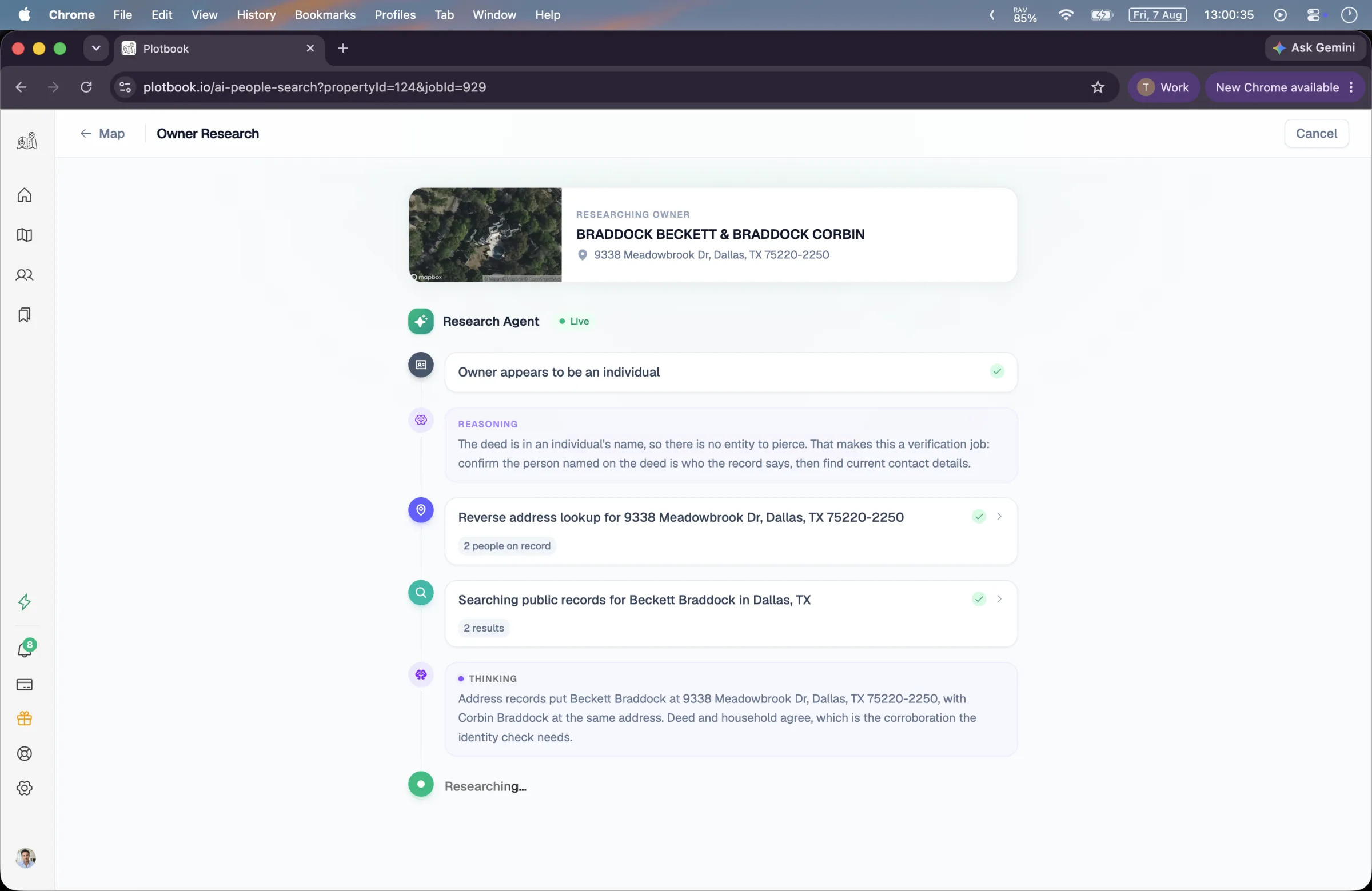
A run is not one model call, it is a pipeline. Deterministic lookups establish ground truth before the AI reasons at all, so the agent starts from evidence rather than from a guess.
- 01
It reads the deed record
The agent starts from the county record: the exact owner name on the deed, the situs address, assessed value, and the tax-bill mailing address from the parcel data.
- 02
It classifies the owner
A deterministic classifier types the deed owner (person, LLC, corporation, trust, estate, or partnership) and picks the right playbook before the AI spends a single step. Banks, government entities, and HOAs are recognized and skipped without charge.
- 03
It runs verified lookups first
Before the AI reasons at all, Plotbook runs a reverse-address lookup on the property, and, when the tax bill goes somewhere else, on the mailing address too. Absentee ownership is detected automatically, and those verified leads seed the research.
- 04
The agent investigates
With eleven specialized tools (business-registry search, county property records, professional databases, LinkedIn discovery, public-records sites, even FEC donation records) the agent follows the entity to the person, corroborating identity across independent sources before committing.
- 05
You get a named profile
The run ends with a structured profile: name, title, employer, every email and phone it found, LinkedIn, employment history, a research summary explaining the trail, and a confidence score. A four-band wealth estimate follows moments later.
Entity piercing
A different playbook for every kind of deed
Follow the registry
State filings name members, managers, and organizers. The agent hunts those down, and it knows the anonymity states. A Wyoming or Delaware shell that lists only a commercial registered agent is never mistaken for the owner; the agent pivots to the mailing address and county records instead.
Trustee, then beneficiary
County records surface the trustee; an open-web pass looks for the person the trust actually serves. The final profile labels who is trustee and who is principal, so you know exactly which relationship you're looking at.
Executor and heirs
For estate-held property, the agent looks for the executor and likely heirs, often the most time-sensitive prospects on the map.
Verify before enriching
When the deed already names a person, the job is disambiguation: corroborate city, age, address, and employer across sources before pulling contact details, so the profile is the right John Smith.
The toolkit
Eleven tools, chosen by the agent, per case
The agent decides which tools each case needs and in what order: a trust in Texas gets a different investigation than a Delaware shell or a plainly-named homeowner.
Entity & records
The tools that pierce the paperwork.
Business entity search
Searches business-registry sources for an LLC's members, managers, officers, organizer, and registered agent.
Property records search
County appraisal and assessor records plus property aggregators: trustees, grantors, and the mailing address trail.
FEC donation records
Federal campaign-finance records confirm identity and surface employer, occupation, and giving capacity.
Public records search
Sweeps ten people-search databases for addresses, ages, relatives, and identity signals.
Professional & contact
The tools that turn a name into a reachable person.
RocketReach search & enrichment
Finds matching professional profiles, then pulls full contact details, work history, and education.
Apollo search & enrichment
A second, independent professional database, including personal email and phone reveal.
LinkedIn discovery
Targeted LinkedIn search to verify identity, career history, and current role.
Neural web research
Open-web and news search for the press mentions, bios, and company pages that connect an entity to its principal.
Show the work
A research trail you can audit
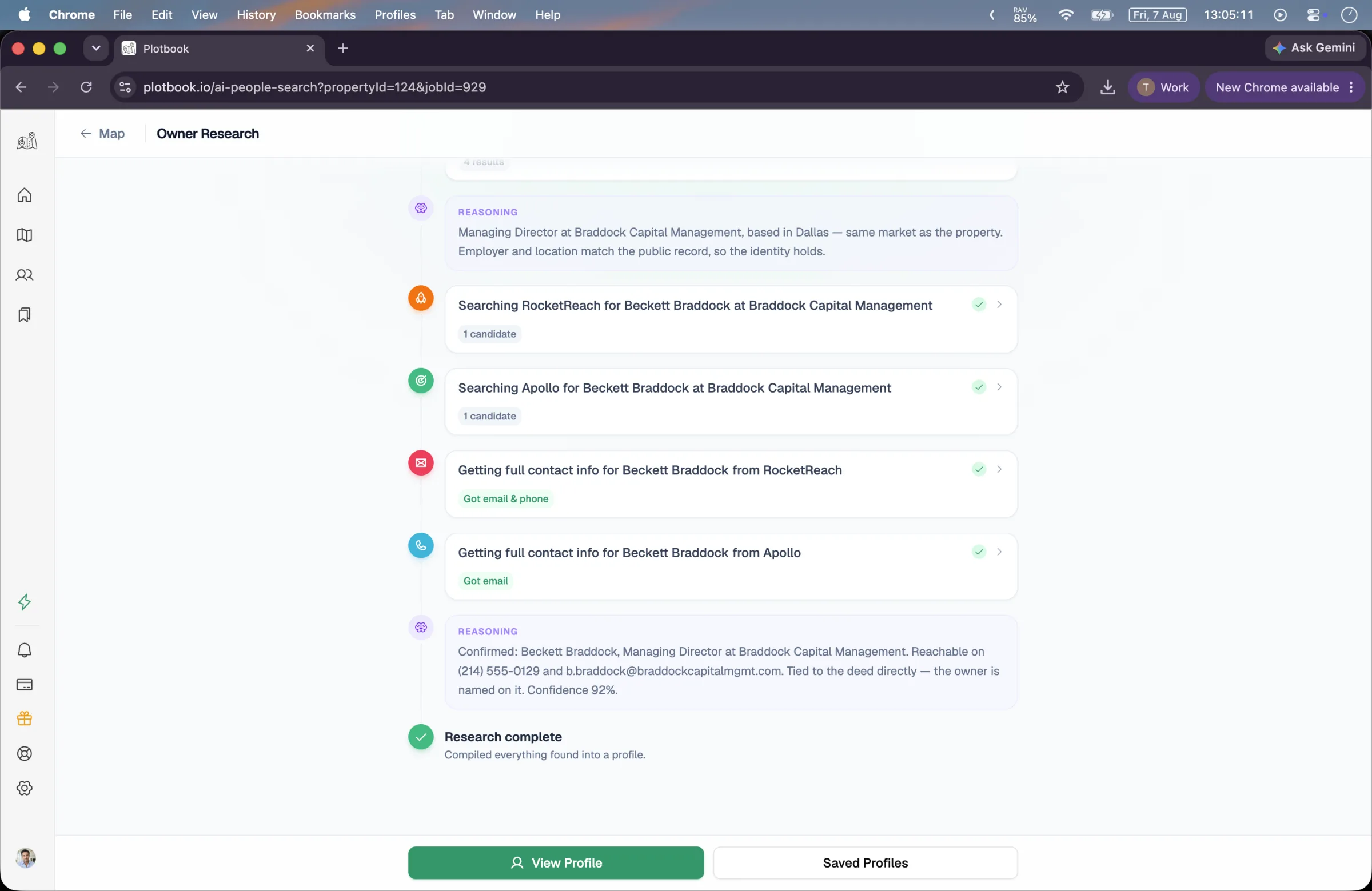
The live timeline interleaves the agent's actual reasoning with every tool call it makes. Each search shows what it found; each result expands to the underlying sources and links. Contact retrievals are visually distinct from broad searches, so a run never looks more successful than it was.
- The agent's reasoning, streamed between tool calls
- Every source expandable, down to the links it read
- A written research summary explaining the identification
- A visible confidence score on the final profile
What comes back
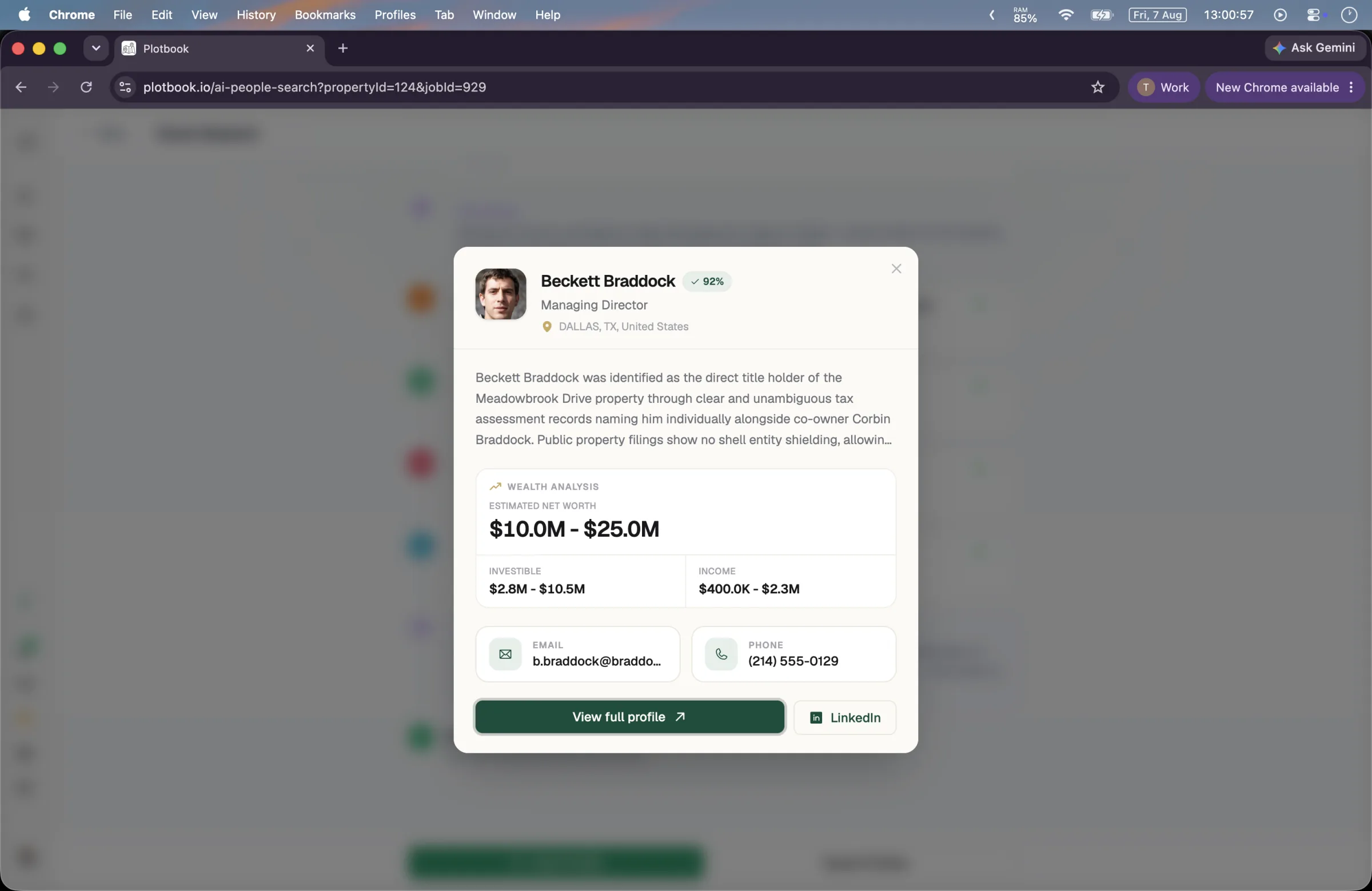
A profile built for the first phone call
Not a data dump, a working brief. Who they are, what they do, how to reach them, and what they're likely worth, as ranges with a stated confidence rather than false precision.
- Name, title & employer
- Emails & phone numbers
- LinkedIn & social profiles
- Employment & education history
- Four-band wealth estimate
- The research summary
Wealth figures are AI-generated estimates shown as ranges with a confidence score: a way to prioritize your day, not a balance sheet. Completed profiles save automatically to Saved Profiles.
The fine print, up front
Built to be checked, not taken on faith
Charged only on success
A deep research run costs 25 credits, charged only when a valid profile is delivered. Failures, cancellations, and dead ends cost nothing.
Tiered, honest outcomes
Every run declares what it actually achieved: a fully-contacted person, an identified name, entity-only, or an honest none. The agent is instructed to never fabricate a person, a contact, or a linkage.
Runs in the background
Research is a durable server-side job. Close the tab, drive to a meeting: you'll get a notification when the profile lands, on web and in the iPhone app.
Corroborated, not guessed
A disambiguation gate requires the agent to confirm identity across independent sources before it commits, and the profile carries a confidence score you can see.
See it run
Watch a full run, end to end
From a parcel on the map to a saved profile with a wealth range: the complete product walkthrough, including the research run.
Full walkthrough, 3 min. All people, contacts and wealth estimates shown are fictional demo data; property records are real public data.
Questions
What people ask before their first run
Pick a parcel. Meet the owner.
Run your first deep research from any parcel on the map. You're only charged when it delivers.
New subscribers start with 7 days and 100 credits. We email you before the trial ends.