Plotbook vs Finny
Finny sends the message. Plotbook stops at the research
Finny is the best-funded product in this category and it does more than we do: it scores how well a prospect matches your existing clients, watches intent signals for people actively looking for financial guidance, and then runs email, LinkedIn, and voicemail outreach on your behalf. Plotbook does none of the outreach and none of the scoring. It shows you a territory, tells you who owns the property in it, and hands you the evidence. Whether that is a smaller product or a more appropriate one depends on your compliance posture and where your prospects come from.
Finny details from public sources, checked August 2026. Finny figures below are theirs or from industry reporting: a proprietary conversion score, a reported 1.8B+ intent signals, automated email, LinkedIn, and voicemail outreach, and a $17M Series A led by Venrock in January 2026. They do not publish pricing. Check the official Finny product page. Plotbook is the vendor here, so read this as our argument and check it against theirs.
The short answer
A campaign engine, or a research desk
Finny is an end-to-end prospecting engine: identify, score, contact, book. Plotbook is a research tool that ends before contact, on purpose. If you want volume and are comfortable with automated outreach going out under your name, Finny is doing considerably more work for you. If your compliance function would rather you approached prospects through your own channels, or if you are working a market where your existing client base tells you nothing useful, the automation is not the part you need.
Pick Plotbook if research is the constraint
- You want to know who owns a specific property, which is not a question a predictive model answers.
- You prospect a geography rather than a national population filtered down.
- Your compliance process prefers you initiate contact through your own channels rather than an automated sequence.
- You are entering a new market, or building a new practice, so your existing client base is a poor template.
- You want to see the sources behind an answer rather than receive a score.
Pick Finny if outreach is the constraint
- You have prospects but no consistent process for contacting them.
- You want multi-channel sequences run automatically rather than by hand.
- Predictive scoring against your existing client base is a signal you trust and want to act on.
- Intent data on people actively seeking financial guidance is worth paying for in your market.
- You want one platform covering identify through to meeting booked.
Neutral ground
What each product actually is
Both sell to independent advisors and almost nothing else about them lines up. Here is each on its own terms.
Plotbook
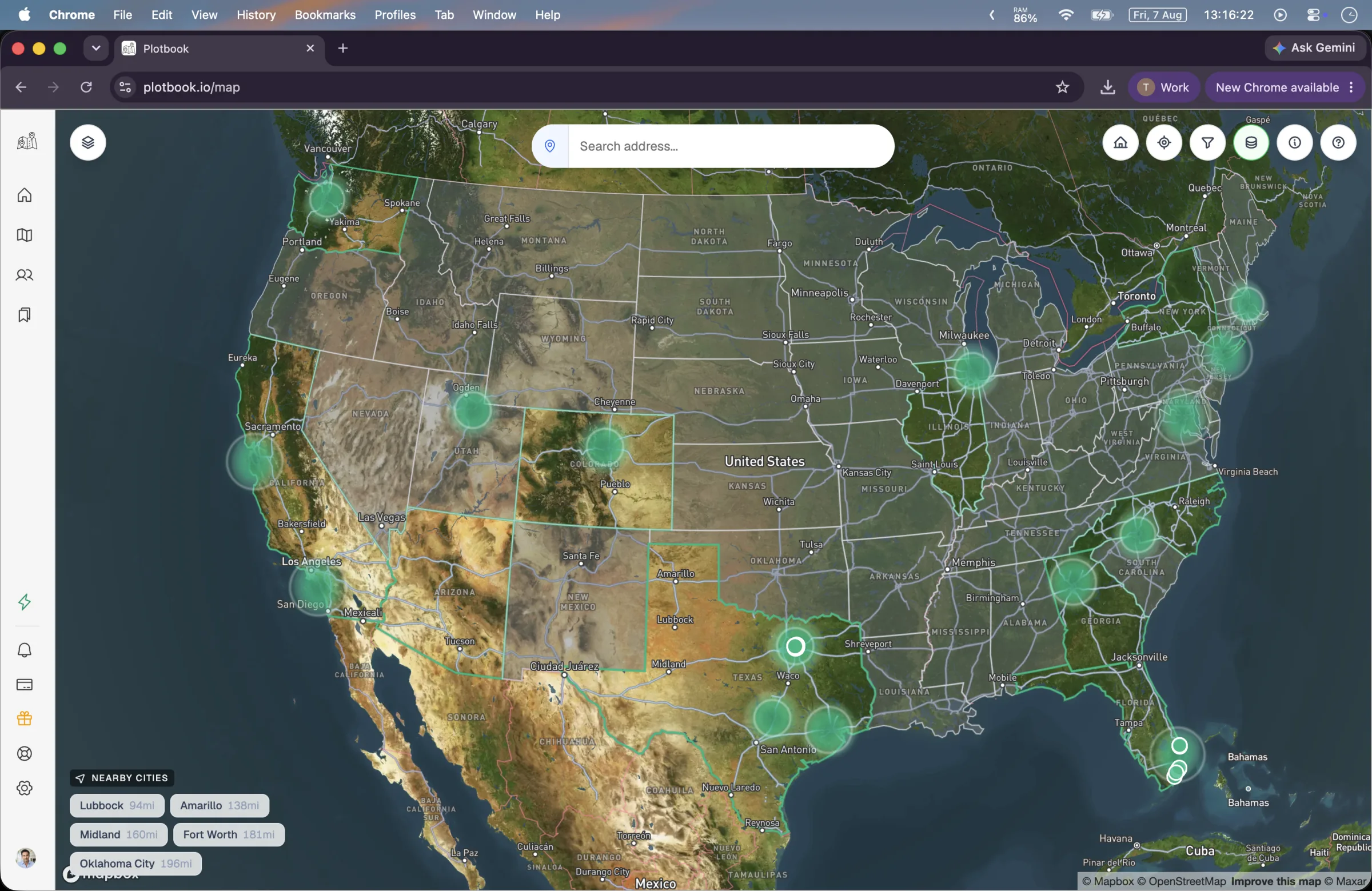
A map of US property colored by assessed value, with an AI agent that identifies the owner behind a deed and estimates their wealth in ranges.
- Entry point
- A place on a map
- Core signal
- Assessed property value and the deed
- Scoring
- None. No fit or conversion score.
- Outreach
- None. The product ends at research.
- Cold start
- Needs nothing but a geography
- Pricing
- $79 to $499 per month, published, self-serve
Finny
An AI prospecting engine for advisors that scores advisor-prospect fit, tracks life events and intent signals, and automates multi-channel outreach.
- Entry point
- A filter set, or your existing clients
- Core signal
- Predictive fit scoring plus intent and life-event data
- Scoring
- A proprietary score per advisor-prospect pair
- Outreach
- Automated email, LinkedIn, and voicemail, with compliance review
- Cold start
- Existing client data improves the modeling
- Pricing
- Not published
Side by side
Capability by capability, including where we lose
Phrases rather than checkmarks. Rows favouring Finny are set in darker type on their side, and the outreach rows are the ones most likely to decide this.
| Capability | Plotbook | Finny |
|---|---|---|
| Automated outreach | PlotbookNone, by design. Plotbook never contacts anyone for you. | FinnyEmail, LinkedIn, and voicemail sequences, run for you |
| Predictive fit scoring | PlotbookNone. No conversion or propensity model of any kind. | FinnyA proprietary score for each advisor-prospect pair |
| Intent signals | PlotbookNone | FinnyReported at 1.8B+ signals identifying people actively seeking financial guidance |
| Geographic discovery | PlotbookBrowse any US market on a parcel map colored across six value bands | FinnyList and filter based; no map interface |
| Starting from an address | PlotbookA first-class entry point, with reverse lookup or full research depending on the deed | FinnyNot an offered workflow |
| Identifying the person behind an LLC or trust deed | PlotbookEntity classification, then registry, county record, and open-web research | FinnyNot an offered workflow |
| Working without existing client data | PlotbookNeeds nothing. A new practice and a twenty year practice see the same map. | FinnyModeling an ideal prospect profile draws on your existing clients |
| Life event and money-in-motion tracking | PlotbookNone. Nothing is monitored after a run. | FinnyTracked, including home purchases, job changes, retirement |
| Compliance surface | PlotbookResearch only. Nothing goes out under your name, so there is no outreach to supervise. | FinnyAutomated outreach with a compliance review step |
| Showing its work | PlotbookA live timeline of every search and source, kept on the profile | FinnyA score; the model is proprietary |
| Published pricing | Plotbook$79, $199, or $499 per month, on the site | FinnyNot published |
Finny figures are theirs or from industry reporting as of August 2026. They do not publish pricing, so this table says so rather than estimating. The compliance row is marked as favouring neither because which posture is correct genuinely depends on your firm.
The cold start
A model of your ideal client is useless when you are starting out
Predictive matching works by learning what your good clients look like and finding more of them. When you have a mature book in a market you have served for years, that is a strong method and it is exactly what you want.
It is much weaker in three common situations. A new practice has no book to learn from. An advisor moving into a new geography has a book that describes the old one. And a firm deliberately trying to move upmarket is asking the model to find more of the clients it is trying to stop taking. In each case the template is either missing or actively wrong.
Plotbook has no template. It reads the county record, which is the same for everyone: nationwide parcel data from Regrid covering 150M+ parcels, painted across six assessed-value bands, with deed owner names printed on parcels once you pass zoom 16. An advisor on day one sees the same map as one on year twenty. Reading it costs no credits on any plan, including the trial, so exploring a new market before you commit to it is free.
- Six assessed-value bands from under $500K to over $10M, usable as filters
- Deed owner names read straight off the parcel tiles
- 232 hand-curated high-net-worth ZIP codes as a heatmap for orientation
- No onboarding data, no client upload, and no model training required
Stopping before contact
We do not send anything under your name
Plotbook has no outreach features at all. No email sequences, no LinkedIn automation, no voicemail drops, no templates. That is a deliberate boundary rather than a roadmap gap, and it cuts both ways, so it is worth being clear about both.
The cost is real: Finny is doing work for you that you will otherwise do yourself or not do at all, and for advisors whose actual bottleneck is consistent follow-up, that is the more valuable half of the problem. If nobody at your firm is going to run the sequence by hand, a research tool will not fix your pipeline.
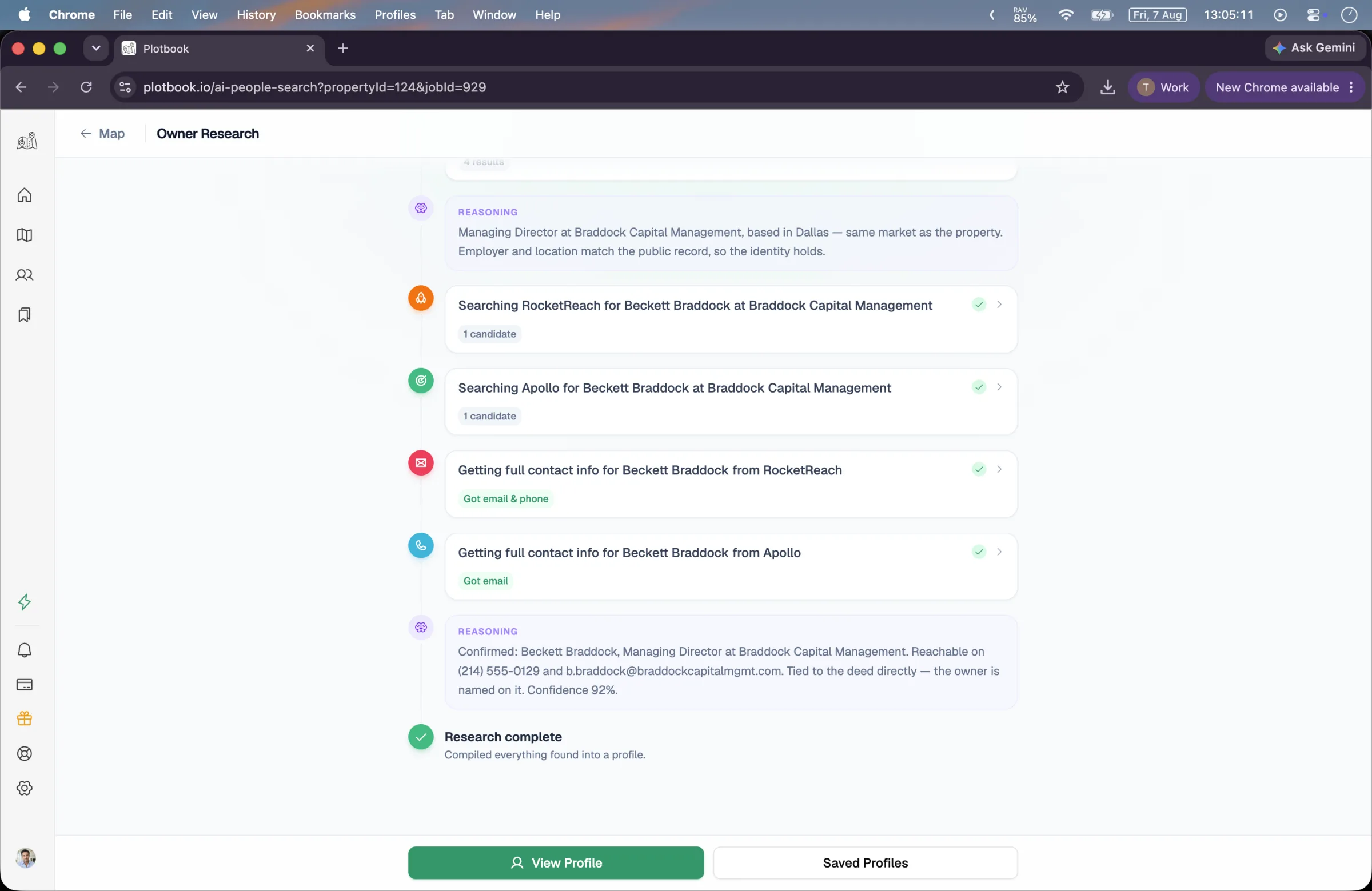
The benefit is that there is no automated communication to supervise, archive, or defend. Some RIA compliance functions are uneasy about AI-generated outreach going out at volume under an advisor's name, and a tool that only produces research does not raise the question. What Plotbook gives you instead is the evidence: a named owner, contact details retrieved from licensed providers, four wealth ranges with a confidence score, and the full timeline of which registries, county records, and databases were queried to reach that name. You approach through your own channels, with the reasoning in front of you.
The other side
What Finny does better than us
Finny is doing more of the job than we are. If your constraint is anywhere downstream of finding a name, most of this list applies to you.
It closes the loop
Identify, score, contact, book. Plotbook stops after identify, which means everything downstream is still your problem. For an advisor who is not going to build an outreach process themselves, that is the difference between a pipeline and a list.
Intent data
Signals identifying people actively looking for financial guidance are close to the strongest prospecting input available, because timing beats targeting. Plotbook has nothing comparable and no plan to.
Predictive fit scoring
A score per advisor-prospect pair, learned from conversions. Plotbook's wealth ranges describe a person's likely finances, not their likelihood of becoming your client. Those are different claims and we only make the weaker one.
Life event tracking
Home purchases, job changes, retirement, inheritance. Plotbook monitors nothing after a research run finishes.
Compliance review built into outreach
If you are going to automate outreach, having review in the product is better than bolting it on. We avoid the problem rather than solving it, which is not the same as solving it.
Momentum and validation
A $17M Series A led by Venrock in January 2026 and strong industry recognition mean a well-resourced roadmap and a company that will still be here. We are considerably smaller, and that is a legitimate thing to weigh.
If your pipeline problem is that nobody is following up, buy Finny. Plotbook helps at exactly one point in that pipeline: knowing who is worth contacting in a market you have chosen geographically, including when the deed is held by an entity and there is no name to score.
Running both
Research here, outreach there
There is no integration between them and we are not going to imply one. What there is, is a clean division of labour: Plotbook produces qualified names from a geography, and whatever outreach system you run, Finny or otherwise, does the contacting.
The practical seam is CSV export, which carries the identified owner, their contact details, the linked parcel, the four wealth ranges, the confidence score, and the research summary explaining how the identification was made. That is enough for an outreach tool to work from and enough for a compliance reviewer to check.
One constraint to plan around: CSV export is a Professional and Enterprise feature. On the $79 Starter plan you can research and keep profiles but not export them, so a Starter seat is a research tool rather than a source of lists.
- Prospect the geography in Plotbook, run the sequences wherever you already run them
- Export with parcel, contacts, wealth ranges, confidence score, and research summary attached
- Use Plotbook when a deed is entity-held and there is no person to score yet
- CSV export requires Professional ($199/month) or Enterprise ($499/month)
What it costs
Published, which is half the point
Finny does not publish pricing, so a like-for-like number is not available. What we can do is show ours completely, including what each action costs once you are inside.
- Browsing the map and filtering by value band
- included
- Opening a parcel Plotbook has not seen before
- 1 credits
- Instant owner lookup on a residential address
- 15 credits
- Full research run on an entity-held deed
- 25 credits
- Keeping the result as a profile
- 10 credits
- Exporting to CSV
- 5 credits
Panning, zooming, the six value-band filters, and the deed owner names printed on parcels. Free on every plan, including the trial.
First lookup of a given parcel. Cached afterwards, so returning is free.
Reverse address lookup against residential records, for deeds held in a person's name.
Classification, registry and county records, contact databases, disambiguation. Charged only if it succeeds.
Enrichment and permanent storage in your prospect book, with the research trail attached.
Professional and Enterprise only. Starter cannot export.
Starter is $79 per month for 750 credits, Professional $199 for 2,500, Enterprise $499 for 8,000, with roughly 20% off billed annually. New subscribers get 7 days and 100 credits, which is enough to work a neighborhood properly before deciding. The trial takes a card and converts on day 8, and we email you before it does.
Questions
Plotbook and Finny, asked directly
Keep comparing
Plotbook vs Aidentified
The closest comparison in the category: relationship mapping and money-in-motion alerts.
Plotbook vs Catchlight
Conversion scoring and enrichment, from a product that cannot discover prospects.
For wealth advisors
What a territory-first prospecting week actually looks like in Plotbook.
Trust and data policy
Where the data comes from, what is licensed, and what Plotbook will not do with it.
Choose the market before the model
Open a neighborhood you want to own and see who is in it. If your problem turns out to be outreach rather than knowing who to reach, buy the outreach engine instead.
New subscribers start with 7 days and 100 credits. We email you before the trial ends.