Reverse Address Lookup
Who owns this house?
Property ownership is public record. Plotbook puts every county's record on one nationwide map, so you click a parcel and see the name on the deed. Then one more click runs an instant lookup and returns the whole household: owners and residents, with ages, phone numbers, and email addresses.
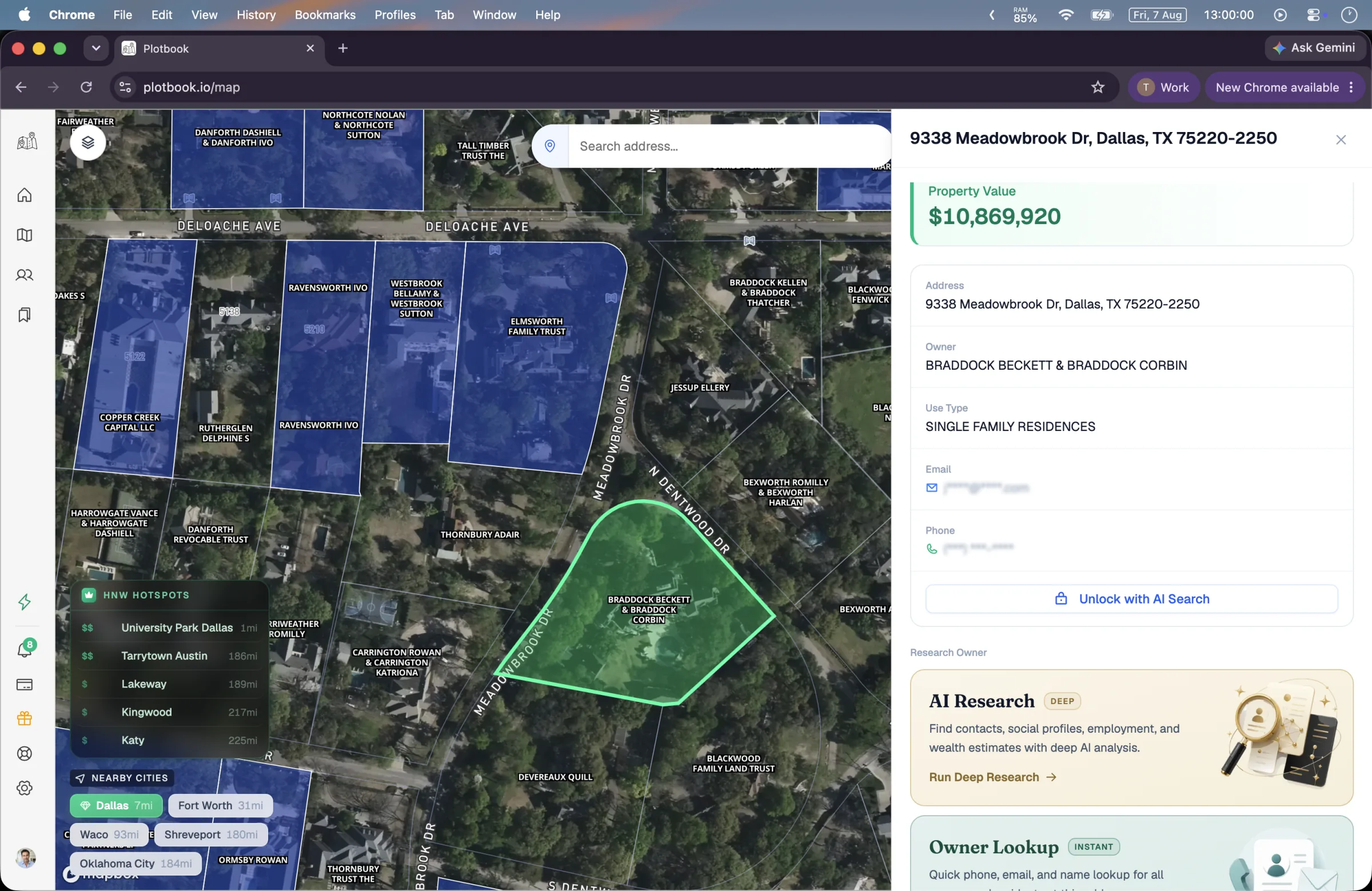
How to look up an owner
Three steps, starting from the map
Being straight about the flow: the lookup lives on the property itself, not in a standalone search box. You find the parcel first, which is deliberate. Seeing the lot, its neighbors, and its value is context a name alone will never give you.
- 01
Find the property on the map
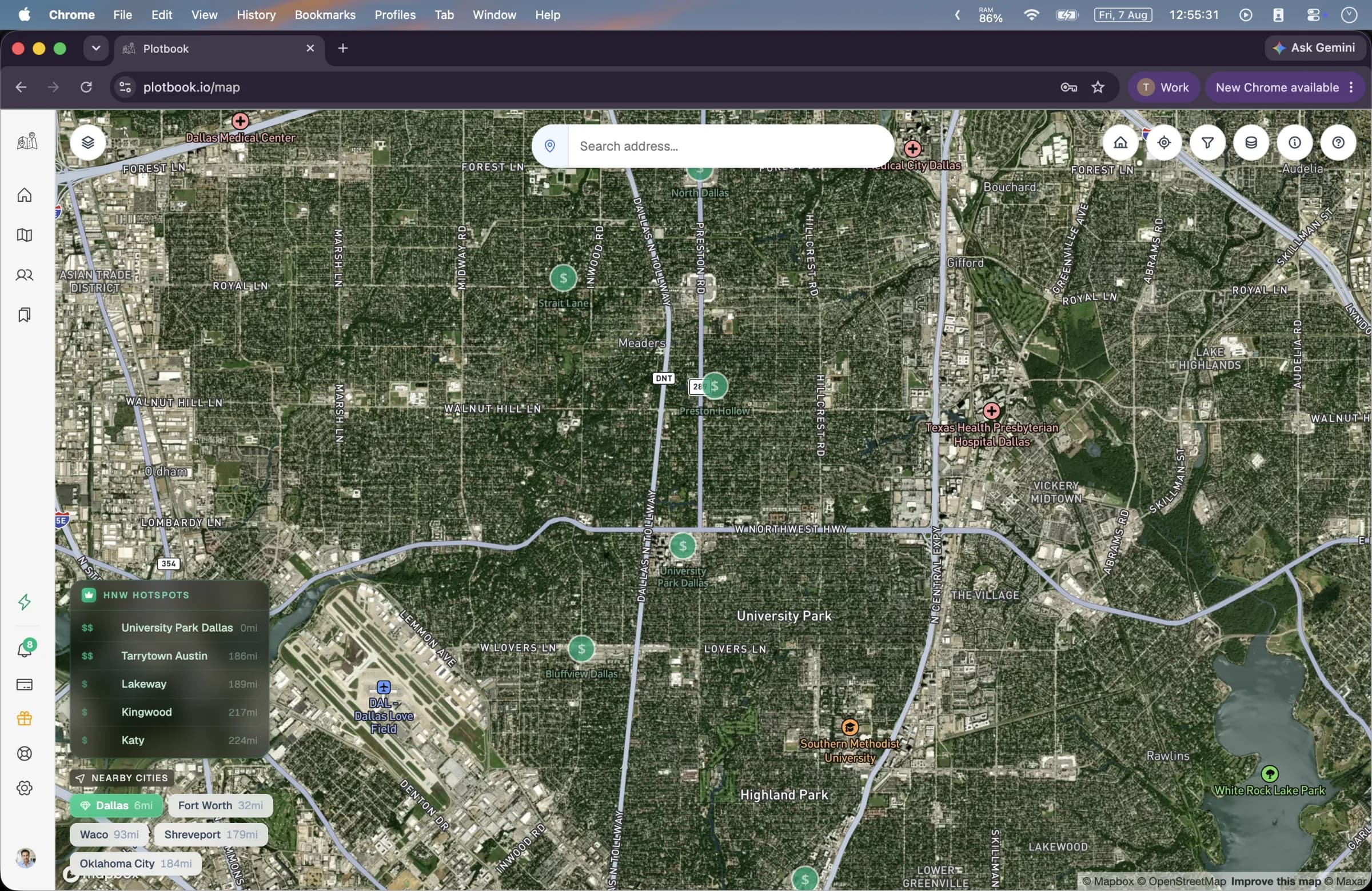
Search the street address, city, or ZIP code, or pan to the block you already have in mind. Parcels appear as you zoom in, each drawn to its real boundary and colored by assessed value.
- 02
Click the parcel
The property drawer opens with what the county holds: the assessed value, the full address, the name on the deed, and the recorded use type. This is the public record, and it is where most lookup tools stop.
- 03
Run Owner Lookup
One click returns everyone associated with the address: owners and residents together, each with age, phone numbers, email addresses, and employer where the records carry them. Save any of them, or all of them, to your profiles.
Two paths
What the deed says decides which one you need
Both cards sit in the property drawer, side by side. The drawer tells you which situation you are in before you spend anything.
The deed names a person
Most homes are held in someone's own name. When the owner line reads like a person, an Owner Lookup answers the question immediately: who owns it, who else lives there, and how to reach any of them. One click, 5 credits, no waiting.
- Owners and residents returned together
- Contacts included where records carry them
- Save one person or the whole household
The deed names an entity
Above a certain value, deeds stop naming people. An LLC, a family trust, a partnership named after the street: an instant lookup cannot name a human because the records do not contain one. That is what the research agent is for. It reads the deed, follows the registry and the mailing address, and finds the person behind the entity.
- Business registry and county record trails
- Trustee and beneficial owner separated
- A written summary of how it got there
Not just the name on the title
You get the household
A lookup returns owners and residents together, deduplicated and badged by role, so you can see who holds the deed and who else lives there. For household level work this is the difference between a name and a picture: the person on the title is not always the person who makes the financial decisions, and a spouse or adult child at the same address is often the right first conversation.
- Owners and residents, role badged
- Phone numbers, mobile and landline
- Email addresses on file
- Employer and job title where known
Save any one of them, or the whole household at once, straight into Saved Profiles, where each person picks up a wealth estimate and can be exported with the rest of your book.
What a lookup costs
5 credits
One instant Owner Lookup, covering everyone at the address. Browsing the map and reading the deed owner on a parcel are part of your subscription.
- Deed owner and assessed value: included in map browsing
- Instant household lookup: 5 credits
- Deep research on an entity deed: 25 credits, charged only on success
Included in every plan; new subscribers start with a 7-day free trial. Looking up a single address? A one-time Owner Report is available on the parcel itself, no plan required. See plans.
Where the data comes from
Public records, licensed contacts
Parcel boundaries, the name on the deed, the recorded use type, and the assessed value all come from public county assessor records. Those documents are public precisely so that anyone can inspect them, which is why every county publishes its own version. Plotbook aggregates them nationally so you are not learning a different portal for every market you work.
The household layer, meaning the residents, their ages, phones, and emails, comes from licensed United States consumer records used under their providers' terms of service. Deceased records are filtered out. Plotbook does not scrape, and does not use illegally obtained data.
Coverage varies by person, and we would rather say that than imply a universal hit rate. Someone with a long, stable address history is usually well documented; a recent mover or a deliberately private individual may return less. Plotbook shows what the records hold.
Compared to the free option
One map instead of 3,000 county portals
A county assessor website is free and authoritative, and for a single address in a county you already know, it is a perfectly good answer. It stops being one the moment your work is geographic: comparing a street, covering a metro that spans four counties, or moving between markets.
Plotbook gives you the same starting record on one nationwide map, with every neighbor visible and colored by value, and then keeps going where the assessor stops: to the household behind the address, and to the research that identifies a person when the deed only names an entity.
See it run
A parcel, an owner, and everyone at the address
The instant lookup in context, alongside the map and the deep research path for entity held deeds.
Full walkthrough, 3 min. All people, contacts and wealth estimates shown are fictional demo data; property records are real public data.
Questions
Looking up a property owner
Start with an address. Leave with a person.
Find the parcel, read the deed, and run the lookup. When the deed hides behind an entity, the research agent takes it from there.
Free account. The parcel and the name on the deed come first; household contacts are optional and priced per address or by plan.