A $3M house might belong to a retired founder with nine figures in liquid assets or to a couple who stretched every dollar to buy it. No public record separates those two, and any product that hands you a single confident net worth figure is hiding that fact rather than solving it. Plotbook returns four ranges, built from what is actually observable, with the reasoning attached and the gaps stated.
Wealth estimation is not part of the research run, it is a separate step that fires once a profile exists, whether the profile came from an owner research run or from saving a people search result. It assembles what is known about the person, their title, organization, employment and education history, and city, along with the linked parcel's assessed value, type, and address, and any residential records showing their home address and other properties they own. A model then returns four conservative ranges in dollars: net worth, income, investible assets, and total assets. There is no account data anywhere in that chain.
Four ranges per profile: net worth, income, investible assets, total assets
Inputs are the linked parcel, residential records, and career and organization signals
Runs asynchronously after a profile is saved, with pending, completed, and failed states
Ranges are requested conservatively and returned as minimum and maximum dollars
No bank, brokerage, holdings, or filing data is used at any point
Included in the research or save that produced the profile, with no extra credit cost
Built to be useful, not to look precise
The purpose of a wealth estimate in prospecting is to answer a triage question: is this household plausibly in the range where the conversation I want to have makes sense. That question is well served by a range and poorly served by false precision. A tool that reports $14,382,000 has not measured anything more finely than one that reports $10M to $20M, it has simply chosen to sound authoritative about the same underlying guess.
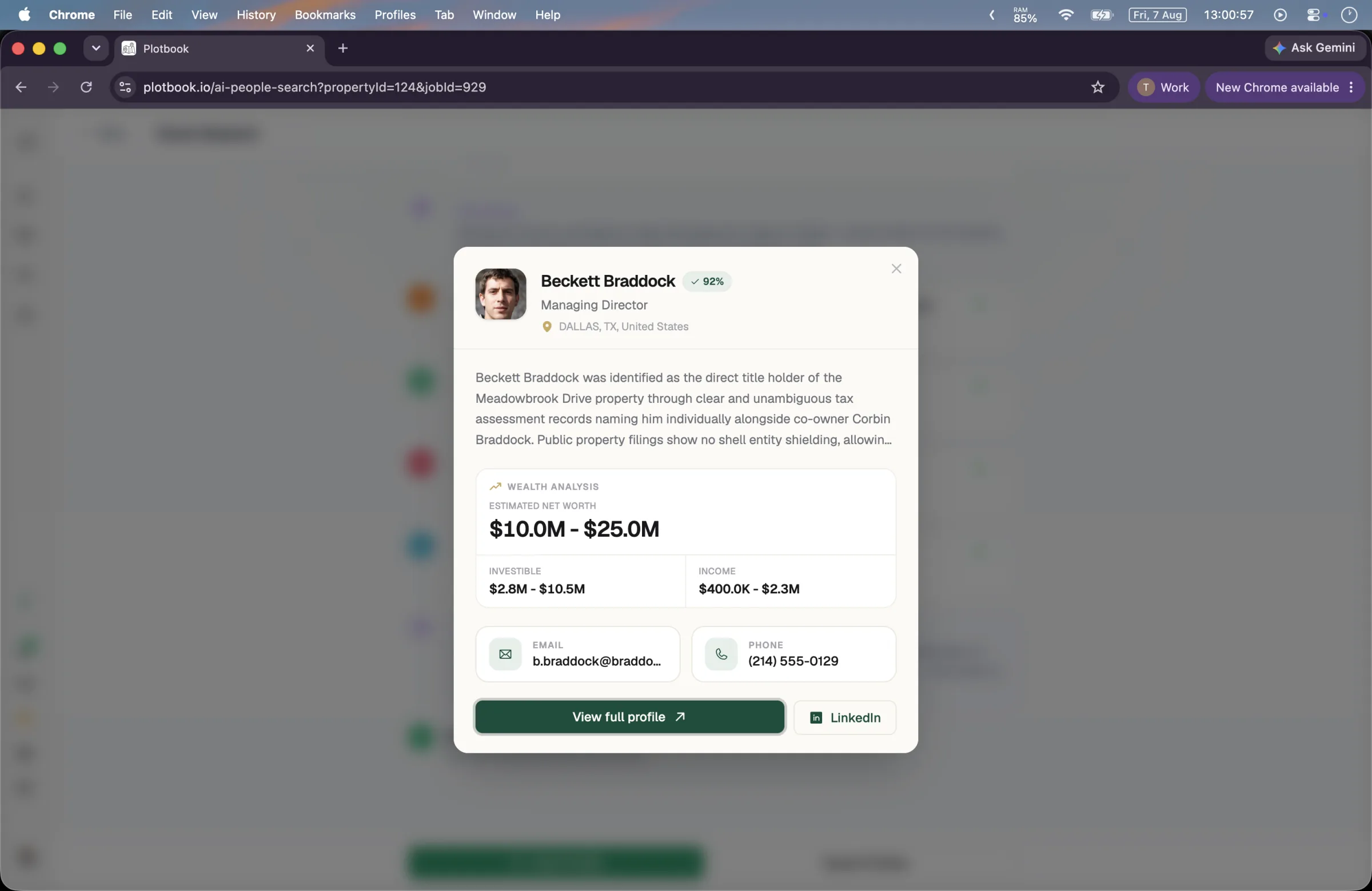
So the output is four ranges rather than one number, and the four are genuinely different questions. Net worth is the headline. Total assets is the gross picture before whatever is owed against it. Investible assets is the one advisors actually care about, since a large fraction of many balance sheets is a house nobody is going to liquidate. Income speaks to ongoing capacity rather than accumulated capacity, which is the more relevant figure for a recurring gift or a savings relationship.
Each is returned as a minimum and a maximum in dollars, and the schema enforces that. The model cannot answer with a single figure even if it wanted to.
Net worth: the headline range, assets net of what is likely owed
Total assets: the gross picture, including the property itself
Investible assets: the portion that could plausibly be deployed
Income: ongoing earning capacity rather than accumulated capacity
The whole input list
It is worth publishing the input list in full, because the honest way to judge an estimate is to know what it was allowed to see. Three groups of signals are assembled and passed to the model, and nothing else is.
From the linked parcel: the property address, the county's assessed value, the recorded owner, and the use type, read out of the cached property record. From residential records, where a lookup returned them: the person's current home address and up to five other properties they are recorded as owning. From the profile itself: name, title, city, state, country, organization name, domain, and website, LinkedIn URL, employment history, education history, and skills.
That is the entire input surface. There is no credit data, no tax return, no brokerage feed, no filing of holdings, and no purchased consumer wealth score. If a signal is not in the list above, it did not influence the estimate.
Parcel: address, assessed value, recorded owner, use type
Residential records: current home address, up to five other owned properties
Person: title, organization, employment and education history, skills, location
Nothing else, and specifically no account, holdings, or filing data
The most solid input, with a catch
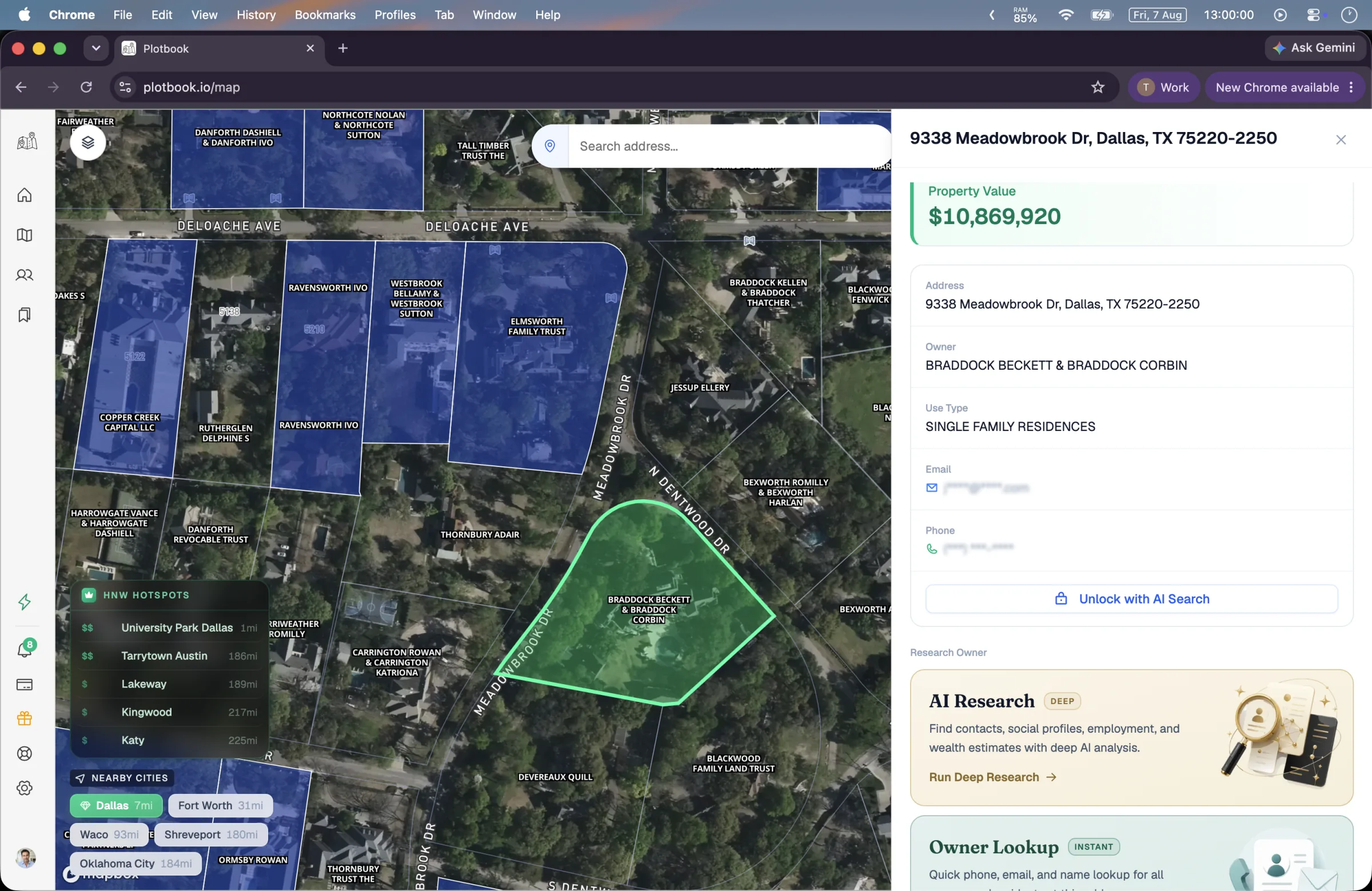
Property is the input with the firmest footing, because it is a public record rather than an inference. Somebody's name is on a deed for a parcel a county has valued, and that establishes a floor: whatever else is true, this household controls an asset of roughly that size.
The catches are worth stating plainly. Assessed value is a tax figure on a county cycle and can drift from market value in either direction. Leverage is invisible, so an assessment tells you what the asset is worth and nothing about how much of it the household actually owns. And a single property is a weak sample of a balance sheet.
This is why the second property matters so much more than the first. When residential records show the same person recorded on additional properties, the estimate moves harder than the added value alone would justify, because multi-property ownership is one of the few observable signals that reliably separates accumulated wealth from a large mortgage. Up to five of those are passed in alongside the linked parcel.
What a career implies
Career data is the inferential half of the estimate and it is where the reasoning actually happens. A title carries information: the compensation structure of a managing director, a founder, a partner, or a surgeon differs in kind and not just in degree from a salaried role, and equity-heavy industries accumulate differently from ones that pay in cash.
Duration matters as much as level, because wealth is cumulative. Twenty years of senior earnings is a fundamentally different balance sheet from the second year of a large salary, even where the current number is identical, and employment history is passed in whole rather than as a current title so that trajectory is visible.
The honest weaknesses live here too. A retired executive with no current employer looks thin on paper and is often the wealthiest person on the street. A founder of a private company has an asset nobody can see the size of. Inherited wealth leaves almost no career trace at all. The model is instructed to stay conservative, which means these cases tend to be underestimated rather than overestimated, and that is the preferable direction for a triage tool: a prospect you look at more closely than necessary costs you a few minutes, while one you dismiss wrongly costs you the relationship.
One structured call, after the profile exists
Mechanically, this is a single structured generation. The assembled context goes to Gemini 3.1 Pro through OpenRouter with medium reasoning effort, and the response is forced to match a schema of four objects each carrying a minimum and a maximum in dollars. The instruction asks explicitly for conservative ranges. Because the schema is enforced at the call, there is no parsing step where a malformed answer could be quietly reinterpreted.
It runs asynchronously, after the profile has been written, which is why a new profile appears with an estimating state before its number lands. The prospect list polls while an estimate is pending and fills the chip in when it completes. Each profile carries an explicit status of pending, completed, or failed, and a timestamp for when its estimate was produced, so a stale or missing estimate is visible as such rather than reading as a zero.
The estimate is produced once, at profile creation. It is a snapshot of what was knowable then, not a subscription that revalues quarterly, and the timestamp on the profile is the honest way to tell how old it is.
The width of the range is information
A range is not a hedge, it is a reading. When the bounds sit close together, the underlying signals corroborated each other: a clear title at an identifiable organization, a long employment history, a well-assessed property, maybe a second one. When the bounds are far apart, the signals were thin or in tension, and the right response is to look at the evidence rather than the number.
Two other markers on the same profile help calibrate. The confidence score, from 0 to 100, describes how well the identification itself held up, along with a count of how many independent sources agreed. That score is about who this person is, not about how much they have, and it deserves reading first: an estimate attached to a shaky identification is not a wealth question at all, it is an identity question.
The written research summary is the third piece. It states how far the research run actually got, and where the profile was assembled from fewer sources it says so. Taken together, the three tell you whether you are looking at a well-evidenced household or a plausible sketch, which is a distinction most wealth screening products deliberately blur.
Narrow range: corroborating signals across property, career, and records
Wide range: thin or conflicting inputs, worth opening the evidence
Confidence score and source count: about the identification, not the wealth
Research summary: states how far the run got and what it could not confirm
On the list, the profile, and the export
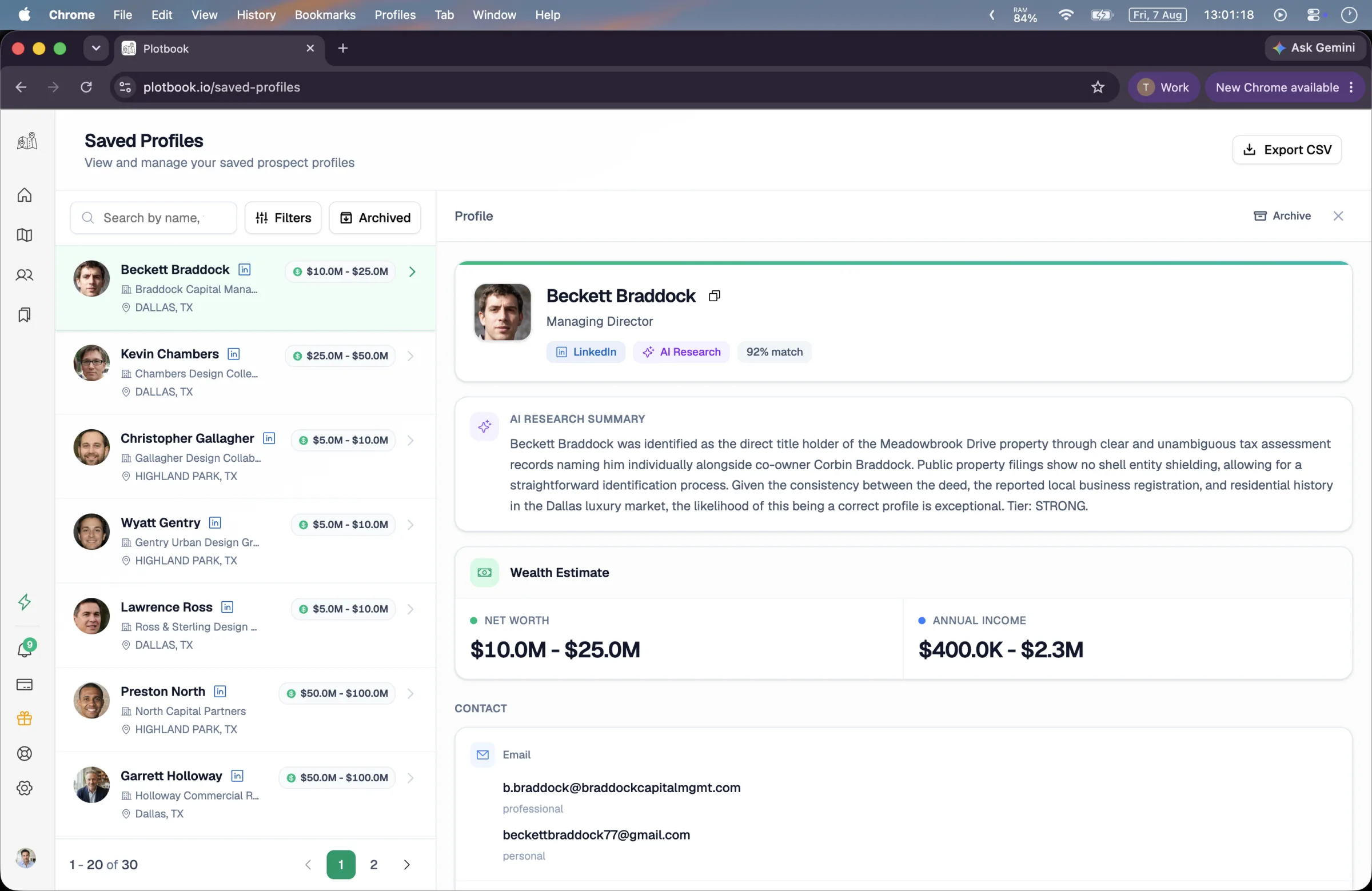
In the prospect list each row carries a net worth range chip, or an animated estimating state while one is being produced, which makes the list scannable in the way that actually matters when you are deciding whose morning you are going to occupy. The list can also be filtered by estimate status, so you can separate the profiles that have a completed estimate from the ones still pending or failed.
On the profile itself, all four ranges appear together in the wealth section, above the contact details and beside the research summary that explains where the underlying facts came from. On the map, a parcel linked to a saved profile shows the same figures in its drawer, which is what turns the map from a lookup surface into a view of the ground you have already worked.
In a CSV export, the wealth estimates column group carries the net worth and income ranges alongside the rest of the profile, so the figure survives the handoff into whatever system your team actually runs the pipeline in.
In order
From a saved profile to four ranges
The estimate is downstream of everything else. Nothing here starts until a person has actually been identified, which is deliberate: an estimate attached to the wrong person is worse than no estimate.
01
A profile is created
Either an owner research run completes, or a people search result is saved. The estimate is triggered from the saved profile, so a person exists before any wealth reasoning happens.
02
Property context is read
The linked parcel is read from the cached property record: address, county assessed value, recorded owner, and use type. This is the public-record floor the estimate is anchored to.
03
Residential records are added
Where a lookup returned them, the person's current home address and up to five other properties they are recorded as owning are included, which is the strongest observable separator of accumulated wealth.
04
Career signals are assembled
Title, organization with domain and website, LinkedIn, employment history, education history, skills, and location go in as the inferential half of the picture.
05
Four ranges are generated
Gemini 3.1 Pro produces net worth, income, investible assets, and total assets, each as a minimum and maximum in dollars under an enforced schema, with an explicit instruction to stay conservative.
06
It attaches to the profile
The result is written with a completed status and a timestamp, appearing as a range chip in the list, the full four-band card on the profile, and columns in a CSV export. A failure is marked failed rather than shown as zero.
The specifics
Numbers you can check
What is countable about the estimate, including the fact that it costs nothing on its own. There is no accuracy percentage in this table because there is no honest way to compute one against private balance sheets.
Estimated bands
4
Net worth, income, investible assets, and total assets, each returned as a minimum and a maximum in dollars.
Output shape
Ranges only
Enforced by the response schema. A single point figure cannot be returned even when the model is confident.
Model
Gemini 3.1 Pro
Through OpenRouter, at medium reasoning effort, in one structured generation per profile.
Input groups
3
Linked parcel, residential records including up to five other owned properties, and career and organization signals.
Estimate states
Pending, completed, failed
Visible per profile and filterable in the prospect list. Pending rows poll until the estimate lands.
Identification confidence
0 to 100
A separate score about who the person is, shown with the number of corroborating sources. Read it before the wealth number.
When it runs
Once, at creation
Asynchronously, after the profile is saved. It is a timestamped snapshot rather than a figure that revalues on a schedule.
Additional cost
0 credits
Included in the research run or profile save that produced the profile. There is no separate charge for the estimate.
Wealth figures are AI-generated estimates. They are intended for prioritizing your day, not for underwriting, lending, insurance, employment, or any other decision that calls for verified financial data.
Where it stops
What the estimate cannot know
Six things the model is structurally blind to. None of them are fixable with a better prompt, which is why they are published rather than buried.
It cannot see any account
No bank balance, no brokerage position, no retirement account, no trust corpus, no filing of holdings. Every figure is extrapolated from public and licensed signals about property and career.
Leverage is invisible
Public records show what somebody owns, not what they owe against it. Two households with identical property and identical titles can have entirely different balance sheets, and nothing in the input list distinguishes them.
Inherited wealth leaves no trace
The career signal is the inferential engine, and inherited or exited wealth barely touches it. A modest profile can sit on top of a large balance sheet, and conservative instructions mean those cases are typically understated.
It is only as good as the identification
An estimate attached to the wrong person of a common name is confidently meaningless. The confidence score and source count exist for exactly this reason and should be read first.
It is a snapshot, not a subscription
The estimate is produced once when the profile is created and carries the timestamp of that moment. Nothing revalues it as markets move or as the person's circumstances change.
It is not a screening score
There is no giving history, no propensity or affinity model, no philanthropic capacity rating, and no ability to filter your prospect book by wealth band. Products in that category solve a different problem.
The fastest way to calibrate an estimate is to run it on a household whose situation you understand, and see whether the range lands where your judgment already sits.