Plotbook vs PropertyRadar
Lists to market to, or owners you understand
PropertyRadar sits in the real estate marketing tradition: define criteria across property records, build a targeted list, keep it monitored as conditions change, and drive campaigns from it. That is a volume business and the product is shaped for it. Plotbook is shaped for the opposite: far fewer owners, each one researched properly, with a professional identity and a wealth picture attached. Both start from parcels. Almost nothing after that is the same.
PropertyRadar details from public sources, checked August 2026. PropertyRadar capabilities here are described only at the level of what they publish about their own product. We hold no dated pricing or usage figures for PropertyRadar, so this page quotes none. Check the official PropertyRadar product page. Plotbook is the vendor here, so read this as our argument and check it against theirs.
The short answer
Volume, or depth
The question is how many owners you need and how much you need to know about each. A marketing operation wants thousands of records with enough contact data to run a campaign, and cost per record is what matters. An advisor or a fundraiser wants a handful of owners understood well enough to justify a personal approach, and depth per record is what matters. Buying the volume tool for the depth job leaves you with a list you cannot act on personally.
Pick Plotbook if you need to understand the owner
- You will approach a small number of people personally rather than mail a list.
- You need a professional identity: role, employer, career history, not just a name on a deed.
- You need wealth context in the form of estimated net worth, income, investible assets, and total assets.
- You need the human behind an LLC or trust deed, researched with the reasoning shown.
- You want to see the value distribution of a market on the map before choosing where to work.
Pick PropertyRadar if you need lists and campaigns
- You build targeted property lists from detailed criteria and act on them at volume.
- You want lists monitored so new matches surface as conditions change.
- Contact data for marketing outreach is the output you need most.
- You run campaigns and want the list tooling and the outreach path connected.
- You are a real estate professional, which is who the product is built for.
Neutral ground
What each product actually is
We hold less sourced detail on PropertyRadar than on most vendors here, so this card stays at the level of what they publish about themselves.
Plotbook
A map of US property colored by assessed value, with an AI agent that identifies the owner behind a deed and estimates their wealth in ranges.
- Built for
- Advisors, fundraisers, and luxury agents
- Unit of work
- One owner, researched
- Map
- Parcels colored across six assessed-value bands, with deed owner labels at close zoom
- Owner output
- A named person with role, employer, contacts, and four wealth ranges
- Campaign tools
- None. CSV export only.
- Pricing
- $79 to $499 per month plus credits, published
PropertyRadar
A property data and marketing platform for real estate professionals, built around discovering properties by criteria, building lists, and driving outreach from them.
- Built for
- Real estate professionals and property marketers
- Unit of work
- A list
- Map
- Property search with mapping and heatmap views
- Owner output
- Owner of record with contact data for outreach
- Campaign tools
- List monitoring and marketing workflows
- Pricing
- Not published by us; ask them
Side by side
Capability by capability, including where we lose
Phrases rather than checkmarks. Rows favouring PropertyRadar are set in darker type on their side. Where we do not hold a sourced fact about them, the cell says so instead of guessing.
| Capability | Plotbook | PropertyRadar |
|---|---|---|
| Building targeted property lists | PlotbookNot a list product. Value band filtering on the map only. | PropertyRadarThe core function, from detailed property criteria |
| Monitoring lists over time | PlotbookNone. Nothing is watched after a research run. | PropertyRadarList monitoring as conditions change |
| Wealth estimation on the owner | PlotbookFour AI-generated ranges with a confidence score, per researched person | PropertyRadarNot a wealth product |
| Professional identity of the owner | PlotbookRole, employer, employment history, LinkedIn where found | PropertyRadarOwner of record and contact data |
| Map colored by assessed value | PlotbookSix value bands, as the default view | PropertyRadarMapping and heatmap views for property criteria |
| Identifying the person behind an LLC or trust deed | PlotbookEntity classification, then registry, county record, and open-web research, with a disambiguation gate | PropertyRadarOwner of record as filed |
| Contact data at volume | PlotbookPer person, at credit cost. Not designed for list-scale appending. | PropertyRadarBuilt for outreach at list scale |
| Marketing and campaign workflows | PlotbookNone at all | PropertyRadarPart of the product |
| Showing its work | PlotbookA live timeline of every search and source, kept on the profile | PropertyRadarProperty records as filed |
| Fit for financial advisors and fundraisers | PlotbookThe intended buyer | PropertyRadarBuilt for real estate professionals |
| Published pricing | Plotbook$79, $199, or $499 per month, on the site | PropertyRadarNot published by us; we hold no sourced figure |
We hold no dated pricing or usage research for PropertyRadar, so this table describes only what PropertyRadar publicly presents as its own product and leaves the rest blank rather than guessing. If you work at PropertyRadar and something here is wrong, write to us and we will fix it.
Unit of work
A thousand records, or ten you can actually use
A list product is optimised for cost per record, because the business model behind it is volume outreach: build criteria, pull thousands of matches, mail or call them, convert a small percentage. Every design decision follows from that, and it is the right design for that business.
An advisor cannot run that business. You are going to approach a small number of people personally, probably by name, probably knowing something about them. Ten records you understand are worth more than a thousand you do not, and a list tool's economics give you exactly the wrong thing.
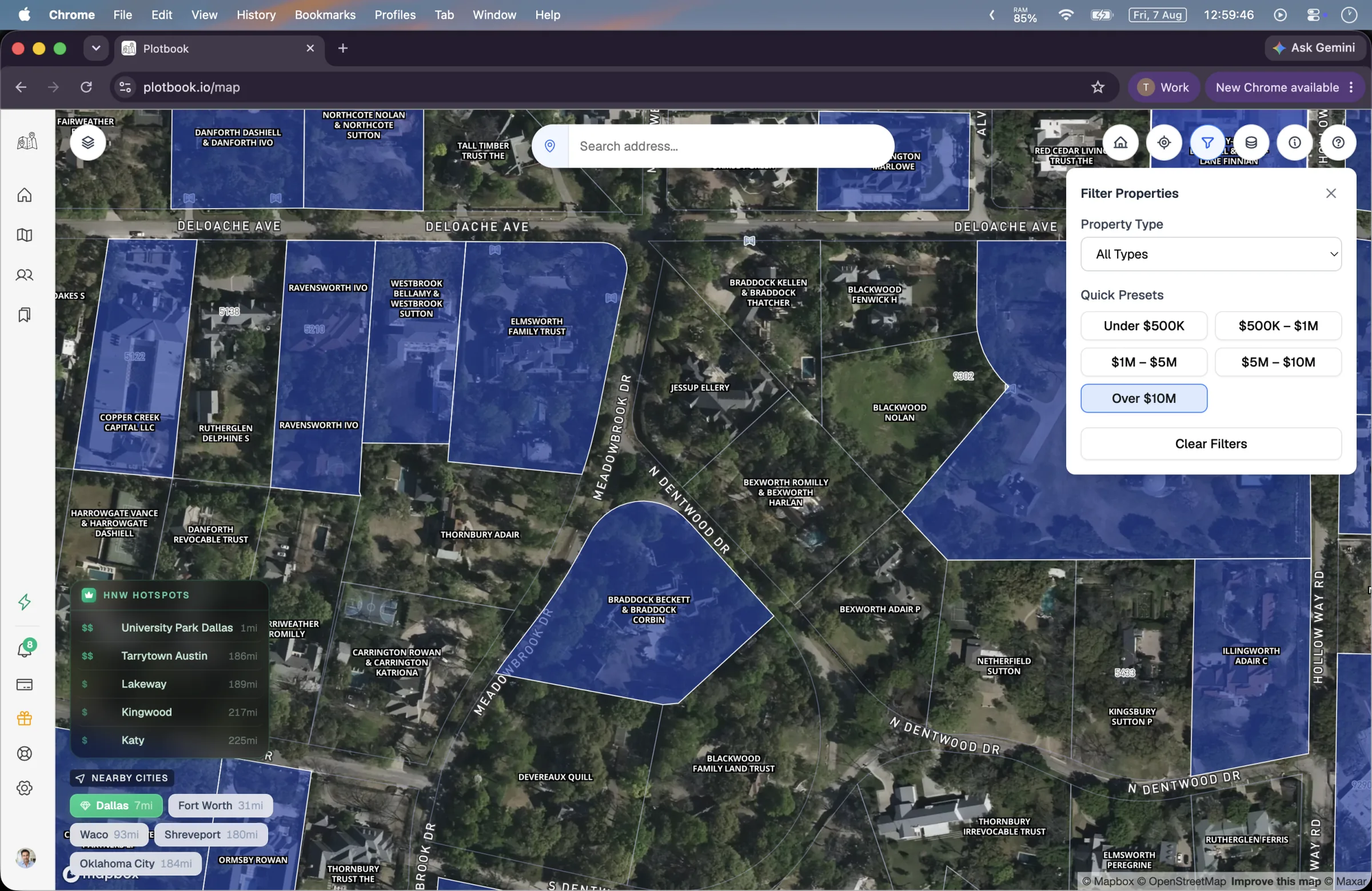
Plotbook is built around that smaller number. The exploration is free: nationwide parcel data from Regrid across 150M+ parcels, colored in six assessed-value bands, with deed owner names printed on the parcels once you pass zoom 16, plus a heatmap of 232 hand-curated high-net-worth ZIP codes for orientation. Panning, filtering, and reading owner names cost no credits on any plan. You only start spending when you decide a specific owner is worth understanding.
- Six assessed-value bands from under $500K to over $10M, usable as filters
- Deed owner names read straight off the parcel tiles at close zoom
- 232 hand-curated high-net-worth ZIP codes as a heatmap at country zoom
- Free to browse; credits are spent only on the owners you choose
What a record contains
The owner of record is where the work starts
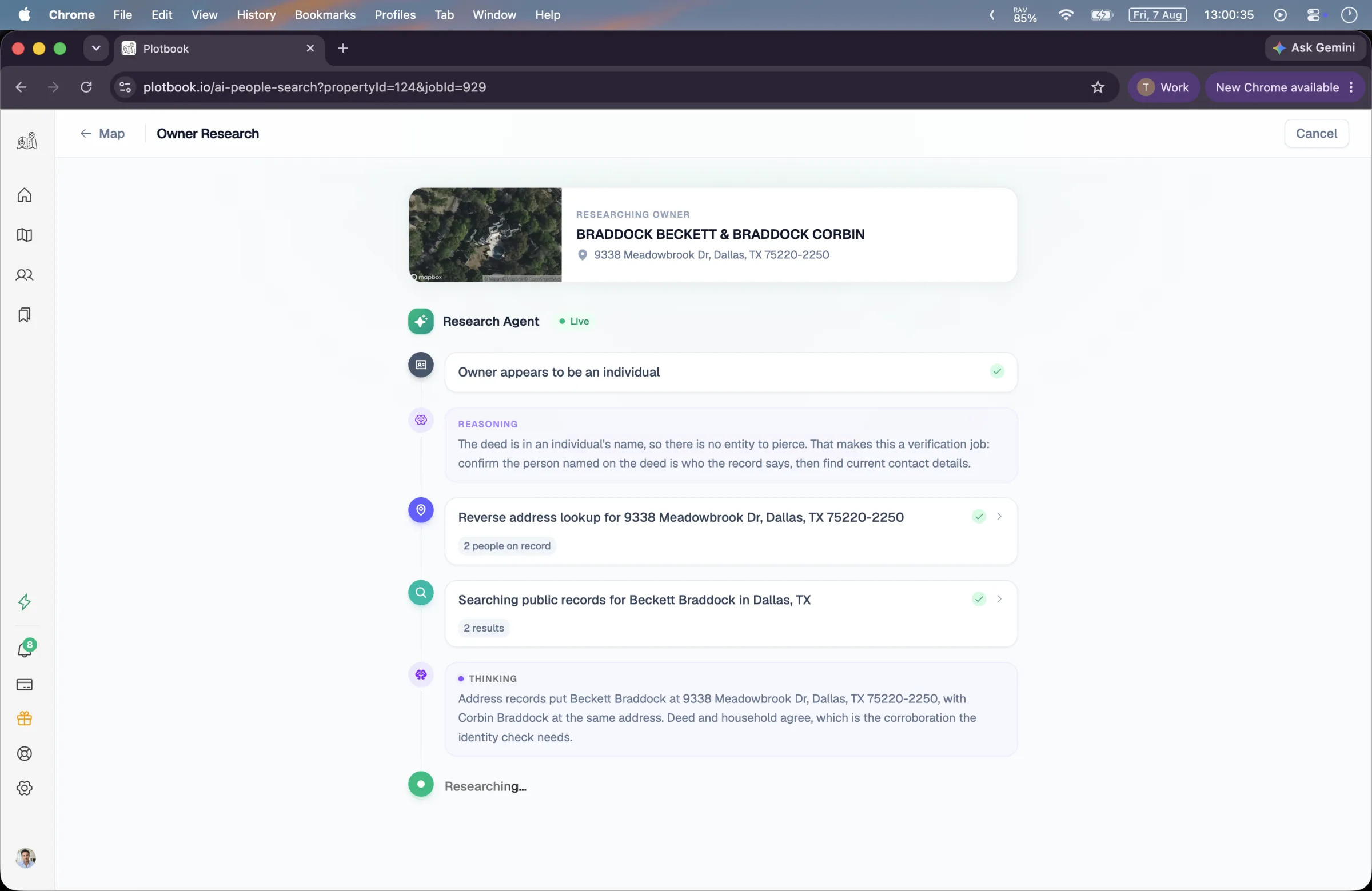
Property platforms report the owner as filed, which is exactly what a public record contains and exactly where it stops. If the deed says a person's name, you have a name. If it says an LLC, a trust, or a partnership, that is what you get, and at the top of a market that is what you get most often.
Plotbook treats the filed name as the beginning. A deterministic classifier sorts the owner into person, LLC, corporation, trust, estate, partnership, or institution before any AI runs, and institutions such as banks, government bodies, and HOAs short circuit with no research and no charge. LLCs go to business registry aggregators for members, managers, officers, and organizers, with explicit handling for Wyoming, Delaware, New Mexico, and Nevada so a commercial registered agent is never reported as the owner. Trusts go to county records for the trustee, then to the open web for the beneficial owner, with trustee and principal roles labeled separately. Absentee properties get a second reverse lookup against the tax mailing address.
What comes out is a person rather than a filing: role, employer, employment history, emails and phone numbers from licensed contact providers, and four wealth ranges covering net worth, income, investible assets, and total assets, each with a confidence score. A disambiguation gate requires independent corroboration before anyone is named, every run states the tier it actually reached, and the 25 credits are charged only if it succeeds.
The other side
What PropertyRadar does better than us
For a real estate marketing operation, most of this list is the actual job, and Plotbook does none of it.
List building from property criteria
Defining a target set across detailed property attributes and pulling it as a list. Plotbook filters on assessed value band and nothing else, and does not produce lists at all.
Monitoring over time
Keeping a list live so new matches surface as conditions change. Plotbook monitors nothing. A profile is a snapshot of the run that produced it.
Contact data economics at volume
Reaching thousands of owners affordably is what a marketing platform is built for. Plotbook charges 5 credits for a reverse lookup or 25 for a research run, which is the wrong shape for volume by a wide margin.
Campaign workflow
The path from list to outreach lives in the product. Plotbook has no marketing features at all, only CSV export on Professional and Enterprise.
Property attribute depth
Real estate platforms carry transaction, mortgage, and status detail that Plotbook does not. We show assessed value, use type, boundaries, mailing address, and owner of record, and that is the whole of it.
Maturity in its category
An established product serving real estate professionals, with the training and support that implies. Plotbook is newer and aimed at a different buyer.
If your work is building property lists and marketing to them, PropertyRadar is doing that job and Plotbook is not attempting it. We are worth considering only when the owner, as a person, is the thing you actually need to understand.
Running both
Narrow the list, then go deep
The natural pairing is sequential. Use a list platform to identify the properties that meet your criteria across a market, then use Plotbook on the small subset where understanding the owner would actually change how you approach them.
For a luxury agent that subset is the entity-held deeds on the most valuable properties, where the filed owner is an LLC and a mailing campaign has nowhere useful to land. For an advisor it is the handful of owners in a target neighborhood worth a personal introduction rather than a postcard.
Export is CSV, on Professional and Enterprise, carrying the identified owner, contacts, linked parcel, four wealth ranges, confidence score, and research summary. There is no integration between the products and we will not imply one.
- Use a list platform for coverage, Plotbook for the owners worth understanding
- Use Plotbook when the filed owner is an LLC or trust and the list has nowhere to go
- Research a small subset rather than the whole list, since Plotbook's economics reward depth over volume
- CSV export requires Professional ($199/month) or Enterprise ($499/month)
What it costs
Priced for depth
Plotbook bills a subscription plus credits, spent only when a paid source is called for you. That economics rewards researching a few owners properly and punishes bulk work, which is worth understanding before you subscribe.
- Browsing the map and filtering by value band
- included
- Opening a parcel Plotbook has not seen before
- 1 credits
- Instant owner lookup on a residential address
- 15 credits
- Full research run on an entity-held deed
- 25 credits
- Keeping the result as a profile
- 10 credits
- Exporting to CSV
- 5 credits
Panning, zooming, the six value-band filters, and the deed owner names printed on parcels. Free on every plan, including the trial.
First lookup of a given parcel. Cached afterwards, so returning is free.
Reverse address lookup against residential records, for deeds held in a person's name.
Classification, registry and county records, contact databases, disambiguation. Charged only if it succeeds.
Enrichment and permanent storage in your prospect book, with the research trail attached.
Professional and Enterprise only. Starter cannot export.
Professional at $199 a month gives 2,500 credits, which is roughly 60 full research runs or 160 reverse lookups. If you need thousands of records a month for campaigns, this is the wrong economics and a marketing platform is the right purchase. New subscribers get 7 days and 100 credits; the trial takes a card and converts on day 8, and we email you before it does.
Questions
Plotbook and PropertyRadar, asked directly
Keep comparing
Plotbook vs PropStream
The other map-first real estate platform, argued on deal filters against wealth signal.
For luxury agents
Understanding who owns a high-value property before you approach them.
Reverse address lookup
Starting from a house rather than a name, and what each path costs.
Where the property data comes from
The Regrid parcel layer, how current it is, and what it does not contain.
Ten owners you can actually call
Pick a neighborhood, find the entity-held deeds a list would give up on, and see what a research run turns them into. That is the trade this comparison comes down to.
New subscribers start with 7 days and 100 credits. We email you before the trial ends.