Plotbook vs WealthEngine
WealthEngine scores your list. Plotbook finds it
These two products sit at opposite ends of the same problem. WealthEngine takes a file of names you already have and returns modeled wealth ratings for each one, built in part on CoreLogic property data you never actually see. Plotbook puts the property data on screen, lets you browse a market by assessed value, and works backwards from a parcel to the person who owns it. If you have no list yet, screening cannot help you. If you have a 40,000-name donor file, a map cannot rate it.
WealthEngine details from public sources, checked August 2026. WealthEngine is an Altrata product and does not publish pricing; the contract shape described here is from industry reporting rather than a rate card. Check the official WealthEngine product page. Plotbook is the vendor here, so read this as our argument and check it against theirs.
The short answer
Which one you actually want
This is a discovery versus screening question, and it is usually not close once you know which one you have. Screening tools answer 'which of these people matter'. Plotbook answers 'who are the people'. Firms with a large existing constituent file and a database team to work it should be looking at WealthEngine. Firms staring at a target market with no names in it should not buy a screening seat, because there is nothing to screen.
Pick Plotbook if you have a territory, not a list
- You prospect by geography: a set of neighborhoods, a lake, a country club corridor, a metro you actually serve.
- You want to see who owns a specific property, including when the deed is in the name of an LLC or a trust.
- You are an individual advisor or a small team, and a five-figure annual contract with procurement attached is not happening.
- You want to see the reasoning behind an answer, not just receive a rating from a model you cannot inspect.
- You need to start this week, on a card, without a sales cycle.
Pick WealthEngine if you already have the names
- You have an existing constituent, donor, or client file and need every record rated at once.
- You want modeled propensity and capacity scores across a full database, not a research run per person.
- You need results delivered into Salesforce or Blackbaud natively rather than exported and imported.
- You want an API to score records inside your own systems continuously.
- You are an enterprise with the budget and the data team to operate a screening platform properly.
Neutral ground
What each product actually is
Before any comparison, here is each product described the way its own team would describe it. Everything after this section is our argument, and you should read it as one.
Plotbook
A map of US property where parcels are colored by assessed value, with an AI research agent that identifies the person behind a deed and estimates their wealth in ranges.
- Built for
- Individual advisors and small teams
- Entry point
- A geography. You open a market and browse it.
- Property data
- Nationwide parcel data from Regrid, covering 150M+ parcels, on screen as vector tiles
- Wealth figures
- AI-generated estimates, always as ranges with a confidence score
- Pricing
- $79, $199, or $499 per month, on a card, cancellable yourself
- Delivery
- In-app profiles plus CSV export on Professional and above
WealthEngine
An Altrata wealth identification platform holding millions of pre-scored consumer profiles, used to rate and segment lists an organization already holds.
- Built for
- Enterprise wealth management, nonprofits, luxury brands
- Entry point
- A file of names you upload, or a query against their database
- Property data
- CoreLogic, reported at 99.99% US property coverage, used as a scoring input
- Wealth figures
- Modeled scores: net worth, income, investable assets, real estate value
- Pricing
- Enterprise contracts, not published; API sold in tiers
- Delivery
- Platform, API, and native CRM integrations
Side by side
Capability by capability, including where we lose
No checkmarks and no crosses. A tick against a competitor's name is usually a claim we cannot defend, so every cell here is a phrase instead. Rows where the honest answer favours WealthEngine are set in darker type on their side.
| Capability | Plotbook | WealthEngine |
|---|---|---|
| Finding prospects you did not already know about | PlotbookBrowse any US market on the parcel map and work outward | WealthEngineProspect Generator queries their database; no spatial browsing |
| Rating a list you already hold | PlotbookNo batch scoring. One research run per prospect. | WealthEngineThe core function. Whole-file screening with capacity and propensity ratings. |
| Property data you can look at | PlotbookThe interface itself: parcels colored across six assessed-value bands | WealthEngineCoreLogic data feeds the scores; there is no map or parcel view |
| Property data depth and accuracy | PlotbookRegrid parcel records, 150M+ parcels | WealthEngineCoreLogic, the industry reference standard for property accuracy |
| Identifying the person behind an LLC or trust deed | PlotbookEntity classification then registry, county record, and open-web research per deed | WealthEngineNot an offered workflow |
| Wealth figures | PlotbookFour AI-generated ranges with a confidence score, per researched person | WealthEngineModeled ratings across a full population, refreshed at database scale |
| Showing its work | PlotbookA live timeline of every search and source, kept on the profile afterwards | WealthEngineScores are delivered as ratings; the model is proprietary |
| CRM integration | PlotbookCSV export only, on Professional and Enterprise | WealthEngineNative Salesforce and Blackbaud integrations, plus an API |
| Predictive and propensity modeling | PlotbookNone. Plotbook does not score likelihood to convert or give. | WealthEngineA core part of the product |
| Contact details | PlotbookEmails and phones retrieved per person from contact data providers, masked until you spend a credit | WealthEngineContact append as part of the screening output |
| Coverage outside the United States | PlotbookNone. US parcels only. | WealthEngineAltrata's wider platform reaches beyond the US |
| Getting started | PlotbookCard, 7 day trial with 100 credits, no call required | WealthEngineEnterprise sales cycle, annual contract |
| Entry price | Plotbook$79 per month | WealthEngineNot published; enterprise annual contracts |
WealthEngine capabilities are drawn from Altrata's published product material as of August 2026. They do not publish a rate card, so the pricing row says so rather than inventing a number. If any of this has changed, tell us and we will correct the page.
The buried asset
The best property data in the category, and you cannot see it
WealthEngine's property layer comes from CoreLogic, which is the accuracy benchmark everyone else is measured against. That is a genuine advantage and we are not going to pretend otherwise. But of everything that data could be, WealthEngine uses it as one input among many to a real estate value attribute inside a wealth score.
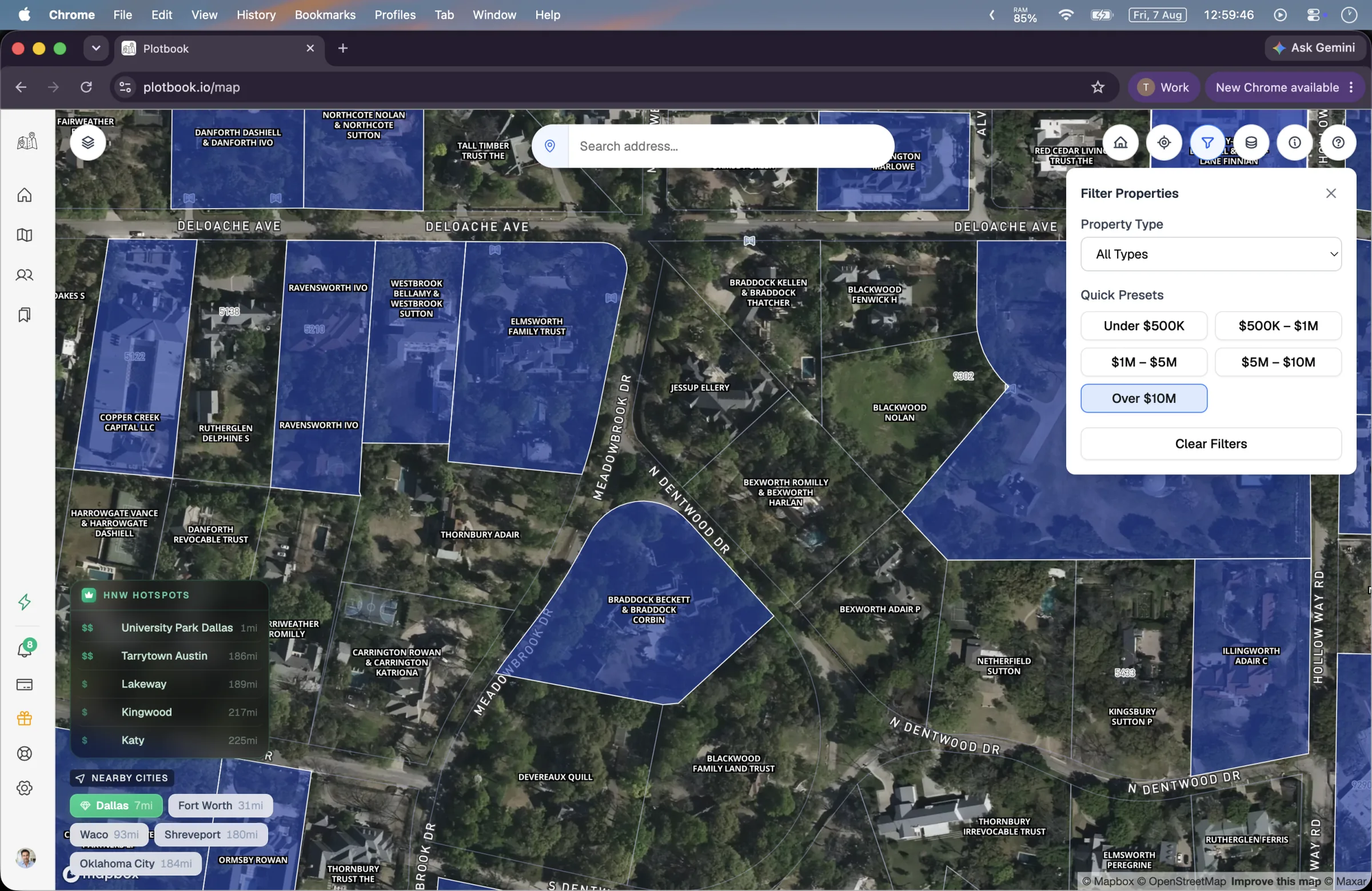
So the property becomes a number inside a rating. You cannot see the parcel. You cannot see its neighbors. You cannot notice that the six houses along one stretch of shoreline are each assessed above five million dollars and that nobody in your book lives on any of them. The single most visible, most durable signal of household wealth in America is reduced to a scoring feature.
Plotbook inverts that. The parcel data is the interface. You open a market, parcels paint in six bands by assessed value, and above zoom 16 the name on the deed is printed on the parcel itself. Reading the map costs nothing on any plan, including the trial: panning, filtering to a value band, and reading owner names off the tiles are free. You are looking at the same class of public record WealthEngine is scoring behind the curtain.
- Six assessed-value bands, from under $500K to over $10M, toggleable as filters
- Deed owner names printed directly on parcels once you are close enough to read them
- 232 hand-curated high-net-worth ZIP codes rendered as a wealth heatmap for orientation at country zoom
- Panning, filtering, and reading owner labels cost no credits on any plan
The deed problem
Screening has nothing to say about a deed held by an LLC
At the top of the market, the name on the deed is frequently not a person. It is an LLC registered in Wyoming or Delaware, a revocable trust, or a family partnership, and quite often that is deliberate. A screening platform has no answer here, because screening starts from a person's name and this record does not contain one.
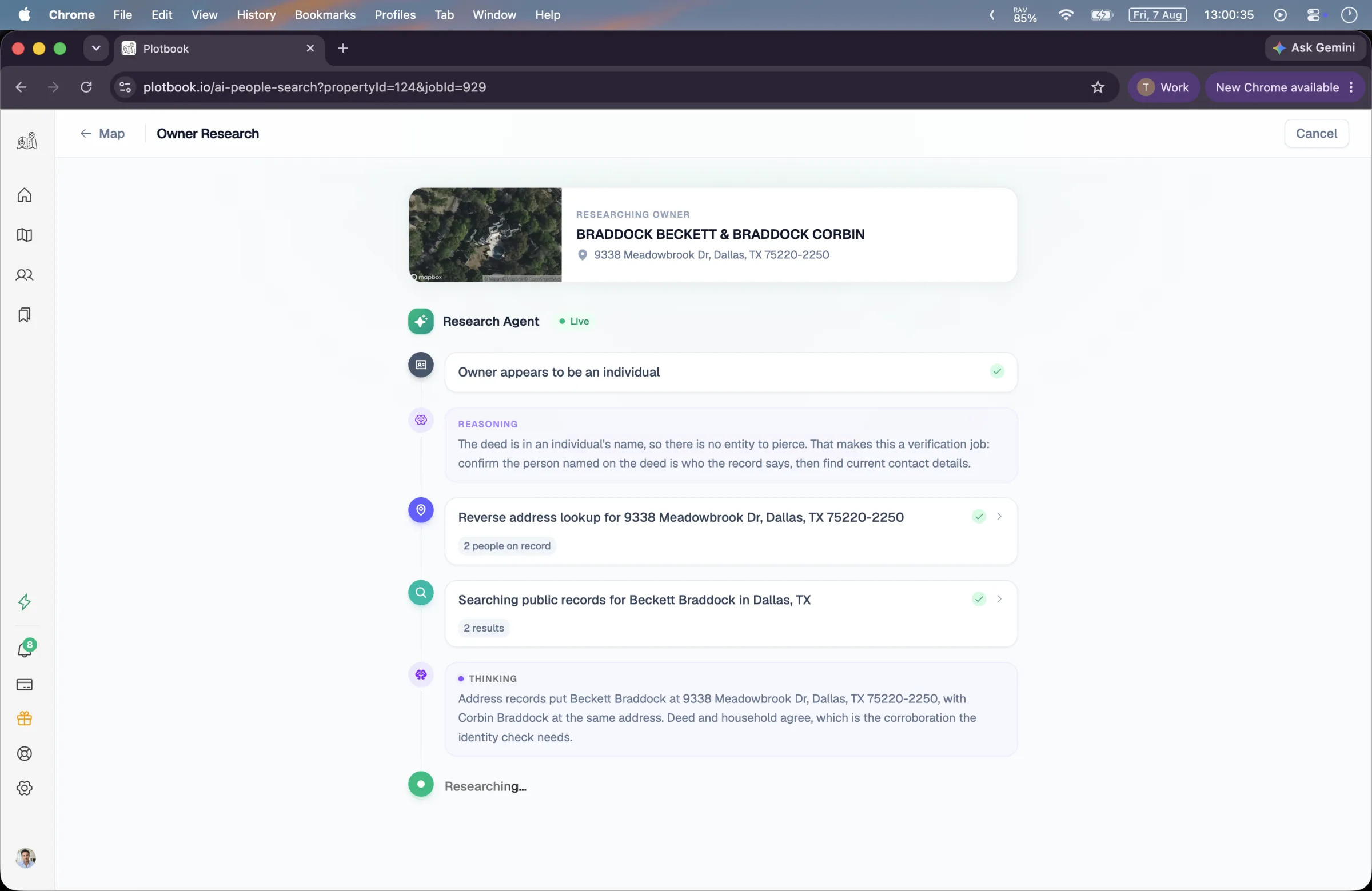
Plotbook treats that as the actual job. A deterministic classifier sorts the owner into person, LLC, corporation, trust, estate, partnership, or institution before any AI runs. Institutions such as banks, government bodies, and HOAs short circuit immediately: no research, no charge. Everything else gets the playbook for its type. LLCs go to business registry aggregators for members, managers, officers, and organizers, with explicit handling for anonymity states so a commercial registered agent is never mistaken for the owner. Trusts go to county records for the trustee, then to the open web for the beneficial owner, with trustee and principal roles labeled separately. Absentee properties get a second reverse lookup against the tax mailing address.
Two things keep it honest. A disambiguation gate requires independent corroboration on city, age, address, or employer before anyone is named. And every run reports the tier it actually reached, from a full profile down to entity only, so a thin result reads as thin instead of reading like an answer. The 25 credit charge only lands on success.
The other side
What WealthEngine does better than us
Comparison pages that find nothing good to say about the competitor are not comparisons. Here is where WealthEngine is the right purchase and Plotbook is not, in specifics.
Scale screening, which Plotbook simply does not do
Upload 40,000 records and get every one rated. Plotbook researches one prospect at a time, at 25 credits a run. There is no batch mode and no file upload. If your job is rating a database, this is not a close call.
CoreLogic property accuracy
Their property layer is the industry reference standard at reported 99.99% US coverage. Regrid parcel data is excellent for boundaries, ownership, and assessed value nationwide, but on pure property attribute accuracy CoreLogic is the benchmark.
Native CRM delivery
Salesforce and Blackbaud integrations plus an API mean scores land where your team already works. Plotbook has CSV export, on Professional and Enterprise only. That is a real workflow difference, not a rounding error.
Propensity and capacity modeling
Ratings trained across a very large population for likelihood to give and capacity to give. Plotbook has no equivalent and does not claim one. Our wealth ranges describe a person, they do not predict a behaviour.
Population-wide refresh
Their scores are maintained across the database continuously. Plotbook's data is only as current as the last research run you paid for, plus whatever the county last published.
Institutional standing
Altrata is an established vendor with the compliance, security review, and procurement paperwork a large institution needs. Plotbook is a small company, and for some buyers that alone settles it.
The honest summary: if you have a database and need it rated, buy WealthEngine and do not let a map distract you. If you have a territory and no names, a screening seat is the wrong tool at roughly fifty times the price of the right one.
Running both
They are not really substitutes
Development shops at larger nonprofits often end up with both, and the split is clean rather than redundant. WealthEngine rates the existing file, which is the half Plotbook cannot do. Plotbook works the geography the file does not cover yet, which is the half screening cannot do.
The practical seam is CSV. Plotbook exports a researched prospect with the parcel it came from, the four wealth ranges, the confidence score, and the research summary explaining how the identification was made. That imports into whatever your team already runs. There is no direct integration and we do not claim one.
One caveat worth stating before anyone builds a process on it: CSV export is a Professional and Enterprise feature. On the $79 Starter plan you can research and keep profiles, but you cannot export them.
- Screen the existing file in WealthEngine, prospect the untouched geography in Plotbook
- Export researched Plotbook prospects to CSV with parcel, wealth ranges, confidence score, and research summary attached
- Use Plotbook to identify the human behind an entity-held deed that screening returned nothing for
- CSV export requires Professional ($199/month) or Enterprise ($499/month)
What it costs
A month of real territory work
Plotbook bills a subscription plus credits, and credits are spent only when a paid source is called for you. Here is what actually working a target market looks like, priced honestly.
- Browsing the map and filtering by value band
- included
- Opening a parcel Plotbook has not seen before
- 1 credits
- Instant owner lookup on a residential address
- 15 credits
- Full research run on an entity-held deed
- 25 credits
- Keeping the result as a profile
- 10 credits
- Exporting to CSV
- 5 credits
Panning, zooming, the six value-band filters, and the deed owner names printed on parcels. Free on every plan, including the trial.
First lookup of a given parcel. Cached afterwards, so returning to it is free.
Reverse address lookup against residential records. The fast path when the deed is in a person's name.
The agent path: classification, registry and county records, contact databases, disambiguation. Charged only if it succeeds.
Enrichment and permanent storage in your prospect book, with the research summary attached.
Professional and Enterprise only. Starter cannot export.
Professional is $199 per month for 2,500 credits, which covers roughly 60 full research runs plus the map work around them, or $159 per month billed annually. New subscribers get 7 days and 100 credits, which is enough to run this end to end against a market you already know well enough to catch a wrong answer. The trial takes a card and converts on day 8, and we email you before it does.
Questions
Plotbook and WealthEngine, asked directly
Keep comparing
Plotbook vs iWave
The other screening platform advisors and fundraisers evaluate at the same time.
Plotbook vs Windfall
Precise household net worth figures at screening scale, against research on one person at a time.
Property Wealth Map
The parcel map itself: six value bands, deed owner labels, and what reading it costs.
How the estimates are built
What goes into the four ranges, and what is inference rather than record.
Check it against a market you know
The fastest way to judge this comparison is to open a neighborhood you already understand and see whether the map tells you something a screening file would not. That takes about ten minutes.
New subscribers start with 7 days and 100 credits. We email you before the trial ends.