For luxury real estate agents
You have farmed this street for years. Now read it.
Farming a luxury neighborhood usually means mailing an address and hoping. Plotbook puts the county record on the map instead: what every home is assessed at, whose name is on every deed, which owners get their tax bill somewhere else entirely, and who the person is behind the ones that read as a family trust.
The job today
At the top of the market, the mailbox is not the owner
Farming works, and every agent in a good neighborhood is doing it. Which is the problem: the household you want to represent gets the same four postcards a month from four different agents, all addressed to Current Resident, all interchangeable. The one thing that would make a conversation different is knowing who actually lives there and something true about them, and that is the one thing a mailing list cannot give you.
In the price band where the commissions are, it gets harder. A large share of deeds name a family trust, an LLC, or a partnership. The tax bill often goes to a management company or to a different state. The house you want to list is owned by someone who has never received a single one of your mailers, because the mailers go to a corporate address in another city.
Meanwhile, the county has the answer and always has. Ownership and assessed value are public record. The gap has only ever been the shape they come in: one parcel at a time, on a portal built for tax appeals rather than for reading a street.
How agents work it
From a farm to a listing conversation
One pass over a neighborhood produces something no mailer list contains: a named owner per house, and a reason to talk to a specific handful of them.
- 01
Put your farm on the map
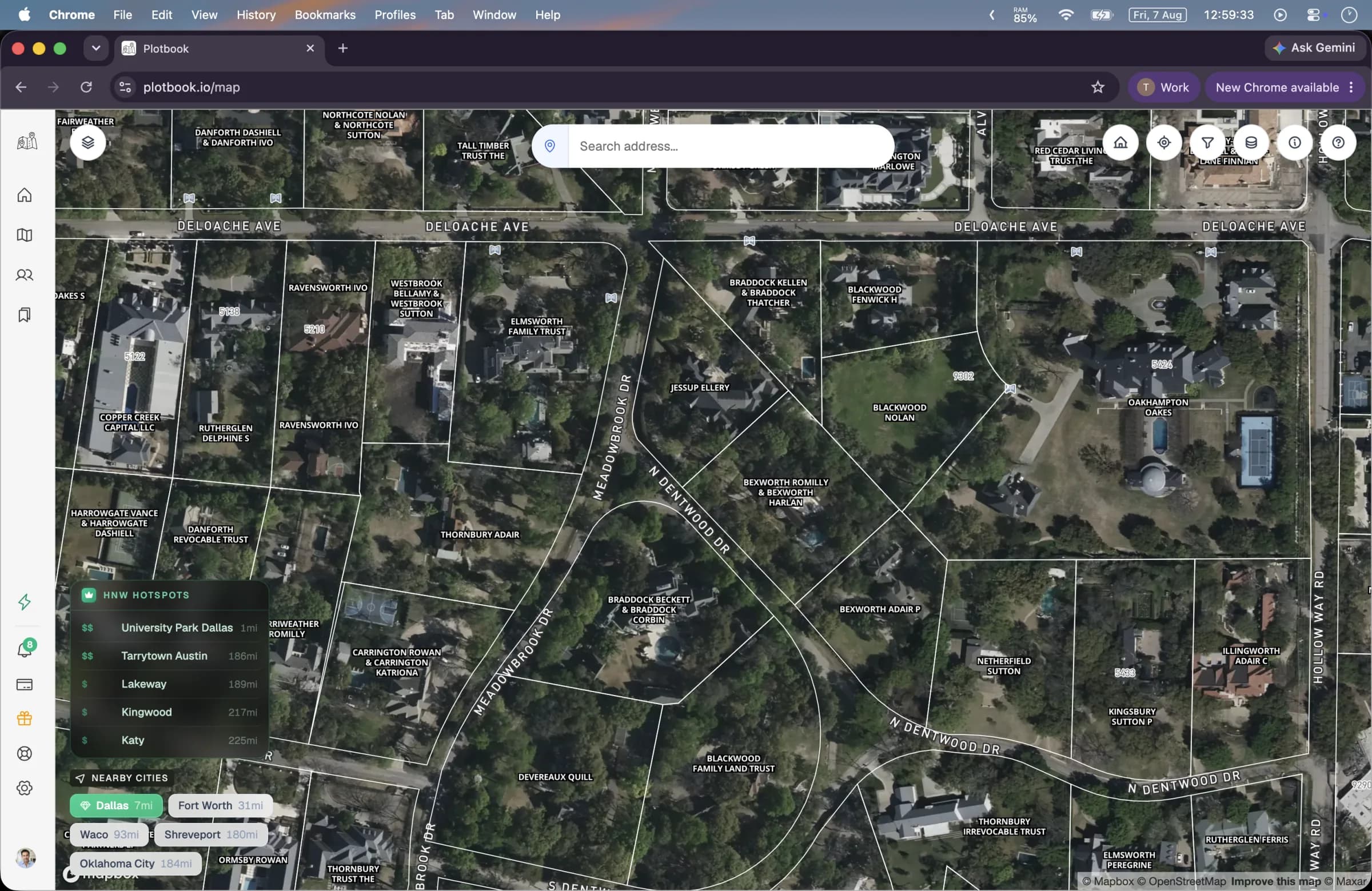
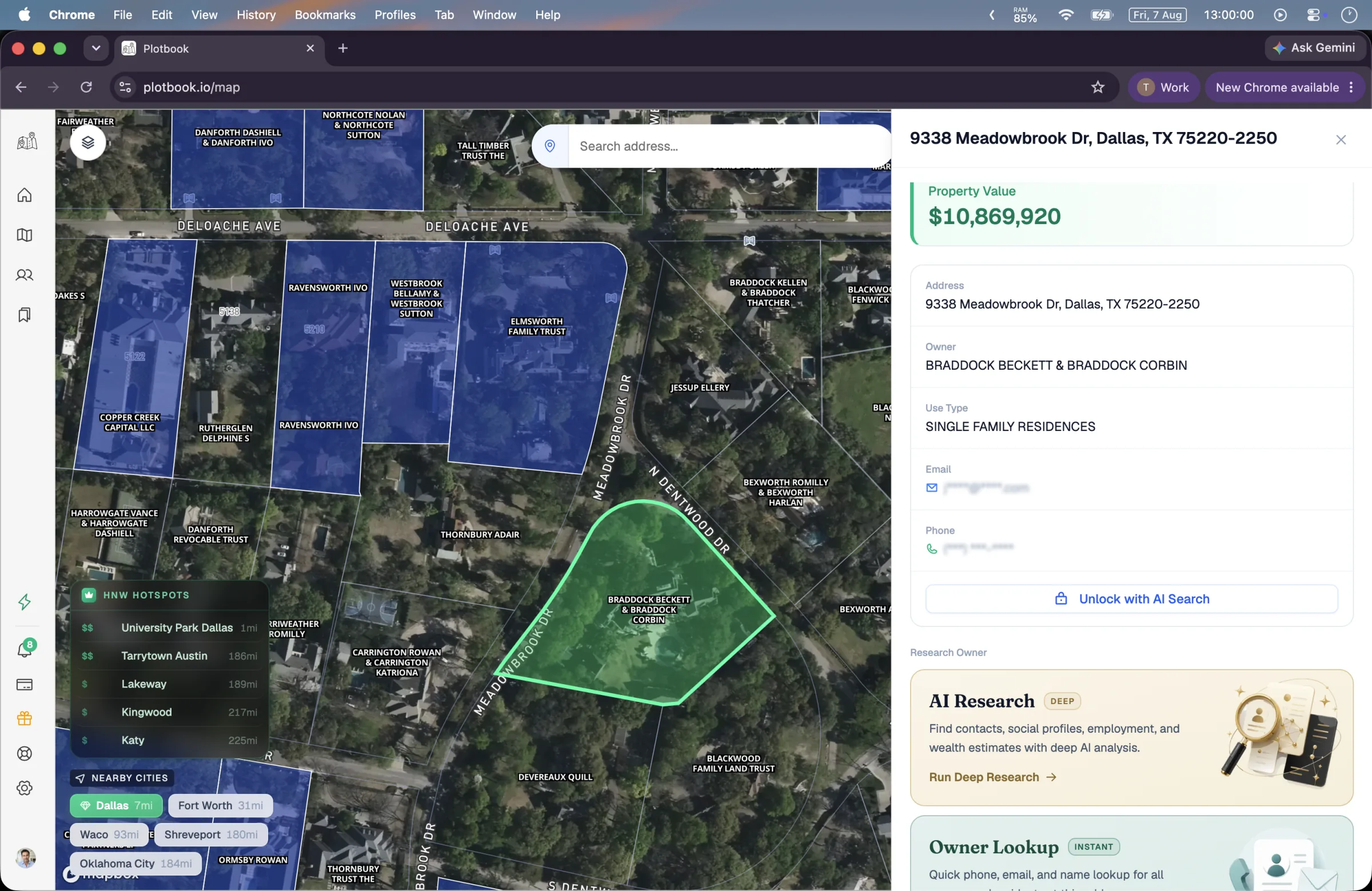
Search the neighborhood, ZIP, or an address at its center. Parcels draw in from zoom 14, colored across six assessed-value bands, so you can see immediately where the value on a street actually sits rather than where you assume it does.
- 02
Read the deed on every house
From zoom 16 the owner name from the county record prints on each parcel. One pass down a street tells you which homes are held by individuals, which are held by trusts or LLCs, and where the concentrations of each are, which is information no mailer list has ever given you.
- 03
Spot the ones who live somewhere else
Research runs compare the tax-bill mailing address against the property itself. When they differ, that owner does not live there, which for a luxury market usually means a second home, an inherited property, or an investment holding. Those are different conversations, and they are frequently the ones with a transaction in them.
- 04
Get to the person
When a deed names a person, one lookup returns the owners and residents at that address, with ages, phone numbers, and emails. When it names a trust or an LLC, the research agent works registry filings, county records, and the mailing address until it reaches a named human, showing every source it used.
- 05
Keep the farm as a working record
Saved properties render as markers on the map, so the parts of a neighborhood you have already worked stay visible. Each profile carries contacts, the linked parcel, and your notes, and the whole list exports as a CSV for your CRM.
Both sides of the deal
Sellers from the map, buyers from a description
Listing side, you start from the property: a house on the map, a deed, an owner, a contact. That is the loop above. Buyer side, the direction inverts. You have a $12M listing and you need people who can plausibly clear it, so you describe them in plain English instead: managing directors at firms in the metro, founders whose company recently sold, owners of hospitality groups in the county.
The search parses that sentence into structured filters for free, then runs professional and residential databases in parallel and merges the results into one ranked list, deduplicating the same person across sources and raising confidence where independent sources agree. Contact details are merged in code rather than written by the model, so nothing on the card is invented.
- Listing side: parcel, deed, owner, household contacts
- Buyer side: plain-English search across professional and residential data
- Query parsing is free every time; only the search itself is billed
- Every result shows which sources it came from and why it matched
The farm as a record
A neighborhood you have actually read
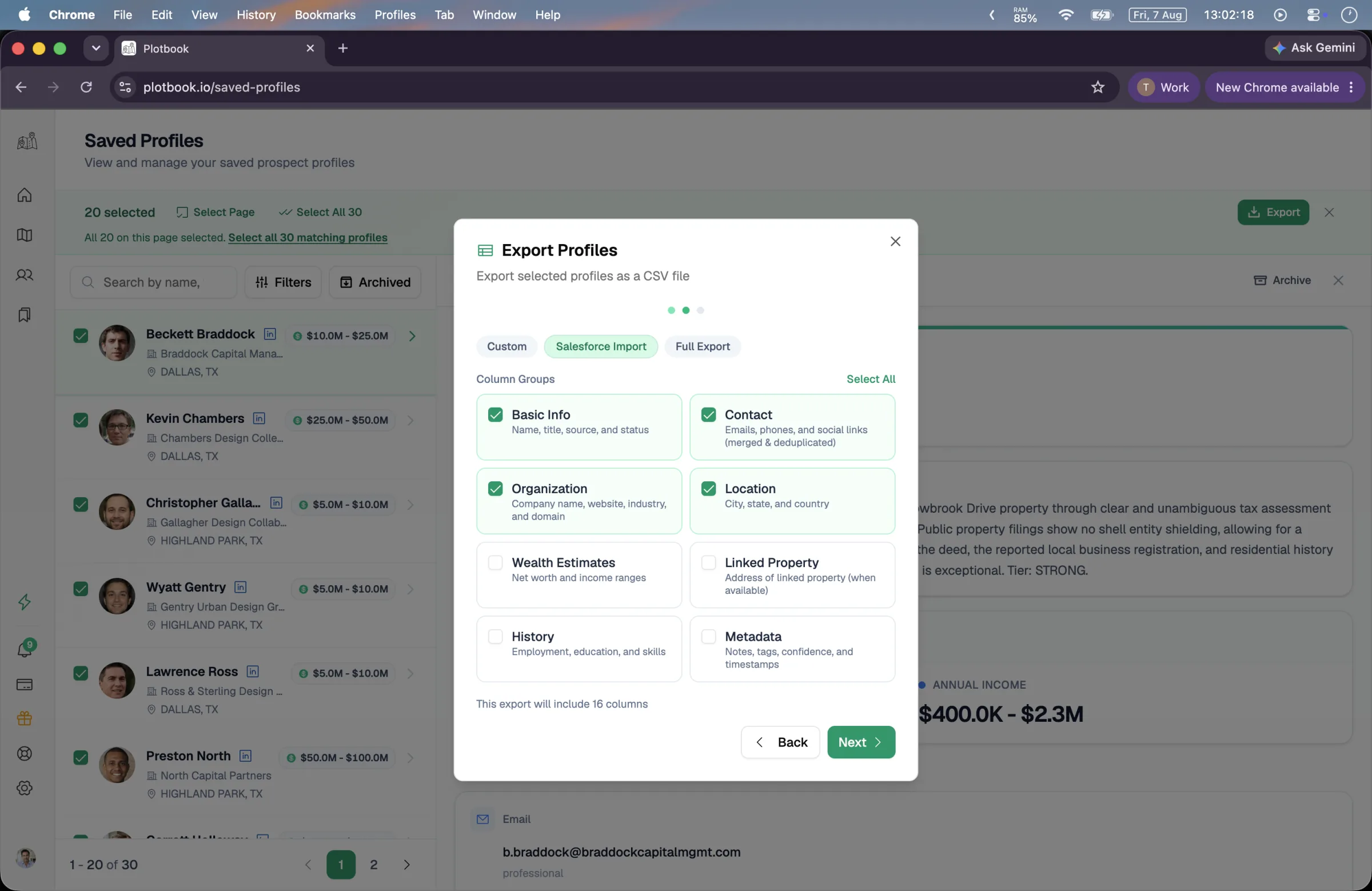
The work compounds. Every owner you identify saves with their contact details, the parcel they own, a research summary explaining how the identification was made, a confidence score, and a wealth estimate in four ranges. Add your own notes: the renovation they mentioned, the timing they hinted at, the reason you rated them warm.
Because saved properties show as markers on the map, the farm stops being an abstraction and becomes a record of coverage. And when your brokerage wants it in the CRM, the export produces a 26-column CSV across 8 selectable groups, with the linked property address included.
- Saved properties visible as markers over the farm
- Your notes on the record, not in a separate spreadsheet
- Search across name, title, company, city, and email
- 26-column CSV export with a 48-hour download link
What you get
The county record, made readable
Everything an agent needs to work a luxury farm from public record rather than from a mailing list.
Every parcel, priced and named
Regrid parcel data across 150M+ US parcels with assessed value, use type, boundaries, and the deed owner name printed on the parcel from zoom 16.
Household lookup
For person-owned deeds, one click returns owners and residents at the address with ages, phones, and emails, deduplicated and role badged.
Second-home detection
The tax-bill mailing address is compared against the property on every research run, and gets its own lookup when the owner receives mail elsewhere.
Trust and LLC research
An agent works entity-held deeds through registry filings, county records, and mailing addresses to a named person, with every source shown.
Buyer-side search
Describe the buyer profile for a listing in plain English and search professional and residential databases in one pass, merged and ranked.
A farm record that persists
Saved owners appear as map markers, keep your notes and their linked parcel, and export as a CSV your brokerage's CRM will accept.
What a farm costs
Less than one mailer drop
Reading the map, the assessed values, and the deed owner names is included in the subscription. Credits are only spent when a paid data source runs, and failures refund automatically.
- Reading a whole street: values and deed owners
- included
- Household lookup on a person-owned deed
- 15 credits
- Research on a trust or LLC deed
- 25 credits
- Buyer-side people search
- 2 to 14 credits
Included with map browsing on an active subscription.
Owners and residents at the address, with phones and emails.
Charged only on success. A dead end costs nothing.
2 for a single database, 4 for the multi-source pass, 10 more when residential records run.
Starter is $79 a month with 750 credits and one licensed state, which covers a single agent working one metro. Professional at $199 adds a second state, 2,500 credits, and CSV export. New subscribers get a 7-day free trial with 100 credits, which is enough to read a farm and run a few lookups before deciding.
Where Plotbook stops
It is not an MLS tool
Everything below is genuinely absent. Knowing that up front is more useful than discovering it in your second week.
No MLS, listings, or comps
No listing status, no days on market, no sold comps, no CMA, and no photos or property detail beyond assessed value and use type. Your MLS remains your MLS.
No likelihood-to-sell scoring
There is no predictive seller model and no life-event triggers. Absentee ownership from the mailing address is a real signal Plotbook surfaces; a propensity score is not something it pretends to have.
No mortgage or equity data
No loan balances, no estimated equity, no lien or foreclosure records. The value layer is the assessed value from the county record.
No dialer, mailer, or DNC scrubbing
Plotbook produces contacts and a CSV. Circle prospecting, calling, texting, and mailing happen in your tools, and the do-not-call and solicitation rules that govern them remain yours to follow.
Plotbook answers who owns it and how to reach them. Your MLS, your CRM, and your outreach tools own everything on either side of that.
See it run
Watch a street become a contact list
The full walkthrough: reading a neighborhood on the map, identifying an owner behind a trust deed, and exporting the result.
Full walkthrough, 3 min. All people, contacts and wealth estimates shown are fictional demo data; property records are real public data.
Questions
What luxury real estate agents ask first
Read your farm the way the county does
Open the neighborhood you know best and see how many of those deeds you could not have named this morning.
New subscribers start with 7 days and 100 credits. We email you before the trial ends.