For family offices
At this level, the deed is never a person
Pull the record on a nine-figure estate and the owner line reads like a filing cabinet: a numbered LLC, a family trust dated a decade ago, a partnership named after the street. That is where every conventional lookup stops, and where the households a family office actually wants quietly disappear from everyone else's list. Plotbook is built for exactly that record.
The job today
The wealthier the household, the thinner the public trail
Entity ownership is not an obstacle a data vendor forgot about. It is the whole point of the structure, and it works: the higher the value of a property, the more likely its deed names something that cannot take a phone call. Consumer databases have nothing to say about a Delaware LLC, and screening products that start from a name have nothing to start from.
So the work falls to a person. Someone opens the state registry, reads the filing, notices the registered agent is a firm with ten thousand clients, checks where the tax bill is mailed, cross-references the county appraisal roll in that second county, searches the news for the family name, and finally arrives at a person. It takes an afternoon per property and it does not scale past a handful.
That sequence is not mysterious. It is a repeatable procedure with known dead ends, which makes it exactly the kind of work worth automating carefully and showing the workings of.
How a run unfolds
Verified facts first, then the agent takes over
A research run is a pipeline, not a single model call. Deterministic lookups establish ground truth before the AI reasons at all, so the agent starts from evidence rather than from a guess.
- 01
It reads the county record
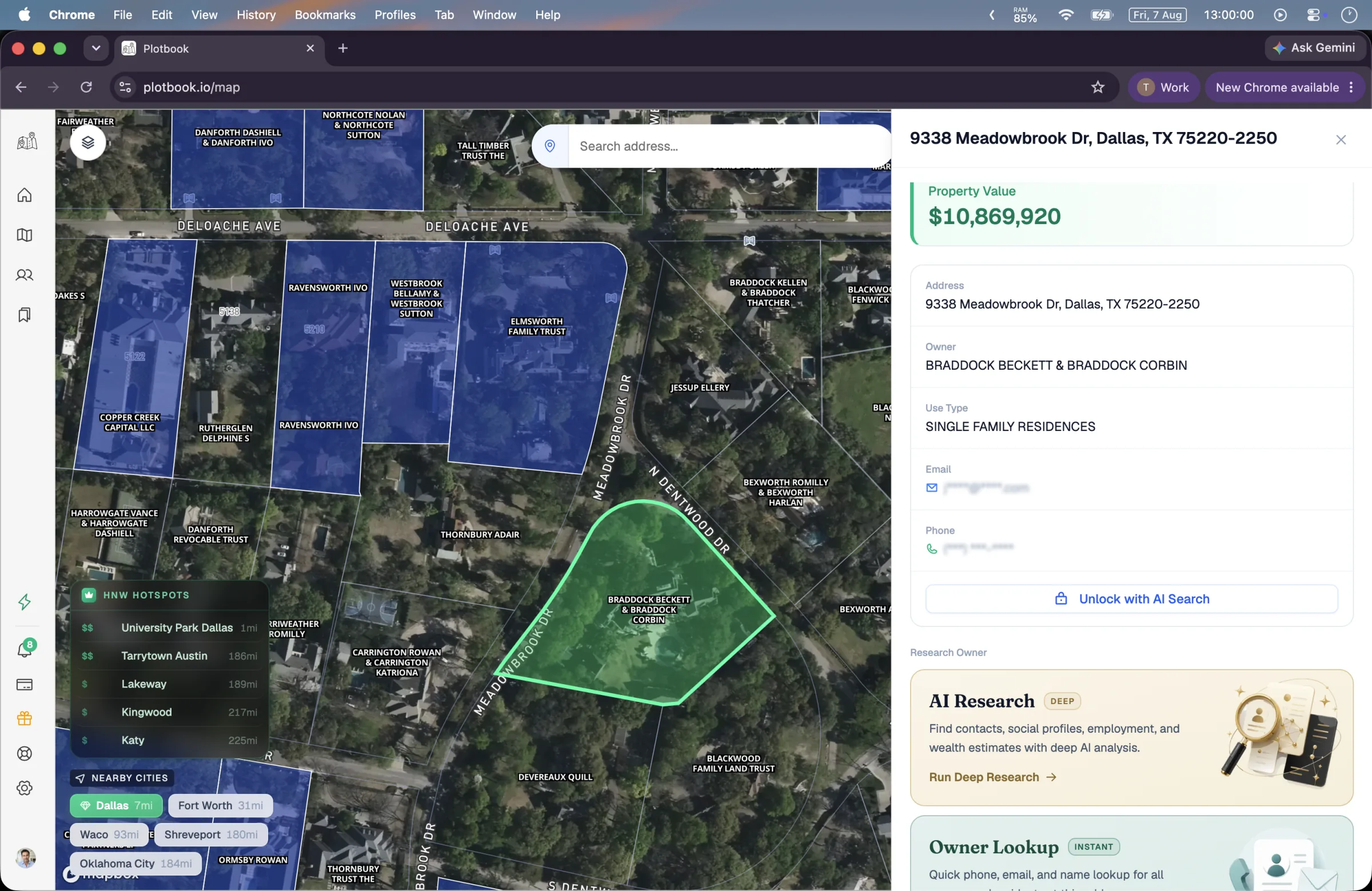
The run starts from the deed: the exact owner name, the situs address, the assessed value, and the address the tax bill is mailed to. That last field is the one a human researcher reaches for first, and the agent treats it the same way.
- 02
It classifies the owner
A deterministic classifier types the deed owner as a person, LLC, corporation, trust, estate, or partnership and selects the playbook before any AI spend. Banks, government entities, and HOAs are recognized and skipped without charge.
- 03
It runs the verified lookups first
Before the agent reasons at all, a reverse lookup runs against the property, and against the mailing address too when the tax bill goes elsewhere. Absentee ownership is detected automatically, and those verified leads seed the research rather than competing with it.
- 04
It works the registries
With eleven specialized tools the agent searches business registry sources for members, managers, officers, and organizers; county appraisal and assessor records for trustees and grantors; professional databases; LinkedIn; public records; and federal campaign-finance filings, which are unusually good at confirming an identity and an employer.
- 05
It corroborates before it commits
A disambiguation gate requires the agent to confirm an identity across independent sources before naming anyone. The run ends with a named principal, contact details, employment history, a written research summary explaining the trail, a confidence score, and a four-band wealth estimate.
A different playbook per structure
It knows the anonymity states
A generic search across an LLC name produces noise. The agent instead branches on what the entity is. For an LLC or corporation it hunts state filings for members, managers, and organizers, and it is explicitly trained on the anonymity jurisdictions: a Wyoming or Delaware shell listing only a commercial registered agent is never reported as the owner, and the run pivots to the mailing address and county records instead.
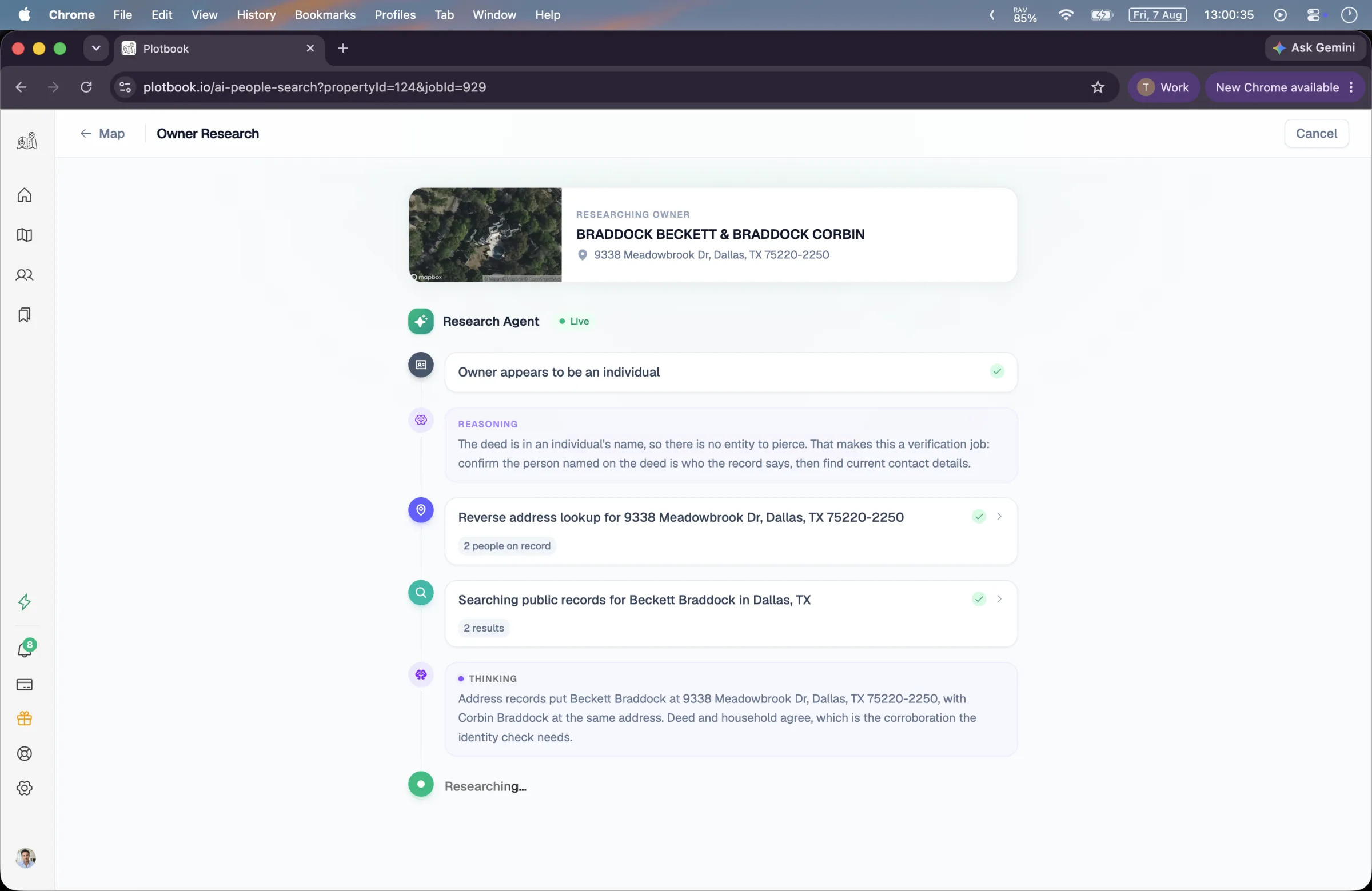
For a trust, county records surface the trustee and an open-web pass looks for the person the trust actually serves, with the final profile labeling which relationship is which. For an estate it looks for the executor and likely heirs. And when the deed already names a person, the job inverts into disambiguation: corroborating city, age, address, and employer before pulling any contact details, so the profile is the right person of that name.
- LLC and corporation: members, managers, organizers, registered agent
- Trust: trustee first, then the principal behind the trustee, each labeled
- Estate: executor and likely heirs, often the most time-sensitive records
- Mailing-address pivot when the tax bill goes to a different property
Show the work
A research trail you can audit
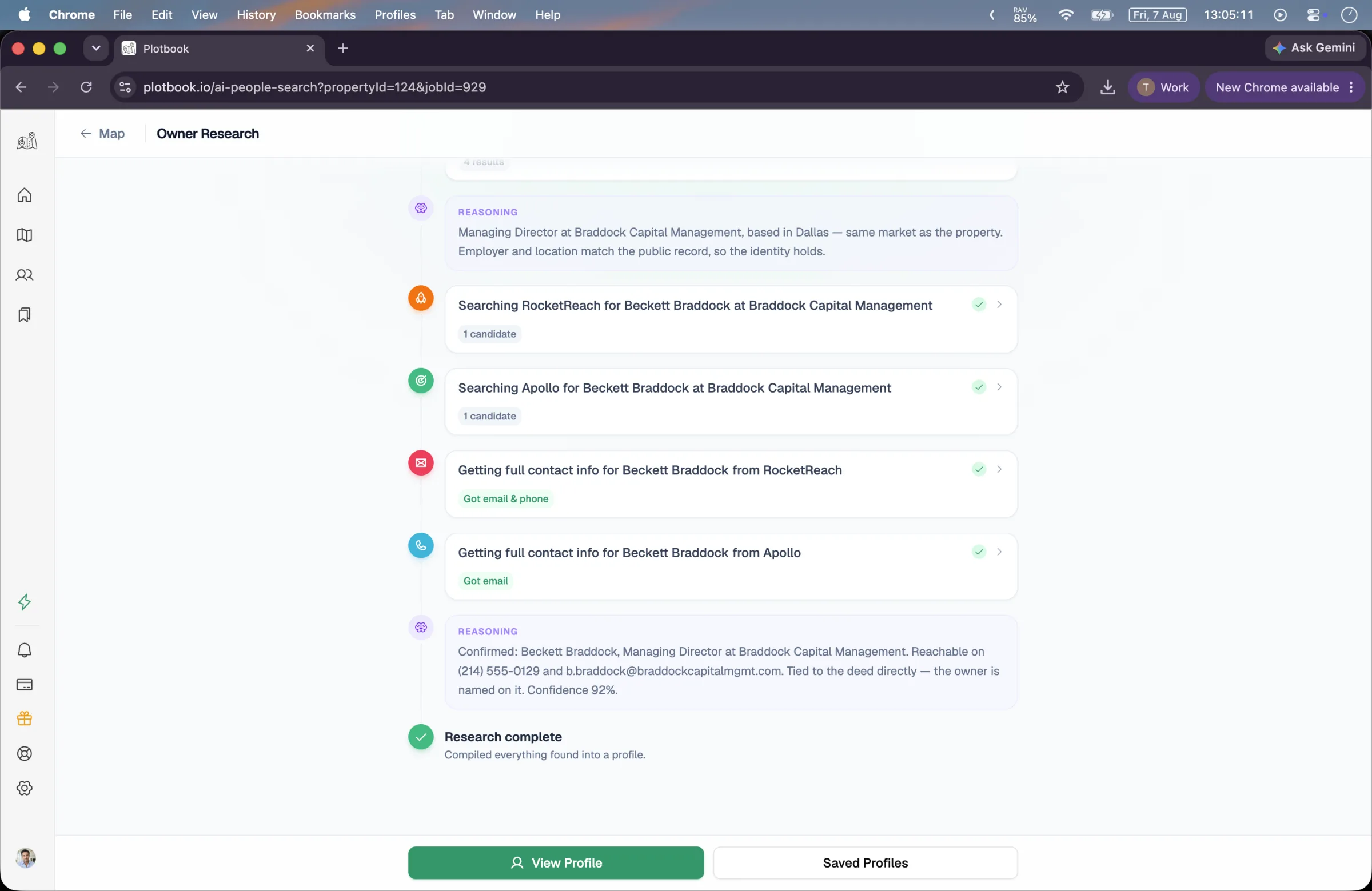
The live timeline interleaves the agent's own reasoning with every tool call it makes. Each search shows what it returned, and each result expands down to the underlying sources and links. Contact retrievals are rendered differently from broad searches, so a run never looks more successful than it was.
That matters more here than in most categories. A name that arrives with no provenance is unusable in a family office context, because nobody will act on it. A name that arrives with the registry filing, the mailing address match, and the corroborating source that confirmed the employer is something a principal can be briefed on.
- The agent's reasoning, streamed between tool calls
- Every source expandable down to the links it actually read
- A confidence score, and an honest entity-only result when the trail ends
- Runs durably on the server: close the tab and get a notification when it lands
What you get
Built for the part of the market that hides well
The map is the entry point, but for a family office the research pipeline is the product. These are the pieces that matter at the top of the market.
Business registry research
Searches registry sources for an entity's members, managers, officers, organizer, and registered agent, and recognizes when the agent is a commercial one.
County records and appraisal rolls
Assessor and appraisal records plus property aggregators, for trustees, grantors, and the mailing-address trail that leads to a second household.
Eleven tools, chosen per case
The agent decides which tools a case needs and in what order. A Texas trust gets a different investigation than a Delaware shell or a plainly named owner.
Nationwide parcel context
Regrid parcel data across 150M+ US parcels, colored by assessed value, so an entity's holding sits in a neighborhood you can actually read.
Corroboration before commitment
A disambiguation gate requires independent sources to agree before a person is named, and every run declares what it actually achieved.
Profiles that keep their provenance
Named principal, contacts, employment history, linked property, research summary, confidence score, and a four-band wealth estimate in ranges.
What research costs
Charged only when it delivers
Entity research is the expensive operation in Plotbook because it is the one that does real work across many sources. It is also the one with the strongest guarantee attached.
- Deep research on an entity-held deed
- 25 credits
- Recognized institutions
- included
- Re-opening a property you already researched
- included
- Instant lookup when a deed names a person
- 15 credits
Charged only on a valid profile. Failures, cancellations, and dead ends cost nothing.
Banks, government entities, and HOAs are detected and skipped before any spend.
Returns the saved profile instantly.
Owners and residents at the address, for the cases that need no agent at all.
Enterprise is $499 a month with 8,000 credits and five team seats, which is roughly 320 entity research runs, plus five licensed states and API access. Professional at $199 covers 2,500 credits and two states. Every failed billed operation is refunded automatically, and new subscribers get a 7-day free trial with 100 credits.
Where Plotbook stops
What entity research cannot promise
Piercing an entity is genuinely hard, and any tool that claims a universal hit rate on it is not describing the same problem.
Some trails genuinely end
When a structure is well built and the public record holds nothing, the run reports an entity-only result rather than naming a plausible person. Every run declares what it actually achieved, including an honest none.
It is not a beneficial ownership registry
Plotbook reads public filings and records. It has no privileged access to any confidential beneficial ownership database, and nothing here should be treated as a legal determination of control or ownership.
It does not map an entity's full portfolio
A profile can carry properties associated with the identified person, but there is no cross-state entity graph that enumerates everything a structure holds. That remains manual work.
There is no financial disclosure data
No 13F or Form ADV holdings, no cap tables, no private company financials, and no deal flow. Wealth figures are AI-generated estimates shown as ranges with a confidence score.
Think of it as the research analyst who works the public record end of an identification, at machine speed and with the sources attached. Legal, tax, and diligence work all still sit with the people who do them now.
See it run
Watch a full run, end to end
From a parcel on the map to a saved profile with a wealth range: the complete walkthrough, including a research run against an entity deed.
Full walkthrough, 3 min. All people, contacts and wealth estimates shown are fictional demo data; property records are real public data.
Questions
What family offices ask first
Pick the hardest deed you know. Run it.
Point it at a property whose owner you already know and see whether the trail it shows you is the one you would have walked. You are only charged when it delivers.
New subscribers start with 7 days and 100 credits. We email you before the trial ends.