For political fundraisers
A district is geography. Your prospect list should be too.
Finance work has an unusual constraint: the boundary matters as much as the capacity. A donor two miles outside the line is a different conversation than one inside it, and every list product you can buy is organized by name rather than by place. Plotbook starts from the map, shows you what the households inside your lines are worth, and finds the people behind them.
The job today
The first list is always somebody's rolodex
Every campaign starts finance the same way. The candidate writes down everyone they know, the finance chair adds a few names, someone pulls a list of past donors from a previous cycle, and that carries call time for about three weeks. Then the well runs dry and the question becomes: who else in this district can write a serious check?
The tools built for that question mostly answer a different one. Donor history files tell you who has given before, which is valuable and also the most heavily worked list in politics, because everyone else has it too. Nothing tells you about the household that has never given to anyone: the business owner in the new development, the retired partner three streets over, the family whose money never showed up in a filing because they were never asked.
Property records reach those households, because owning an expensive home is public, geographic, and independent of whether anyone has ever solicited them before. The obstacles have always been practical: county-by-county portals, no way to read a district as a whole, and deeds that increasingly name a trust instead of a person.
How finance teams work it
From a boundary to call time
The point is a list the candidate can actually work: real people, inside the lines, with a reason to believe each one can give.
- 01
Put the district on the screen
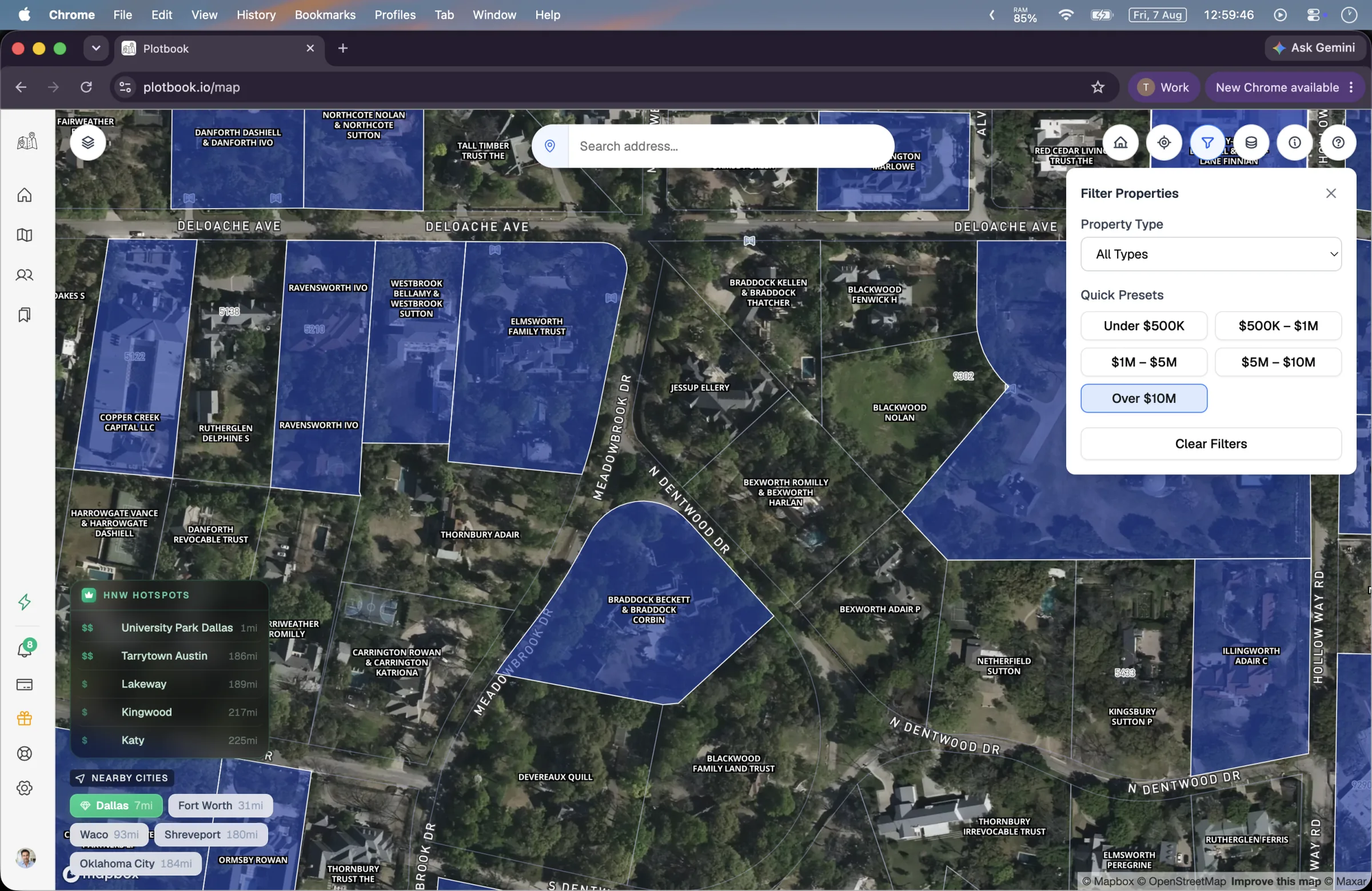
Search the city, ZIP, or an address at the center of the area you are working and the map lands there. Parcels appear from zoom 14, colored across six assessed-value bands, so the concentrations of capacity inside a boundary are visible before you have a single name.
- 02
Screen by what the homes are worth
Five value presets match the legend bands. Setting the floor at the level where a max-out contribution is plausible turns a neighborhood of thousands into a working list of dozens, and the filter persists between sessions so a half-finished pass is still there tomorrow.
- 03
Name the household
From zoom 16 the deed owner is printed on each parcel. When the deed names a person, one lookup returns the owners and residents at that address together with ages, phone numbers, and email addresses, which is what call time actually runs on.
- 04
Get employer and occupation
Research profiles carry title, employer, and employment history. Federal campaign-finance filings are one of the agent's own corroboration sources, which is useful here for a specific reason: those filings are where employer and occupation live, and they are the two fields a contribution record has to carry.
- 05
Build the list, then hand it to the system of record
Each prospect saves with contacts, capacity estimate, the property it came from, and your notes. Export the list as a CSV and load it into whatever your compliance and call time software expects.
Search from the other end
Describe the donor you want, in a sentence
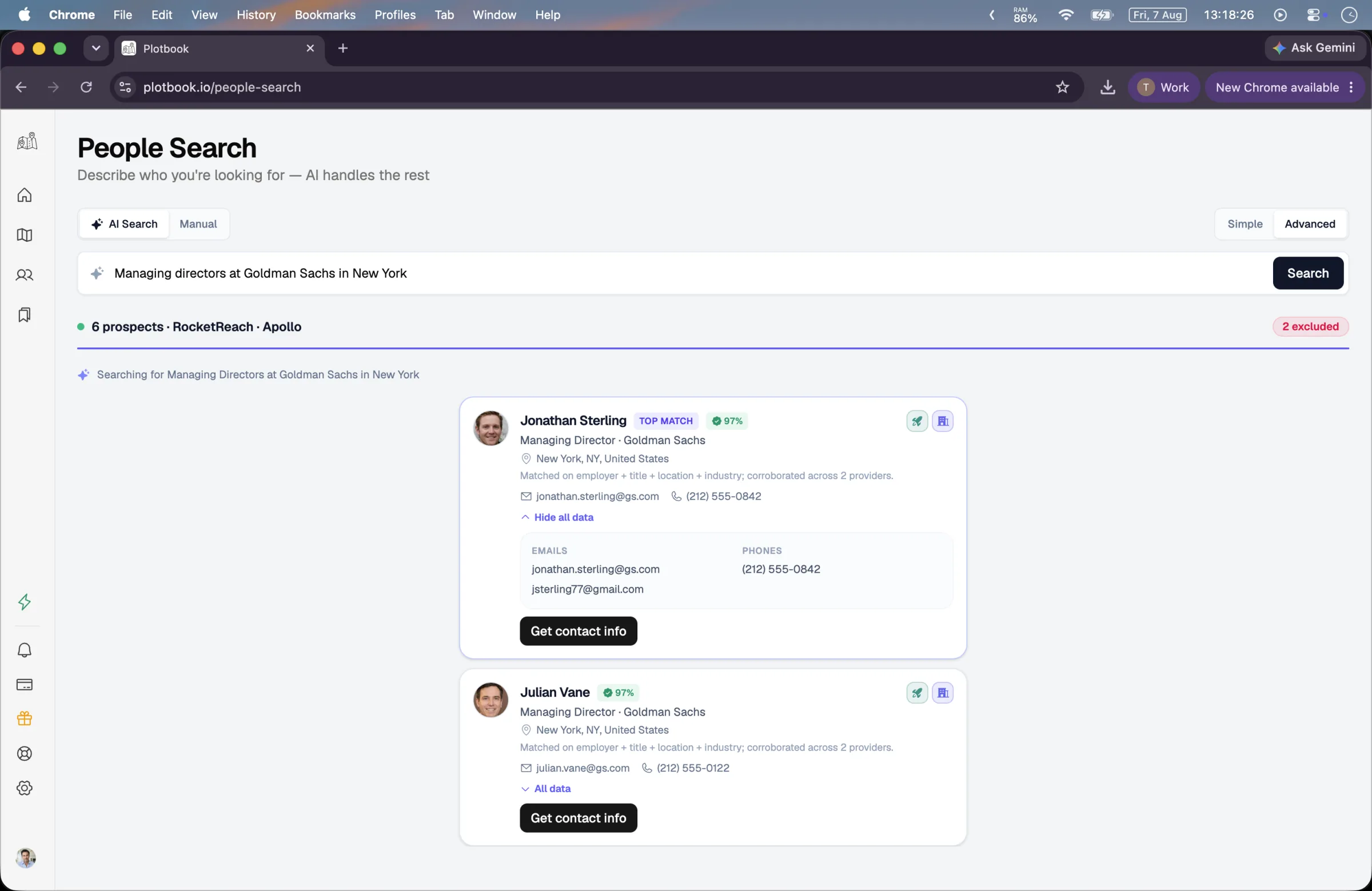
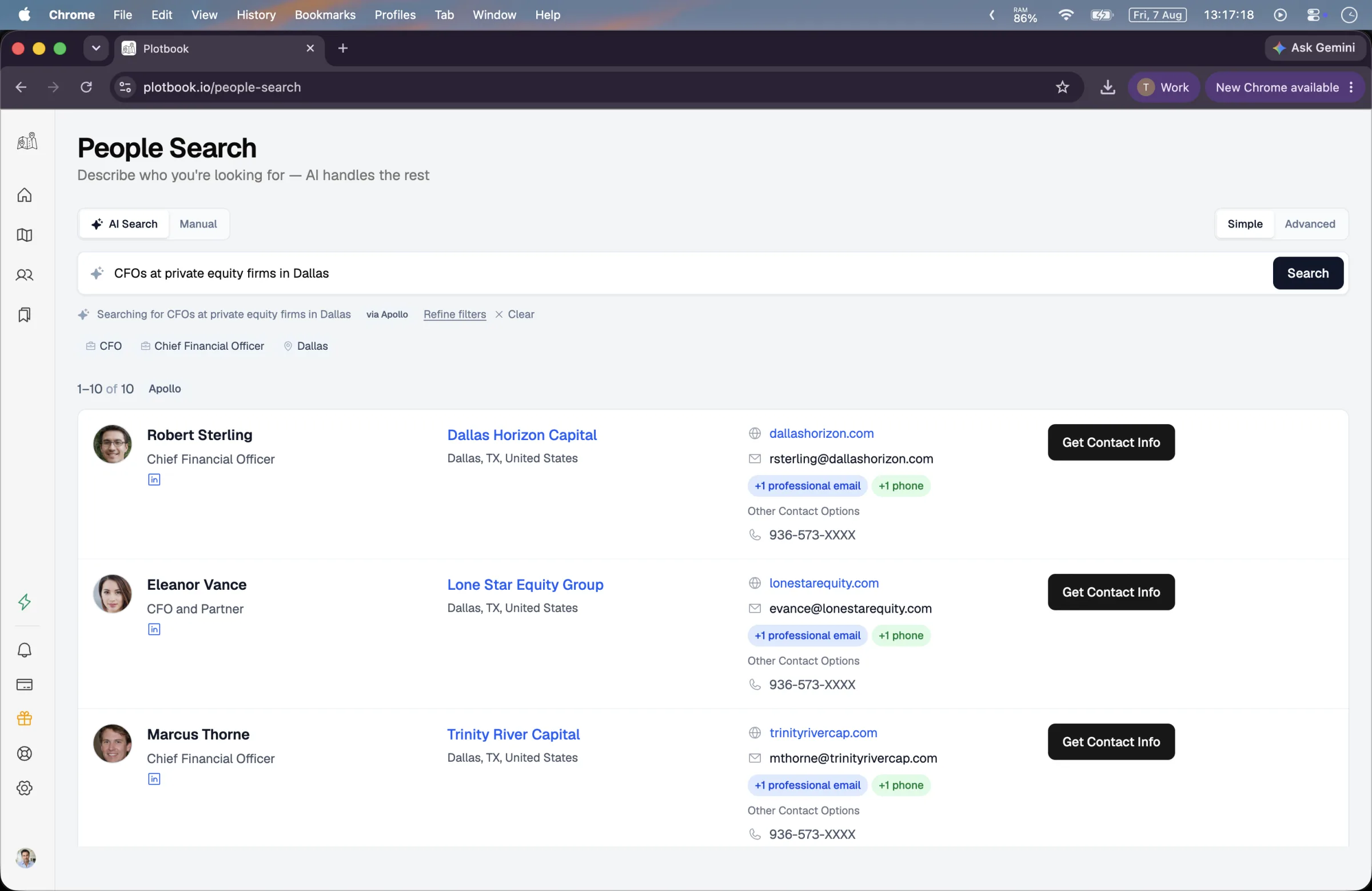
Sometimes you do not start from a house. You start from a profile: managing directors at a firm in the metro, founders whose company just sold, hospitality owners in a particular county. Write that sentence in plain English and the AI turns it into structured filters, picks the databases that can answer it, and runs them.
The multi-source pass runs professional and residential databases in parallel, then merges what comes back into one ranked list, deduplicating the same person across sources and scoring confidence higher when independent sources corroborate each other. The merge is done in code rather than by the model, so contact details cannot be invented. Reading your query is free every time; you are only billed for the search itself.
- Plain-English queries parsed into structured filters, free every time
- Professional and residential databases queried in parallel
- Same-person results merged deterministically, never written by a model
- Confidence rises with corroboration, and every result shows its sources
What lands on the call sheet
Contacts, capacity, and context
A finished profile carries the name, title, and employer; professional and personal emails; phone numbers; LinkedIn and employment history; the property that anchored the identification; a written research summary; a confidence score; and a four-band estimate of net worth, income, investible assets, and total assets, each as a range.
The estimate is a prioritization tool and nothing more. It tells a finance director which twenty of two hundred names to put at the top of tomorrow's call sheet. It is not a giving history, it is not an ask amount, and it is labeled as an estimate everywhere it appears.
- Employer and occupation captured, which reporting will ask for
- Capacity as four ranges with a confidence score, never a single figure
- Your own notes on each record, surviving a staffing change
- CSV export with 26 columns across 8 selectable groups
What you get
Prospect research that respects the boundary
The parts of Plotbook that matter when your universe is defined by a line on a map and your output is a call sheet.
Geography-first screening
Regrid parcel data across 150M+ US parcels, colored by assessed value, so a district reads as capacity rather than as a list of addresses.
Household-level contacts
For person-owned deeds, one lookup returns owners and residents at an address with ages, phones, and emails, deduplicated and role badged.
Employer and occupation
Profiles carry title, employer, and employment history from professional databases, the fields a contribution record has to report.
Public filings as corroboration
Federal campaign-finance records are one of the research agent's sources, used to confirm an identity and surface employer and occupation.
Capacity as ranges
Net worth, income, investible assets, and total assets, each a range with a confidence score, for ordering a call sheet rather than setting an ask.
Export to your system of record
A 26-column CSV with selectable groups and a 48-hour download link, on Professional and Enterprise.
What a cycle costs
Sized for a campaign budget
Reading the map and the deed owner names is included. Credits are spent only when a paid data source runs, and failed operations refund automatically.
- Household lookup on a person-owned deed
- 15 credits
- People search by description
- 2 to 14 credits
- Deep research on a trust or LLC deed
- 25 credits
- CSV export of a finished list
- 5 credits
Owners and residents at the address, with phones and emails.
2 for a single database, 4 for the multi-source pass, 10 more when residential records run.
Charged only on success.
Professional and Enterprise. Up to 5,000 records per file.
Professional is $199 a month with 2,500 credits, roughly 160 household lookups, which is a substantial call sheet for a cycle. Plans license 1 state on Starter, 2 on Professional, and 5 on Enterprise, with more as an add-on. Monthly billing suits campaign timelines. New subscribers get a 7-day free trial with 100 credits.
Where Plotbook stops
Not a compliance system
This is a research tool that ends where the regulated part of your work begins. Being precise about that is not a disclaimer, it is the useful boundary.
No voter file and no party data
There is no voter registration data, no party affiliation, no vote history, no modeled partisanship, and no district boundary overlay. Plotbook shows property, ownership, and capacity. Who is in your universe politically is a question for your voter file vendor.
No contribution history search
You cannot search Plotbook for what someone has given. Federal campaign-finance filings are used by the research agent to corroborate an identity and surface employer and occupation, not exposed as a donor-history database.
No limits, reporting, or processing
There is no contribution limit tracking, no aggregation against a cycle cap, no FEC or state report generation, no bundler management, and no payment processing. Those stay with your compliance software and your counsel.
Capacity is an estimate
Wealth figures are AI-generated ranges with a confidence score. They help you order a call sheet. They are not a giving history, a pledge, or an ask amount, and they should never be recorded as one.
Plotbook sits at the top of the funnel: who is out there and how to reach them. Your compliance platform, your processor, and your counsel own everything from the ask onward, including eligibility of any contribution.
See it run
See the list get built from nothing
The full walkthrough: a neighborhood on the map, an owner identified, a plain-English people search, and the finished list exporting to CSV.
Full walkthrough, 3 min. All people, contacts and wealth estimates shown are fictional demo data; property records are real public data.
Questions
What political fundraisers ask first
Find the donors nobody has called yet
Open your district on the map and look at the households that have never appeared on anyone's list. That is where a new finance pipeline comes from.
New subscribers start with 7 days and 100 credits. We email you before the trial ends.