Plotbook vs iWave
iWave rates your file. Plotbook works the neighborhood
iWave sits in the prospect research tradition: take the constituents a nonprofit already has records for, screen them, rate capacity and affinity, and hand development officers a prioritised list. It is a mature category and it works. What it cannot do is tell you about the household on the good side of town that has never given to you, never attended anything, and appears nowhere in your database. Plotbook comes at the problem from the property instead.
iWave details from public sources, checked August 2026. iWave capabilities here are described only at the level of what they publish about their own product. We hold no dated pricing or usage figures for iWave, so this page quotes none. Check the official iWave product page. Plotbook is the vendor here, so read this as our argument and check it against theirs.
The short answer
Screening your list, or expanding past it
A development shop with a real constituent file should have a prospect research tool, and iWave is one of the established choices in that category. This comparison is only interesting once that box is ticked, because the next question is what to do about the majority of wealthy households in your service area who are not in the file at all. Screening cannot reach them. That gap is the only thing Plotbook is claiming to fill.
Pick Plotbook to expand beyond the database
- Your constituent file is small, or you have already screened it and want new names.
- You fundraise for a place: a hospital, a school, a land trust, a regional arts organisation with a defined catchment.
- You want to see the wealth in your service area geographically rather than as a ranked export.
- You need the person behind a property held by an LLC or a family trust.
- You are a small shop without the budget for a full prospect research platform.
Pick iWave for prospect research proper
- You have a substantial constituent file and need it screened and rated.
- You want capacity, propensity, and affinity ratings on donors and alumni.
- Philanthropic history is central to how you qualify a prospect, which it should be.
- You want results delivered into a donor CRM rather than exported as a file.
- Your team already runs a prospect research function and needs the tooling it expects.
Neutral ground
What each product actually is
Described the way each team would describe itself. We hold less sourced detail on iWave than on other vendors, so this card stays at the level of what they publish.
Plotbook
A map of US property colored by assessed value, with an AI agent that identifies the owner behind a deed and estimates their wealth in ranges.
- Built for
- Advisors, fundraisers, and small teams
- Entry point
- A geography, browsed on a map
- Needs a list
- No. There is nothing to upload and no file to screen.
- Wealth figures
- Four AI-generated ranges with a confidence score, per researched person
- Giving history
- None, beyond federal campaign-finance records used to confirm identity
- Pricing
- $79 to $499 per month, published, self-serve
iWave
A prospect research and donor screening platform for nonprofits, built around researching and rating constituents an organization already has records for.
- Built for
- Nonprofits, higher education, and healthcare development
- Entry point
- A constituent file or a person's name
- Needs a list
- Yes, for the screening workflow
- Wealth figures
- Screening scores and ratings across their data sources
- Giving history
- Central to the product
- Pricing
- Not published by us; ask them
Side by side
Capability by capability, including where we lose
Phrases rather than checkmarks, because a cross against a named vendor is usually a claim we cannot defend. Rows favouring iWave are set in darker type on their side. Where we do not hold a sourced fact about iWave, the cell says so.
| Capability | Plotbook | iWave |
|---|---|---|
| Screening an existing constituent file | PlotbookNot offered. No upload, no batch rating. | iWaveThe core function of the product |
| Finding households not in any file | PlotbookThe core function. Starts from the parcel, not the record. | iWaveOutside the screening model |
| Philanthropic giving history | PlotbookNone. Federal campaign-finance records only, used mainly to confirm identity. | iWaveA primary qualification signal |
| Geographic view of wealth | PlotbookParcel map across six assessed-value bands, plus a hotspot heatmap | iWaveNot a mapping product |
| Identifying the person behind an LLC or trust deed | PlotbookEntity classification, then registry, county record, and open-web research | iWaveNot a published workflow |
| Capacity and affinity ratings | PlotbookNo propensity or affinity scoring of any kind | iWaveCore to prospect research |
| Donor CRM integration | PlotbookCSV export only, on Professional and Enterprise | iWaveIntegrations with donor management systems |
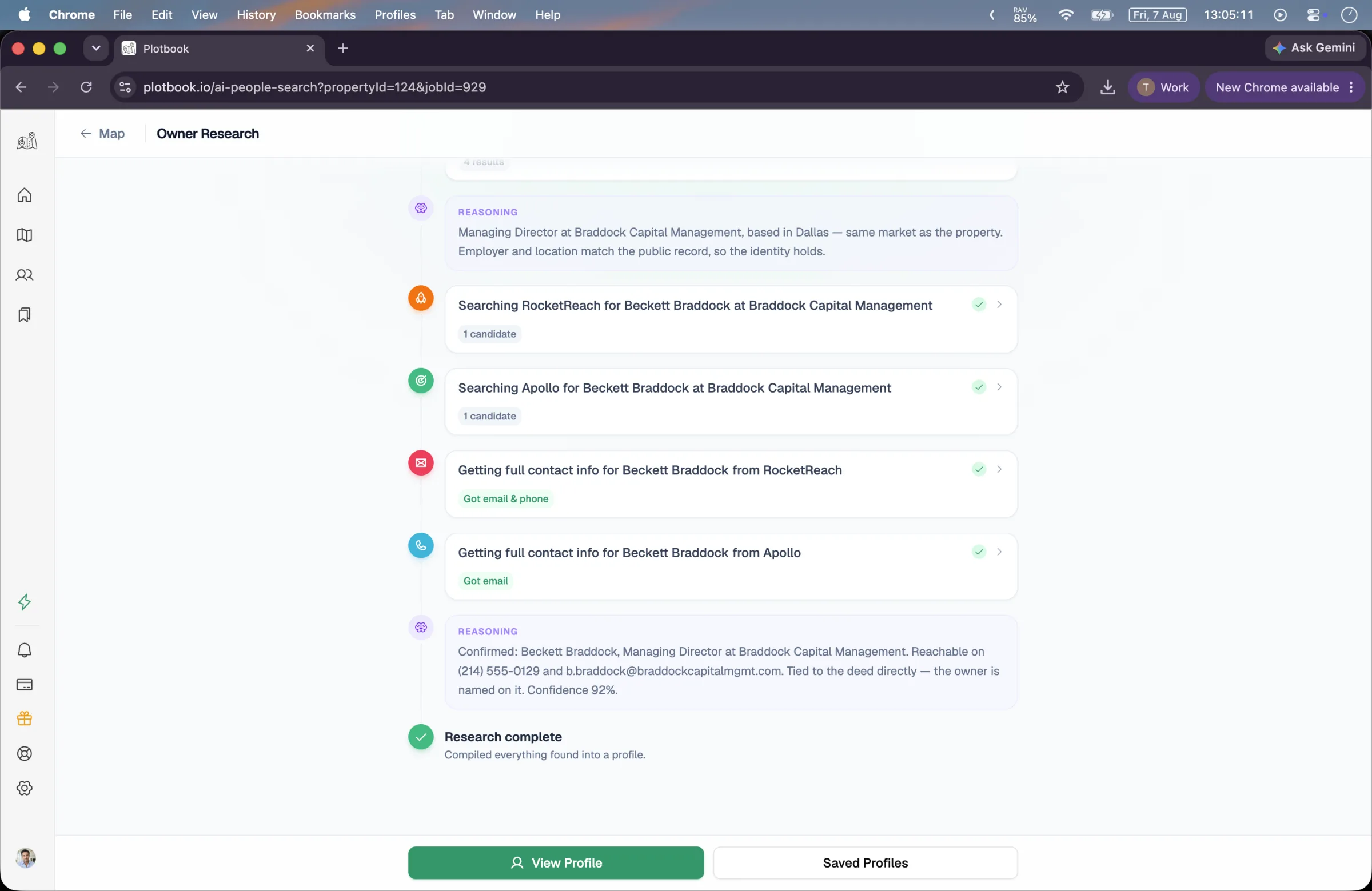
| Showing its work | PlotbookA live timeline of every search and source, kept on the profile | iWaveProfiles cite the sources behind a rating |
| Contact details | PlotbookEmails and phones per person from contact data providers, masked until you spend a credit | iWaveContact information as part of a research profile |
| Published pricing | Plotbook$79, $199, or $499 per month, on the site | iWaveNot published by us; we hold no sourced figure |
We hold no dated pricing or usage research for iWave, so this table describes only what iWave publicly presents as its own product and leaves everything else blank rather than guessing. If you work at iWave and something here is wrong, write to us and we will fix it.
The ceiling on screening
Screening cannot find someone you never met
Prospect research is a genuinely good discipline, and the ratings it produces are more useful than most things sold to fundraisers. But it has a structural ceiling: every answer it can give is about a person already in your file. Screen the file twice and you get the same names back, ranked the same way.
For an organisation tied to a place, that ceiling arrives quickly. A regional hospital foundation, an independent school, a land trust, a community foundation: each serves a defined catchment containing far more wealthy households than have ever interacted with it. Those households are not hiding. Their houses are on the map.
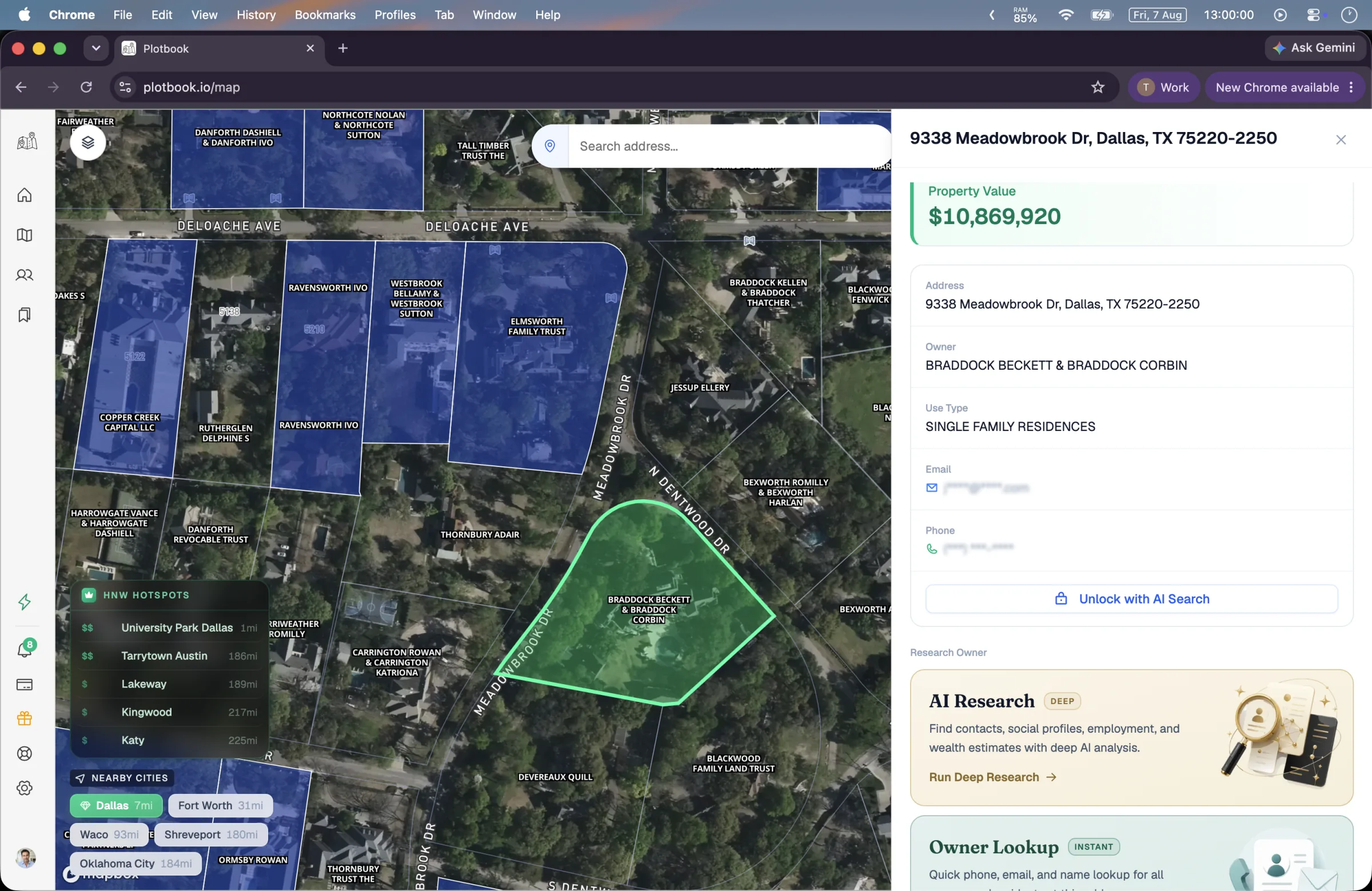
Plotbook gives you the catchment as a picture. Nationwide parcel data from Regrid, covering 150M+ parcels, painted across six assessed-value bands, with deed owner names printed on parcels once you zoom past 16. Filter to parcels over five million dollars inside your service area and you are looking at a prospect pool assembled from the county record rather than from your own history. Reading the map costs no credits on any plan.
- Six assessed-value bands, from under $500K to over $10M, usable as filters
- Deed owner names read straight off the parcel tiles
- 232 hand-curated high-net-worth ZIP codes as a heatmap for orientation
- Panning, filtering, and reading owner labels are free on every plan
What we do not have
No giving history, and that matters
Past giving is the single best predictor of future giving. Every experienced fundraiser knows it, the research supports it, and it is the foundation prospect research is built on. Plotbook does not have it. There is no charitable giving database in the product, no foundation affiliation data, and no gift history of any kind.
What Plotbook has instead is federal campaign-finance records through OpenFEC, and it is worth being precise about how those are used. The research agent queries them mainly to confirm an identity, since a contribution record carries a name, city, employer, and occupation that can corroborate a match. Political giving is a wealth and engagement signal as a side effect, not a philanthropic history, and federal law prohibits using that data for commercial solicitation.
So the honest framing is that Plotbook produces a qualified name and a property-grounded wealth picture, and your existing research process still has to establish affinity. If affinity is the constraint in your shop rather than volume of names, screening is the better spend and we would rather you knew that before signing up.
The other side
What iWave does better than us
For a development office running an established major gifts programme, most of this list matters more than anything on our side of the table.
Screening at file scale
Rate an entire constituent database in one pass. Plotbook researches one prospect at a time at 25 credits a run, with no upload and no batch mode. For a file of any size this is not a comparison, it is a different product.
Philanthropic data
Giving history, foundation affiliations, and the signals that actually predict a gift. Plotbook has none of this and does not claim to.
Capacity and affinity ratings
The ratings a gift officer is trained to work from. Plotbook produces wealth ranges about a person, not a rating of their likelihood to give to you.
Fit with a donor CRM
Prospect research tools are built to sit alongside donor management systems. Plotbook has CSV export, on Professional and Enterprise only, and no direct integrations at all.
A category fundraisers already trust
Prospect research is an established discipline with its own standards and expectations. A parcel map is an unfamiliar object in a development office, and that friction is real.
Coverage of non-property wealth
Plotbook reads the world through real estate. A donor whose wealth is in a private business, a portfolio, or an inheritance, and who rents, is close to invisible to us and perfectly visible to a screening platform.
If you have a constituent file and no screening tool, buy the screening tool first. Plotbook earns its place at the point where the file has been worked and the question becomes where the next hundred names come from.
Running both
Screen the file, then work the map
These two genuinely divide the work rather than duplicate it. Screening tells you who among your existing constituents deserves a gift officer's time. Plotbook tells you who in your service area you have never had a reason to look at.
A practical sequence: define the catchment on the map, filter to the value band that matches your gift table, identify owners on the parcels that come back, and check each name against your database before spending anything further. Names already in your file go back into the screening workflow, where they belong. Names that are not are genuinely new prospects, and those are the ones worth a research run.
Export is CSV, on Professional and Enterprise. It carries the parcel, the four wealth ranges, the confidence score, and the research summary explaining how the identification was made, which is enough for a research officer to review rather than take on faith.
- Screen constituents in your prospect research tool, prospect the catchment in Plotbook
- Check names against your database before paying for research, so you do not pay to rediscover a donor
- Export new prospects with parcel, wealth ranges, confidence score, and research summary attached
- CSV export requires Professional ($199/month) or Enterprise ($499/month)
What it costs
Priced for a small shop
Plotbook bills a subscription plus credits, spent only when a paid source is called for you. Working a catchment costs far less than most people assume, because the map itself is free to read.
- Mapping your catchment and filtering by value band
- included
- Opening a parcel Plotbook has not seen before
- 1 credits
- Instant owner lookup on a residential address
- 15 credits
- Full research run on an entity-held deed
- 25 credits
- Keeping the result as a profile
- 10 credits
- Exporting to CSV
- 5 credits
Panning, zooming, the six value-band filters, and the deed owner names printed on parcels. Free on every plan, including the trial.
First lookup of a given parcel. Cached afterwards, so returning is free.
Reverse address lookup against residential records, for deeds held in a person's name.
Classification, registry and county records, contact databases, disambiguation. Charged only if it succeeds.
Enrichment and permanent storage in your prospect book, with the research trail attached.
Professional and Enterprise only. Starter cannot export.
Starter is $79 per month for 750 credits, Professional $199 for 2,500, Enterprise $499 for 8,000, with roughly 20% off billed annually. New subscribers get 7 days and 100 credits, which is enough to map a catchment and research a handful of owners properly. The trial takes a card and converts on day 8, and we email you before it does.
Questions
Plotbook and iWave, asked directly
Keep comparing
Plotbook vs DonorSearch
The philanthropic data comparison, where giving history is the whole argument.
Plotbook vs WealthEngine
Enterprise wealth screening, and the property data it keeps behind the curtain.
For nonprofits
How development teams use a parcel map alongside their prospect research process.
AI Owner Research
What one research run actually does, and what it costs when it fails.
Look at your catchment as a map
Filter your service area to parcels above the value your gift table starts at, and count how many owners you do not recognise. That number is the argument.
New subscribers start with 7 days and 100 credits. We email you before the trial ends.