Plotbook vs Wealth-X
Wealth-X knows who is already famous
Wealth-X employs a large team of research analysts to hand-build dossiers on the global ultra-high-net-worth: source of wealth, philanthropic history, interests, family, board seats. For a named billionaire it is the best product on earth. But it is a closed library. If the person you are looking at has never been researched by an analyst, Wealth-X has nothing, and most of the wealth in your county has never been researched by anyone. Plotbook starts from the opposite end: it does not know who matters, it knows who owns this.
Wealth-X details from public sources, checked August 2026. Wealth-X is an Altrata product sold on enterprise contracts with no published rate card, so no price is quoted for it here. Check the official Wealth-X product page. Plotbook is the vendor here, so read this as our argument and check it against theirs.
The short answer
This is a question of altitude
Wealth-X is built around individuals with reported fortunes at the very top of the distribution, curated globally. Plotbook is built around US residential property, which means it reaches people whose wealth is real, local, and completely undocumented by any analyst. Most independent advisors serve households well below the threshold Wealth-X is designed for, which makes the choice less about quality than about whether the people you want are inside the library at all.
Pick Plotbook if your prospects are local and unlisted
- The households you serve hold between one and thirty million dollars, which is below the altitude Wealth-X is built for.
- Your prospects are business owners, developers, and long-tenured property holders that no research analyst has ever profiled.
- You work a defined US geography and want to see it, parcel by parcel.
- You need the owner behind an LLC-held deed, which is a property question rather than a biography question.
- You want to start on a card this week rather than negotiate an annual contract.
Pick Wealth-X if you are researching named individuals
- You already have a name and need depth on them: source of wealth, philanthropy, family, affiliations, interests.
- Your work is genuinely global rather than confined to US property.
- You are a private bank, a family office, or a luxury brand where a small number of very large relationships is the whole business.
- You want a dossier assembled by human analysts rather than an automated research run.
- Relationship and affiliation context matters more to you than finding new names.
Neutral ground
What each product actually is
Two products that both get called wealth intelligence and share almost no assumptions. Here is each one on its own terms before we argue for ours.
Plotbook
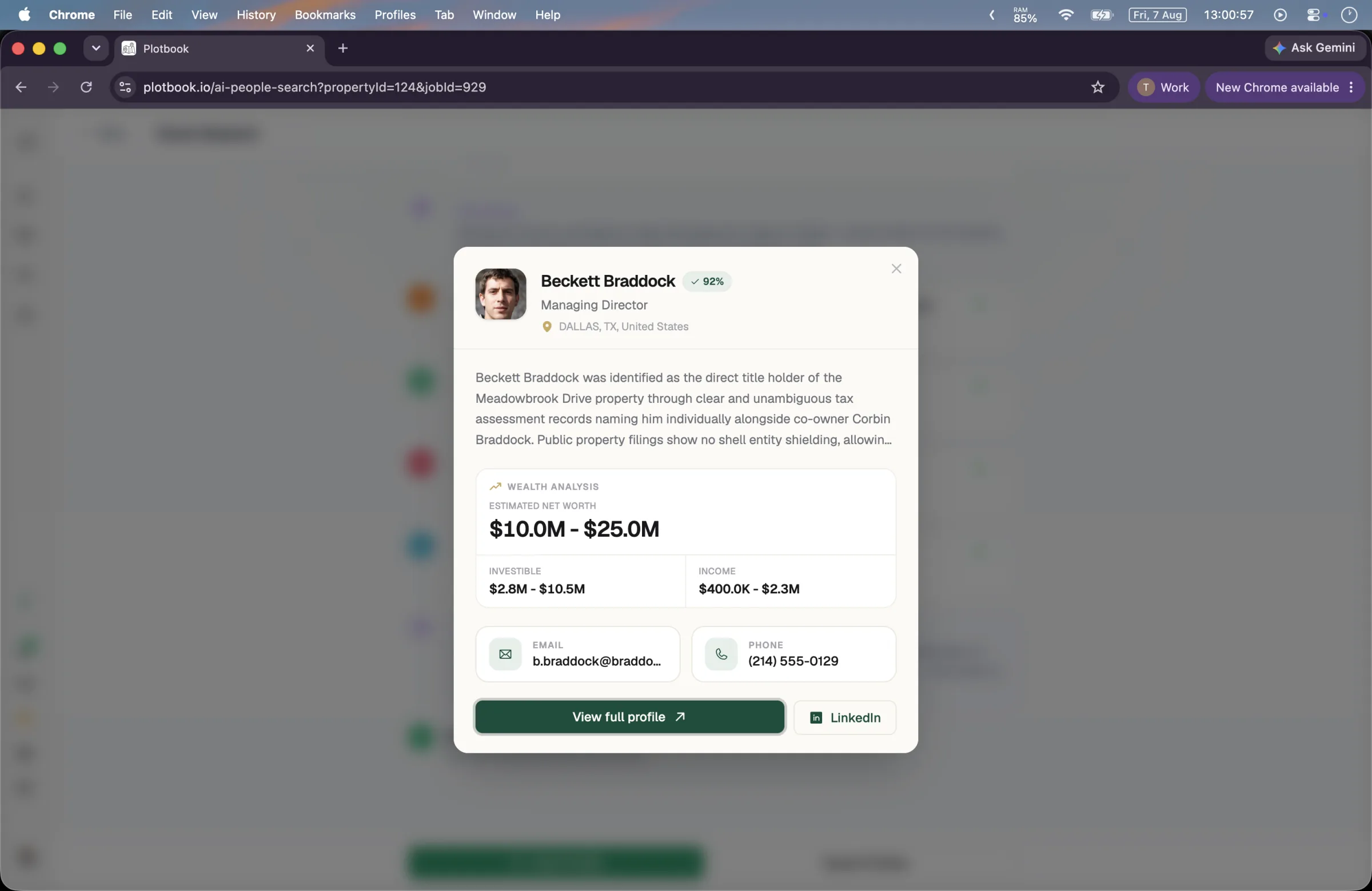
A map of US property colored by assessed value, with an AI agent that identifies the owner behind a deed and estimates their wealth in ranges.
- Coverage
- United States only, at parcel level
- Population
- Anyone who owns US property, whether or not they are documented anywhere
- Research
- Automated: an AI agent working registries, county records, and contact databases per run
- Wealth figures
- Four AI-generated ranges with a confidence score, produced per person
- Entry point
- A place on a map
- Pricing
- $79 to $499 per month, published, self-serve
Wealth-X
An Altrata intelligence library of curated dossiers on ultra-high-net-worth individuals worldwide, assembled and maintained by human research analysts.
- Coverage
- Global
- Population
- Reported at 3.2M+ curated profiles, concentrated at the top of the wealth distribution
- Research
- Human analysts curating and maintaining dossiers
- Wealth figures
- Analyst-assessed net worth with breakdowns and source-of-wealth narrative
- Entry point
- A person's name
- Pricing
- Enterprise contracts and a dossier credit system, unpublished
Side by side
Capability by capability, including where we lose
Every cell is a phrase rather than a checkmark, because a cross against a named vendor is usually a claim we cannot defend. Rows where the honest answer favours Wealth-X are set in darker type on their side.
| Capability | Plotbook | Wealth-X |
|---|---|---|
| Depth on a person who is already documented | PlotbookWhatever one automated research run finds: role, employer, history, contacts | Wealth-XAnalyst-built dossier: source of wealth, philanthropy, family, affiliations, interests |
| Reaching a person nobody has profiled | PlotbookThe core function. Starts from a deed, not from a reputation. | Wealth-XOutside the model. The library holds curated profiles. |
| The $1M to $30M household | PlotbookSquarely the target | Wealth-XBelow the altitude the product is built for |
| Genuine ultra-high-net-worth depth | PlotbookThin. We estimate ranges, we do not narrate a fortune. | Wealth-XThe best in the category, by a distance |
| Coverage outside the United States | PlotbookNone | Wealth-XGlobal |
| Geographic discovery | PlotbookBrowse any US market on a parcel map colored by value | Wealth-XNo map or spatial browsing |
| Identifying the owner behind an LLC or trust deed | PlotbookEntity classification, then registry, county record, and open-web research | Wealth-XNot the workflow; the entry point is a person's name |
| Human verification | PlotbookNone. Corroboration is automated, with a disambiguation gate and a stated confidence tier. | Wealth-XAnalyst-reviewed |
| Philanthropic history | PlotbookFederal campaign-finance records only, used mainly to confirm identity | Wealth-XA core dossier field |
| Time to first answer | PlotbookMinutes, self-serve, on a card | Wealth-XEnterprise contract first |
| Entry price | Plotbook$79 per month | Wealth-XNot published; enterprise annual contracts |
Wealth-X capabilities are drawn from Altrata's published product material as of August 2026. Profile counts are theirs. We do not quote a price for Wealth-X because they do not publish one.
The closed set
A library can only return what someone already wrote
Curation is Wealth-X's strength and its boundary in the same breath. Analysts build dossiers on people who are findable: public company executives, founders with press coverage, documented philanthropists, names that appear in filings and profiles. That work is careful and it is genuinely hard to replicate.
But the wealthy person three streets over who has owned a commercial portfolio quietly since 1994 has no dossier, because nobody has written about them. Neither does the family that sold a regional distribution business to a private buyer. Neither does most of the wealth in most American counties. A search returns nothing, and nothing is indistinguishable from not wealthy.
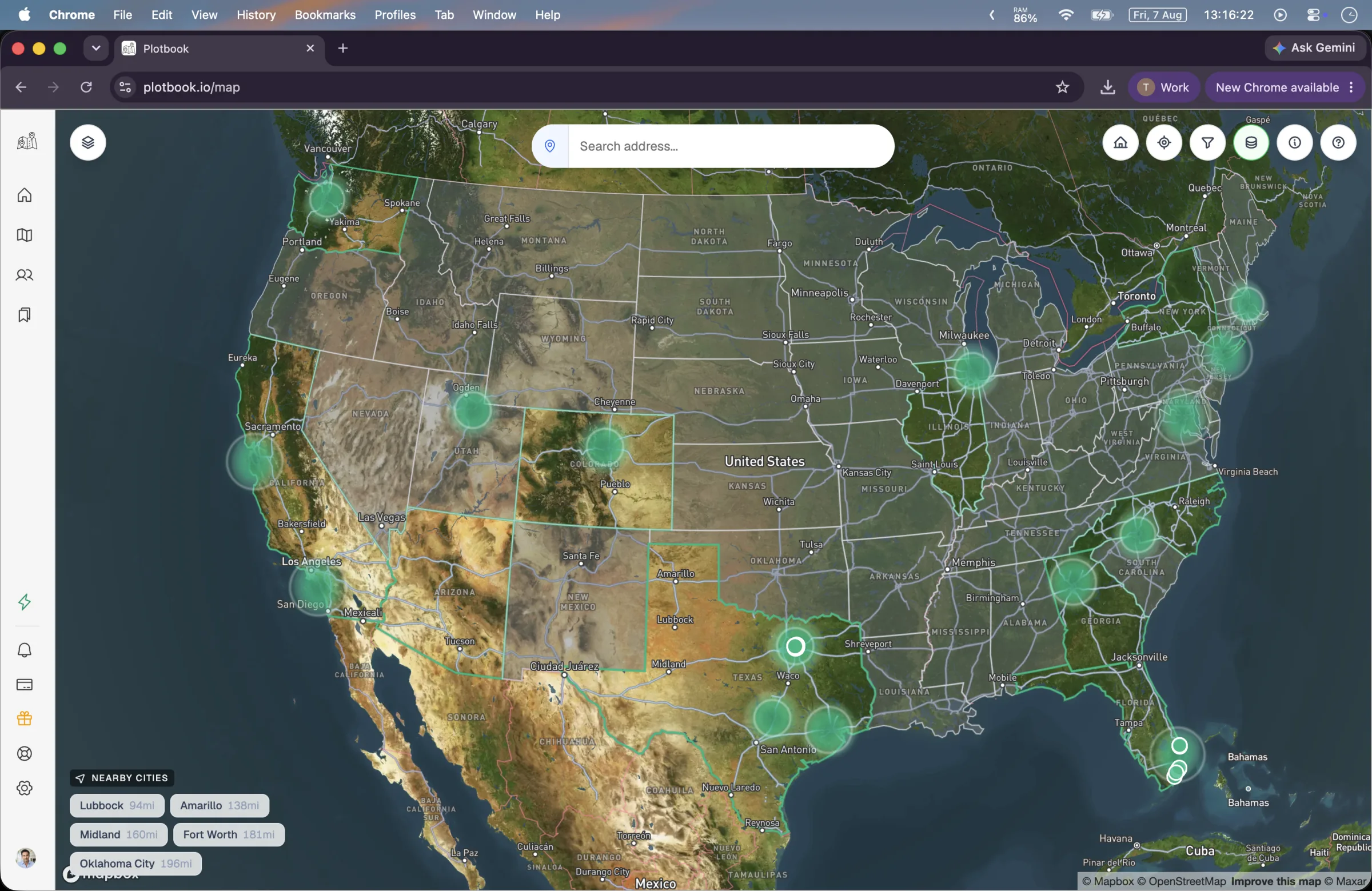
Plotbook has no opinion about who is notable. It reads the county record. A parcel assessed above five million dollars is visible on the map whether or not its owner has ever been written up, and the research agent starts from that deed rather than from a reputation. That is the only method that surfaces someone no analyst has reached, and it is the entire reason to consider it alongside a curated database.
- Nationwide parcel data from Regrid, covering 150M+ parcels, colored across six assessed-value bands
- Deed owner names printed on parcels once you are close enough to read them
- Reading the map costs no credits on any plan, including the trial
- 232 hand-curated high-net-worth ZIP codes as a heatmap for orientation before you zoom in
The missing tier
Most advisors do not serve the people in the book
Wealth-X is built for the very top of the distribution, and its buyers are private banks, family offices, and luxury brands where a handful of enormous relationships is the entire business. That is a coherent product for a coherent buyer.
It is also not the shape of most independent advisory practices. A firm managing a few hundred million dollars is looking for households in the one to thirty million range: a business owner nearing an exit, a retiring physician, a family holding four rental properties and a lake house. That tier is enormous, local, and largely undocumented, which is exactly the tier a curated global library is not designed to enumerate.
Plotbook works that tier because property does. Assessed value at parcel level is a direct, public, current signal about a household, available for every parcel in the country rather than for the few thousand people someone has chosen to profile. The research that follows produces four ranges, net worth, income, investible assets, and total assets, each generated by an AI model from what the run actually found, always shown as ranges with a confidence score rather than as a figure.
The other side
What Wealth-X does better than us
On its own ground Wealth-X is not close to being matched, by us or by anyone. Here is where it is the correct purchase.
Human analysts, at scale
A large research team maintaining curated dossiers is a different kind of asset from an automated agent, and it shows in the depth and the reliability of the narrative. Plotbook has no analysts. Our corroboration is automated and we say so.
Source-of-wealth narrative
How a fortune was actually made, told properly. Plotbook can identify an employer, a role, and a history, but it does not write the story of how someone got rich, and it should not pretend to.
Global coverage
Wealth-X is genuinely worldwide. Plotbook is US-only and parcel-bound. If your prospects hold property in London, Singapore, or Dubai, we cannot see any of it.
Philanthropic and affiliation depth
Giving history, foundation involvement, board seats, and interests are core dossier fields. Plotbook has federal campaign-finance records, which it uses mainly to confirm an identity, and nothing else in this category.
True ultra-high-net-worth altitude
For individuals at the very top, their assessment is grounded in far more than a property record. Our wealth ranges get wider and less useful the further above the residential property signal a fortune sits.
Institutional standing
Altrata is an established vendor with the security review and procurement paperwork large institutions require. Plotbook is a small company, which for some buyers settles the question by itself.
If your job is depth on people who are already known, buy Wealth-X. Plotbook is for the opposite problem: the wealthy household in your own market that no analyst has ever had a reason to write about.
Running both
Discovery first, then depth
The two do compose, in one direction. Plotbook surfaces a name from a property, which is the step a curated library cannot perform. If that name turns out to sit high enough in the distribution to be in Wealth-X, their dossier is a far richer read on the person than anything we produce.
In practice the overlap is smaller than it sounds, because most names a parcel map produces are not in a global UHNW library at all. That is the point of using the map. When one is, treat Plotbook as the finder and Wealth-X as the file.
Plotbook exports researched prospects to CSV with the parcel, the four wealth ranges, the confidence score, and the research summary attached. There is no direct integration with Wealth-X or with any CRM, and CSV export requires Professional or Enterprise.
What it costs
Priced for a practice, not a private bank
Plotbook bills a subscription plus credits, and credits are spent only when a paid source is called for you. The entry point is a card rather than a contract.
- Browsing the map and filtering by value band
- included
- Opening a parcel Plotbook has not seen before
- 1 credits
- Instant owner lookup on a residential address
- 15 credits
- Full research run on an entity-held deed
- 25 credits
- Keeping the result as a profile
- 10 credits
- Exporting to CSV
- 5 credits
Panning, zooming, the six value-band filters, and the deed owner names printed on parcels. Free on every plan, including the trial.
First lookup of a given parcel. Cached afterwards, so returning to it is free.
Reverse address lookup against residential records, for deeds held in a person's name.
Classification, registry and county records, contact databases, disambiguation. Charged only if it succeeds.
Enrichment and permanent storage in your prospect book, with the research trail attached.
Professional and Enterprise only. Starter cannot export.
Starter is $79 per month for 750 credits, Professional $199 for 2,500, Enterprise $499 for 8,000, with roughly 20% off when billed annually. New subscribers get 7 days and 100 credits. The trial takes a card and converts on day 8, and we email you before it does.
Questions
Plotbook and Wealth-X, asked directly
Keep comparing
Plotbook vs WealthEngine
The other Altrata product, aimed at rating lists rather than curating dossiers.
Plotbook vs Aidentified
Relationship mapping and money-in-motion signals, built specifically for advisors.
For family offices
How single and multi-family offices use a parcel map alongside their existing research stack.
How the research agent works
Entity classification, registry playbooks, and the gate that stops it naming the wrong person.
Find the ones nobody wrote up
Open a market you know well and look for owners you have never heard of on parcels you recognise. That is the test this comparison comes down to.
New subscribers start with 7 days and 100 credits. We email you before the trial ends.