

The strongest financial advisor marketing ideas survive because the evidence is designed before the copy. A useful territory teardown, client question clinic, professional workshop, or decision checklist can be compelling without promising an outcome. The fragile ideas start with a superlative, a testimonial, a performance number, or an invented success story and hope disclosure can repair it later.
That order matters in practice. When the headline exists before the evidence, reviewers are asked to rescue a campaign someone already loves. When the source, limitation, and review owner exist first, the writing brief starts inside the boundary instead of negotiating with it afterward.
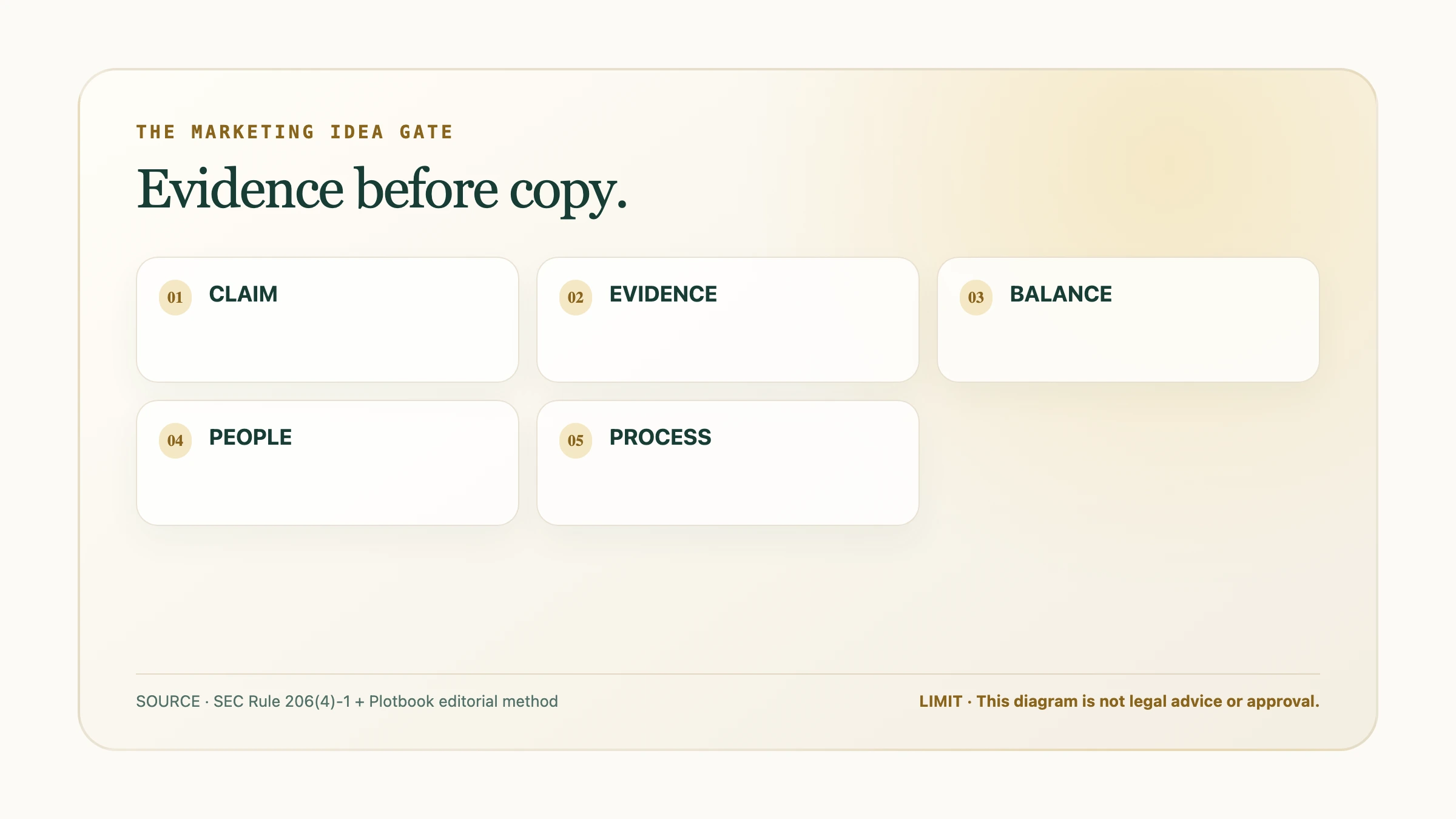
This guide uses a gate: claim, evidence, balance, people, and process. It pairs with our guide to AI prospecting for financial advisors. It is general information, not legal advice or firm approval.
unknown nodeThe five-part gate
The SEC Marketing Rule applies to investment advisers registered or required to be registered with the Commission. Its seven general prohibitions include untrue or misleading material statements, material claims the adviser cannot substantiate on demand, misleading implications, benefits without fair-and-balanced risks, cherry-picked specific advice, unbalanced performance presentation, and a final prohibition on materially misleading advertisements (SEC Small Entity Compliance Guide).
Use five questions before polishing an idea:
- Claim: What would a reasonable reader think is being promised?
- Evidence: What record substantiates every material factual statement?
- Balance: Which risk, limit, or condition belongs beside the benefit?
- People: Does the idea use a client, promoter, rating provider, employee, or paid third party?
- Process: Who approves, archives, updates, and retires the communication?
The SEC's September 2024 ongoing sweep charged nine RIAs and announced $1.24 million in combined civil penalties for issues including untrue or unsubstantiated claims and deficient testimonials, endorsements, and third-party ratings (SEC release 2024-121). The lesson is not "avoid marketing." It is "make the support retrievable."
If you are a registered rep: FINRA Rule 2210
The Marketing Rule covers registered investment advisers. If you are a registered representative of a broker-dealer, or dually registered, your communications also run through FINRA Rule 2210, and your firm's procedures decide who signs off. The rule sorts written communications into three types:
- Correspondence: written or electronic messages sent to 25 or fewer retail investors within any 30-calendar-day period. It is supervised and reviewed under the firm's supervision rules rather than pre-approved piece by piece.
- Retail communication: anything distributed or made available to more than 25 retail investors within any 30-calendar-day period. A registered principal must approve each one before the earlier of its use or its filing with FINRA, subject to narrow exceptions.
- Institutional communication: material sent only to institutional investors, reviewed under written procedures the firm sets.
Some retail communications must also be filed with FINRA's Advertising Regulation Department. A new member firm files retail communications used in public media at least 10 business days before first use during its first year, and communications promoting a specific registered fund or fund family must be filed within 10 business days of first use. Outside those categories and past a firm's first year, a general newsletter or seminar invitation usually needs principal approval but not filing; your firm's procedures make the call. The firm keeps a copy, the approval, and the source of any statistics.
In practice the gate below works the same way for a rep. The difference is that the "process" question has a fixed answer: a principal approves the retail version before anyone else sees it.
1. Publish a territory evidence note
The idea: choose one ZIP code or defined neighborhood and publish what current public records can and cannot establish: parcel coverage, assessment dates, owner-occupancy definitions, or filing lag.
Risky version: "We found the 500 wealthiest households in 85253."
Why it fails the gate: a property source does not establish household net worth or investable assets, and a ranked wealth claim needs a reproducible model and support. It may also imply knowledge the advisor does not have.
Safer build: "What the 2022 IRS ZIP file and current county property records can tell an advisor about this territory, and what they cannot." IRS ZIP data is aggregate income-tax data, not wealth data (IRS SOI ZIP data).
Use the territory profiling audit of Arcadia, Phoenix as the evidence standard.
2. Host a client-question clinic
The idea: collect recurring questions about a defined planning decision and answer the general process in a short live session.
Risky version: "The five tax moves that save business owners the most."
Why it fails the gate: it implies a ranked result, universal suitability, and a tax outcome without establishing method or limitations.
Safer build: "Five questions business owners should assign to their advisor, CPA, and attorney before an LOI." The format teaches coordination without predicting savings.
Do not turn attendee questions into client stories. If a real experience appears later, obtain the needed permissions and review whether it functions as a testimonial.
3. Build a COI companion workshop
The idea: co-host a narrow program with a CPA, estate attorney, or business broker in distinct professional lanes.
Risky version: "Our integrated team gets owners ready to sell."
Why it fails the gate: "integrated team" can imply a formal relationship, and "gets owners ready" may imply a result no evidence defines. Compensation or reciprocal promotion can introduce endorsement questions.
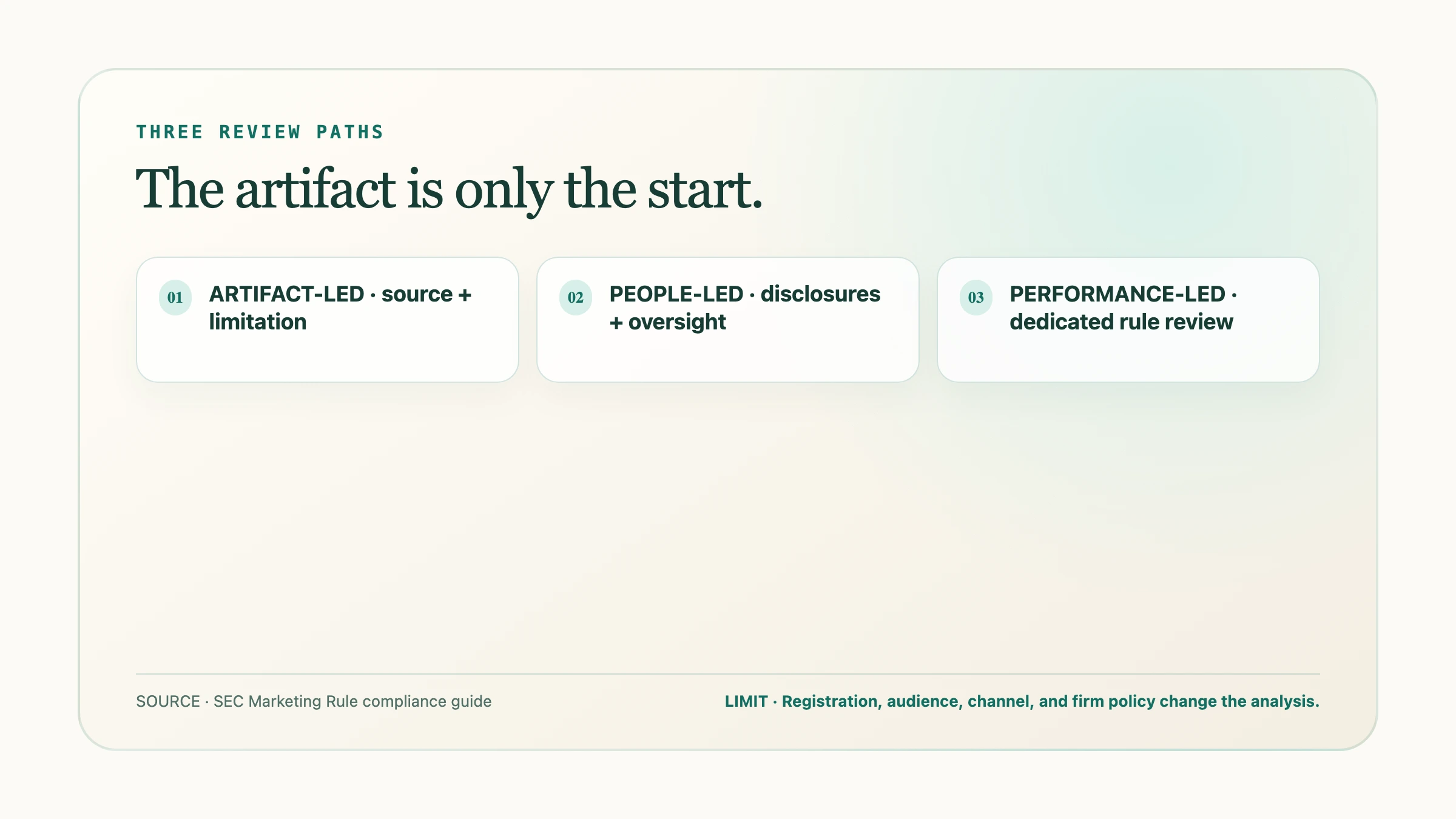
Safer build: name who covers what, disclose the relationship accurately, and teach one shared workflow. The COI outreach kit supplies three professional-specific formats.
The SEC Division of Examinations' December 16, 2025 risk alert, Additional Observations Regarding Advisers' Compliance with the Advisers Act Marketing Rule, covered disclosure, oversight, and compliance practices for testimonials and endorsements, and due diligence and disclosure for third-party ratings (SEC Division of Examinations).
4. Publish an anonymized decision framework
The idea: show the inputs and branches in a planning decision without claiming a client result.
Risky version: "How we saved a founder $2 million in taxes."
Why it fails the gate: it uses a specific result that needs substantiation, material context, fair balance, and potentially client permission. An anonymized story can still be recognizable or operate as a cherry-picked advice example.
Safer build: "Inputs that change a pre-sale planning timeline," using a clearly labeled invented scenario with no implied client. Print assumptions, unknowns, and the professionals who own each decision.
If the example uses performance, hypothetical performance, or extracted results, stop and use the firm's dedicated performance-review process. The SEC guide prohibits gross performance without net performance and sets conditions for hypothetical and predecessor performance.
5. Run a source-backed myth check
The idea: take one repeated industry claim and compare it with a primary source.
Risky version: "Niche advisors grow 45% faster."
Why it fails the gate: the 45% figure in the Kitces 2024 survey is the share of high-growth practices that target a niche, not a growth multiplier. Rewriting a correlation as causation changes the claim.
Safer build: state the population, measure, date, and limit inline: 45% of high-growth practices predominantly targeted at least one niche versus 29% of other practices in that survey (Kitces Report, 2024). Then explain what the evidence does not establish.
This is a good format for the researchable niche scorecard.
6. Create an annotated checklist
The idea: publish a practical checklist whose notes identify the source, owner, and limit of each task.
Risky version: "The compliant AI prospecting checklist."
Why it fails the gate: "compliant" sounds like an approval across firms, registrations, states, channels, and facts. No generic checklist can supply that.
Safer build: "An AI prospecting review checklist" with columns for source, claim, human owner, firm reviewer, and unresolved question. Use the advisor prospecting prompt system for the research chain and label the checklist as operational guidance.
7. Publish a client testimonial only through the people gate
The idea: use a client's own words to describe experience with the practice.
Risky version: a cropped review saying "They changed our financial future" with no client-status, compensation, conflict, or context disclosure.
Why it fails the gate: testimonials and endorsements have clear-and-prominent disclosure, oversight, written-agreement, and disqualification requirements depending on the circumstances. The statement may also imply a result.
Safer build: do not treat "organic" review-site language as exempt by default. Determine who selected, edited, promoted, or compensated the content; preserve the complete source; give required disclosures proper prominence; and remove claims the adviser cannot substantiate.
The 2024 SEC sweep included advertisements with endorsements that failed to disclose paid non-client status and ratings that omitted dates or covered periods (SEC release 2024-121).
8. Use a third-party rating only with a refresh owner
The idea: publish a genuine independent rating or award.
Risky version: "Top advisor" displayed indefinitely, with the year cropped away.
Why it fails the gate: a rating without its date, period, provider, preparation criteria, or compensation context can mislead. Stale ratings were part of the SEC's 2024 sweep.
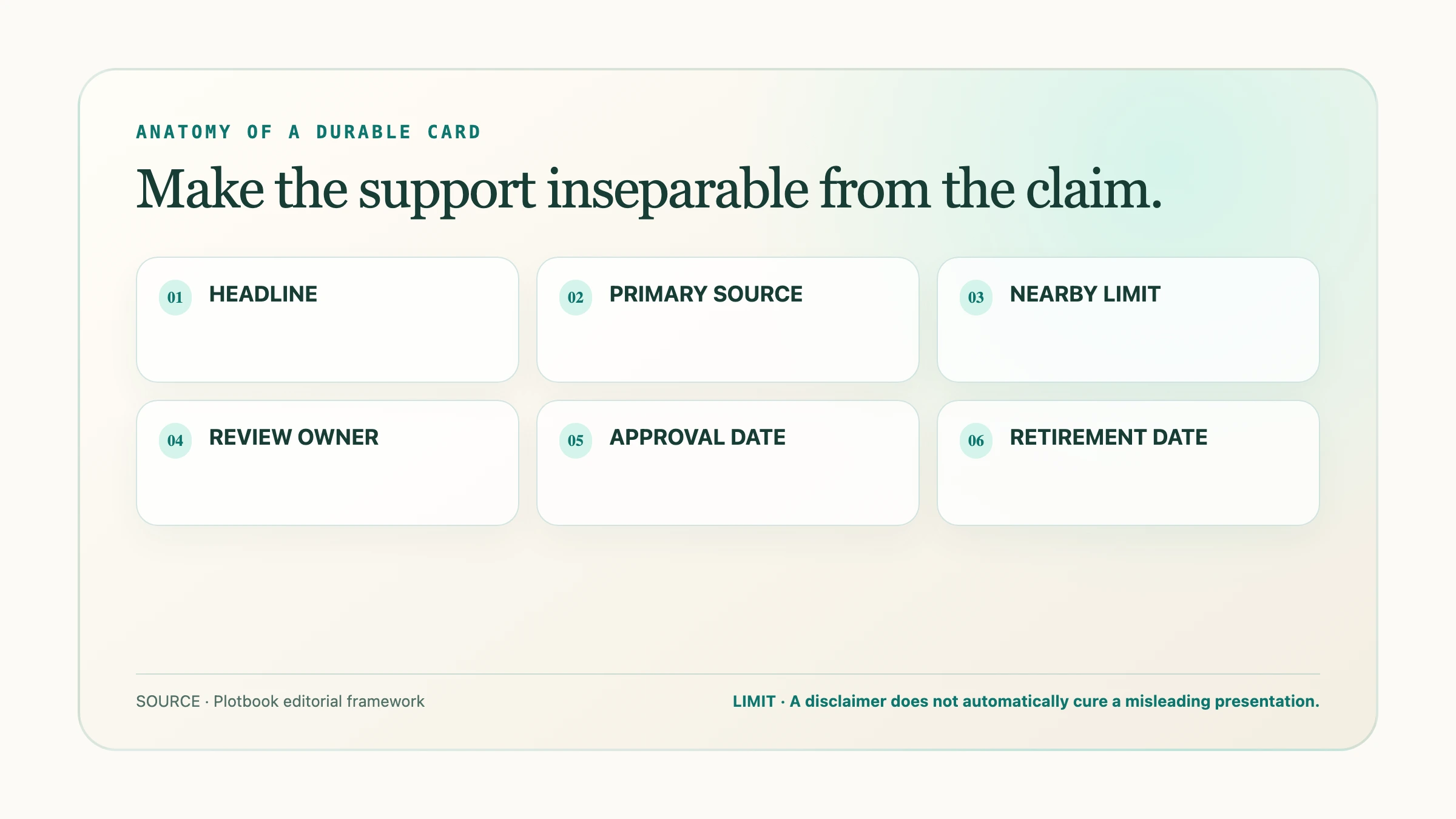
Safer build: keep the rating date and period inseparable from the graphic, disclose compensation where required, document reasonable belief about how the rating was prepared, and assign an expiration or review date.
9. Teach a public seminar with prepared materials reviewed
The idea: run a library or community-center session on one planning decision, such as what to settle before claiming Social Security or selling a business.
Risky version: "Free dinner seminar: retire with guaranteed income."
Why it fails the gate: "guaranteed" is a promise the presenter cannot substantiate for an audience they have not met, and the invitation reaches far more than 25 people. For a registered rep, FINRA Rule 2210(f) applies to public appearances, and scripts, slides, and handouts used there count as communications under the rule. For an RIA, the Marketing Rule excludes only extemporaneous, live, oral remarks, so the invitation, slides, and handouts are prepared materials to route through review.
Safer build: title the session after the decision ("Five questions to answer before you claim Social Security"), send the invitation, deck, and handout through review as one package, and keep the live Q&A general. Note any follow-up offer on the handout so it gets reviewed with everything else.
10. Post on LinkedIn with static and interactive content separated
The idea: publish one short explainer a week on a narrow topic, with a source in every post.
Risky version: a profile headline reading "Top wealth advisor in Scottsdale" and a habit of liking or resharing client comments that praise your results.
Why it fails the gate: the headline is an unsubstantiated ranking. Liking or resharing praise can turn a third party's words into your testimonial, because adopting or helping shape third-party content can make it your communication. FINRA's social media guidance in Regulatory Notice 10-06 treats static content such as a profile as requiring principal approval before posting, while interactive content is supervised like correspondence.
Safer build: get the profile and any standing posts approved, keep a sourced claim in each post, and leave client praise alone unless your reviewer has cleared how it will be handled and disclosed.
What our AI copy test exposed
On August 19, 2026, we asked Claude Opus 5 and GPT-5.6 to write advisor marketing ideas with browsing and local context disabled. Both produced usable formats. Both also produced claims that would need evidence before distribution: implied outcomes, broad descriptions of what clients experience, and certainty unsupported by the prompt. We did not test Gemini or Copilot.
AI is not unusually noncompliant here. A writing model optimizes for complete copy. When the prompt lacks an evidence field, the model fills rhetorical gaps with plausible generalizations.
The fix is mechanical:
- require a source for every material factual statement;
- require a nearby limitation for each benefit;
- ban invented clients, results, rankings, awards, and adoption claims;
- return a claims ledger after the draft;
- route the output through the firm's normal reviewer.
For a first pass before the reviewer, Plotbook's free SEC Marketing Rule Checker takes a pasted post, bio, or web section and lists what a compliance reviewer would likely flag. It does not rewrite or approve copy.
Frequently asked questions
Does the SEC approve financial advisor marketing copy?
No. An adviser needs its own policies and review process. The SEC may examine whether claims can be substantiated and whether the rule's conditions are met.
Are one-to-one emails excluded from the Marketing Rule?
Some one-to-one communications are excluded from the first part of the advertisement definition, subject to qualifications, while compensated testimonials and endorsements are covered under the second part. Registration, content, audience, and other rules still matter; use the firm's reviewer.
Can financial advisors use testimonials?
The Marketing Rule permits them if applicable disclosure, oversight, written-agreement, and disqualification conditions are satisfied. Permission is conditional, not automatic.
Do registered reps follow the SEC Marketing Rule?
The Marketing Rule applies to registered investment advisers. A registered representative's communications fall under FINRA Rule 2210 through the broker-dealer, and dually registered advisors may need to satisfy both. Ask your firm which review path a piece goes through.
Does adding a disclaimer fix a misleading headline?
Not necessarily. The full presentation must be fair and not materially misleading. Design the claim and limitation together instead of relying on a distant footnote.
The idea that survives
A durable marketing idea can answer four questions in one screen: what is this, what supports it, where does it stop, and who reviewed it? Build the artifact first. Write the claim second. If the idea becomes uninteresting when the unsupported promise is removed, it was never a strong idea.
The remaining idea is usually clearer, more specific, and easier to maintain.