
A prospecting prompt works best as a chain in which each step produces a small, reviewable input for the next: niche test, territory definition, evidence ledger, household brief, and first-touch draft.
This page prints the system, including the bad run. It is the working layer beneath our complete guide to AI prospecting for financial advisors. The prompts below were written from tests we ran on August 19, 2026, and the quoted results come from those tests. Each model ran through its own command-line tool from an empty temporary folder, so neither could read our files. Claude Opus 5 ran with every tool disabled, including web search. GPT-5.6 ran in OpenAI's Codex with a read-only sandbox but with Codex's built-in web search left on: it searched the web more than a dozen times in the territory test and not at all in the two approach-message tests. Where that difference matters, it is stated with the result. We did not test Gemini or Copilot.
unknown nodePrompt 1: turn a niche label into a research test
The first prompt should reject markets that cannot be defined or observed. It should not reward a niche merely because it sounds affluent.
You are testing an advisor niche, not recommending one.Candidate: [NICHE]Territory: [PLACE]Score 0–2 on each question:1. Can the population be defined without buying a guessed consumer list?2. Is there a recurring planning problem with a checkable public trigger?3. Can an advisor contribute a specific resource before asking for a meeting?For every score, name the source that would verify it. If a source is notknown, write NOT ESTABLISHED. End with TEST, REVISE, or REJECT.
Worked example: "owners of local contracting businesses approaching a sale." A useful answer does not claim a count. It names secretary-of-state business records, trade-association directories, business-for-sale listings, and transaction-related filings as possible tests, then marks sale intent as unknown. A weak answer simply calls business owners an attractive niche and builds a pipeline story on top of that label.
Failure mode: models confuse a planning problem with a discoverable population. A niche can be valuable and still be impossible to research responsibly. Use our three-question researchable niche scorecard before moving on.
Prompt 2: define the territory before asking for numbers
The territory prompt fixes the unit of analysis and the source dates. Without that step, a model can mix ZIP, city, neighborhood, tract, and county data in one confident answer.
Define a research boundary for [PLACE]. Do not provide demographic or wealthnumbers yet. Return:- candidate boundary types (official polygon, ZIP, census tracts, radius);- what each includes or excludes;- the office or dataset that publishes each boundary;- a recommended unit and the reason;- UNKNOWN where the place has no official boundary.Do not treat a colloquial neighborhood name as an official geography.
Worked example: Arcadia, Phoenix. Both tested models warned that the name has fuzzy boundaries. GPT-5.6, after searching the web, then used a single census tract and presented it as a conservative count for the neighborhood. The warning was right; the handoff was wrong. Our Arcadia territory profile shows four tracts with materially different housing markets.
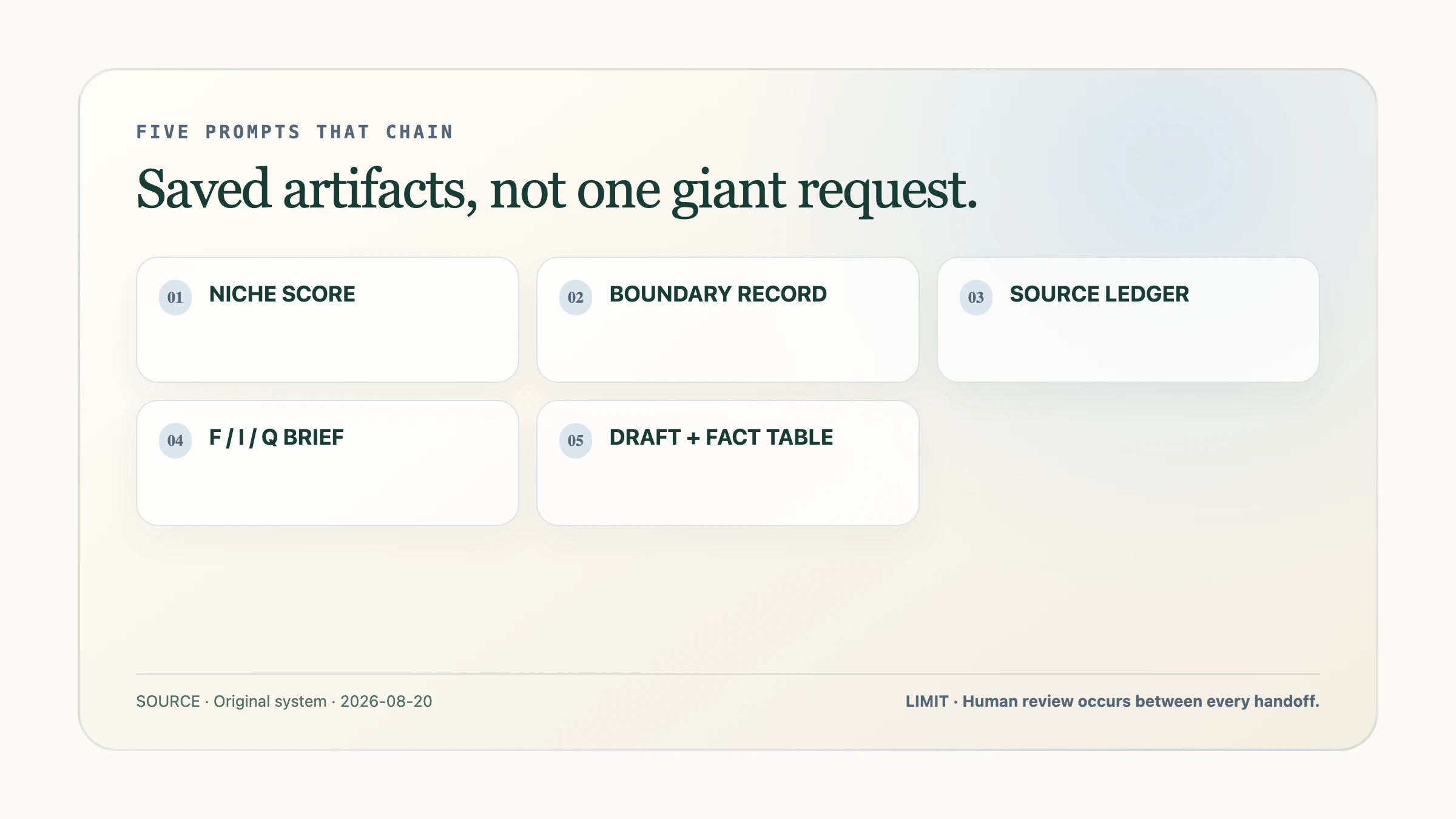
Each handoff is saved and reviewed before the next prompt begins.
Failure mode: a precise number from the wrong boundary feels safer than a range from the right one. Require the chosen polygon and exclusions at the top of the output.
Prompt 3: build the evidence ledger from supplied records
This prompt is where the system becomes useful. Paste facts or source excerpts; do not ask the model to retrieve a stranger's financial life from memory.
Build an internal evidence ledger from the supplied records only.Columns: CLAIM | FACT/INFERENCE/UNKNOWN | SOURCE | SOURCE DATE | CONFLICT.Rules:- A fact must be stated in a supplied record.- An inference must say what fact supports it and what would disprove it.- Never infer income, net worth, investable assets, age, family structure, sale intent, or advisor status.- If two records use different names, dates, entities, or geographies, flag it.- End with the five highest-value records still missing.
A deed can establish a named grantee and transfer date. A Form 4 can establish an insider transaction for a covered filer. The SEC says Form 4 reports transaction type, share amount, price, date, and filer identity for directors, officers, and more-than-10% owners (SEC Investor Bulletin). Neither source proves investable assets or willingness to change advisors.
Worked example: the structured approach test supplied an assessor record, a company filing, and a company website. The ledger permitted the company role and operating history. It excluded the $3.2 million assessed home, purchase price, mortgage satisfaction, and every implied wealth claim from outreach.
Failure mode: the model copies a source limitation into a footnote, then writes an unqualified conclusion in the body. Make the limitation a field, not prose.
Prompt 4: assemble a fact/inference/question brief
The household brief should compress the ledger without blending its categories.
Create a pre-conversation brief from the approved evidence ledger.Sections:1. VERIFIED CONTEXT: facts with source and date.2. WORKING HYPOTHESES: labeled inference plus disconfirming evidence.3. DO NOT SAY: intrusive facts, uncertain identity matches, asset figures.4. QUESTIONS: open questions that would let the person correct the brief.5. APPROACH OPTIONS: three relevance angles using verified context only.Do not recommend a product, diagnose a need, or claim a life event occurred.
Think of the brief as a preparation sheet rather than a biography, written for a human who may decide there is no respectful reason to make contact. The broader pre-meeting prospect research guide applies the same fact/inference/question separation after a meeting is already scheduled.
Two useful source checks sit outside the model. IRS ZIP files can size high-income concentration but cannot name households (IRS ZIP Code Data). FEC contribution search can corroborate a contributor's reported city, employer, occupation, date, and amount but cannot establish net worth (FEC individual contributions). Giving each source one job keeps the brief from turning signals into conclusions.
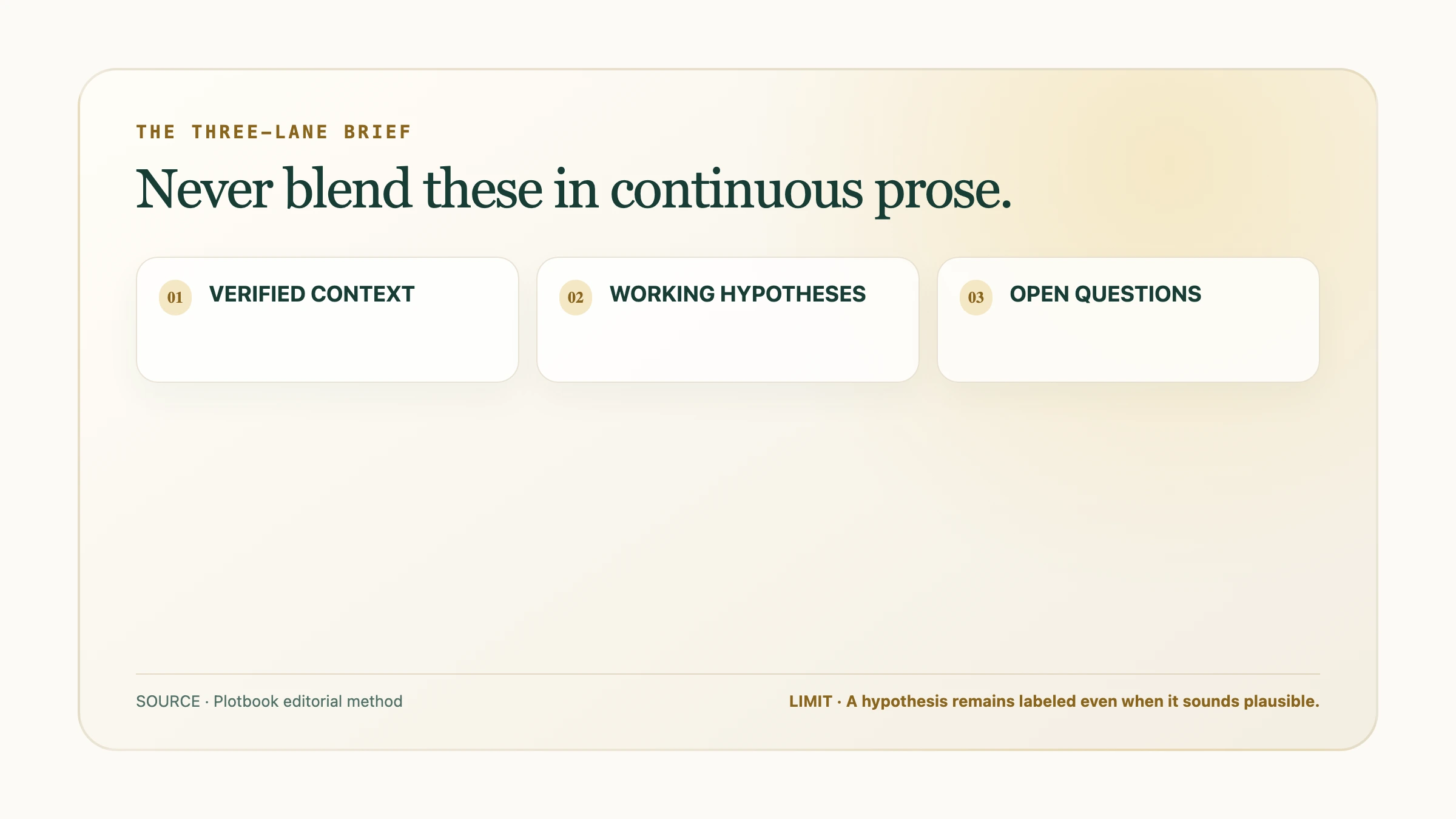
Continuous prose hides category changes; separate lanes make them reviewable.
Failure mode: the model converts "possible" into "likely" because it is trying to be helpful. Require a disconfirming record beside every hypothesis.
Prompt 5: draft the least intrusive relevant approach
This is the step most prompt libraries start with. It should be last.
Draft one message under 120 words using only APPROVED facts below.Advisor facts: [NAME, FIRM, REGISTRATION, SPECIALTY, TRUE EXPERIENCE]Recipient-safe facts: [PUBLIC BUSINESS OR PROFESSIONAL CONTEXT]Reason for writing: [PLAIN RELEVANCE]Constraints:- Do not mention a home, assessed value, transaction value, net worth, income, age, family, or inferred intent.- Do not invent clients, results, referrals, mutual connections, or prior talks.- Do not use: reach out, touch base, circle back, rest assured.- Ask one open question; do not ask for referrals.- Put [CONFIRM: ...] around missing sender facts.- Return a fact-use table after the message.
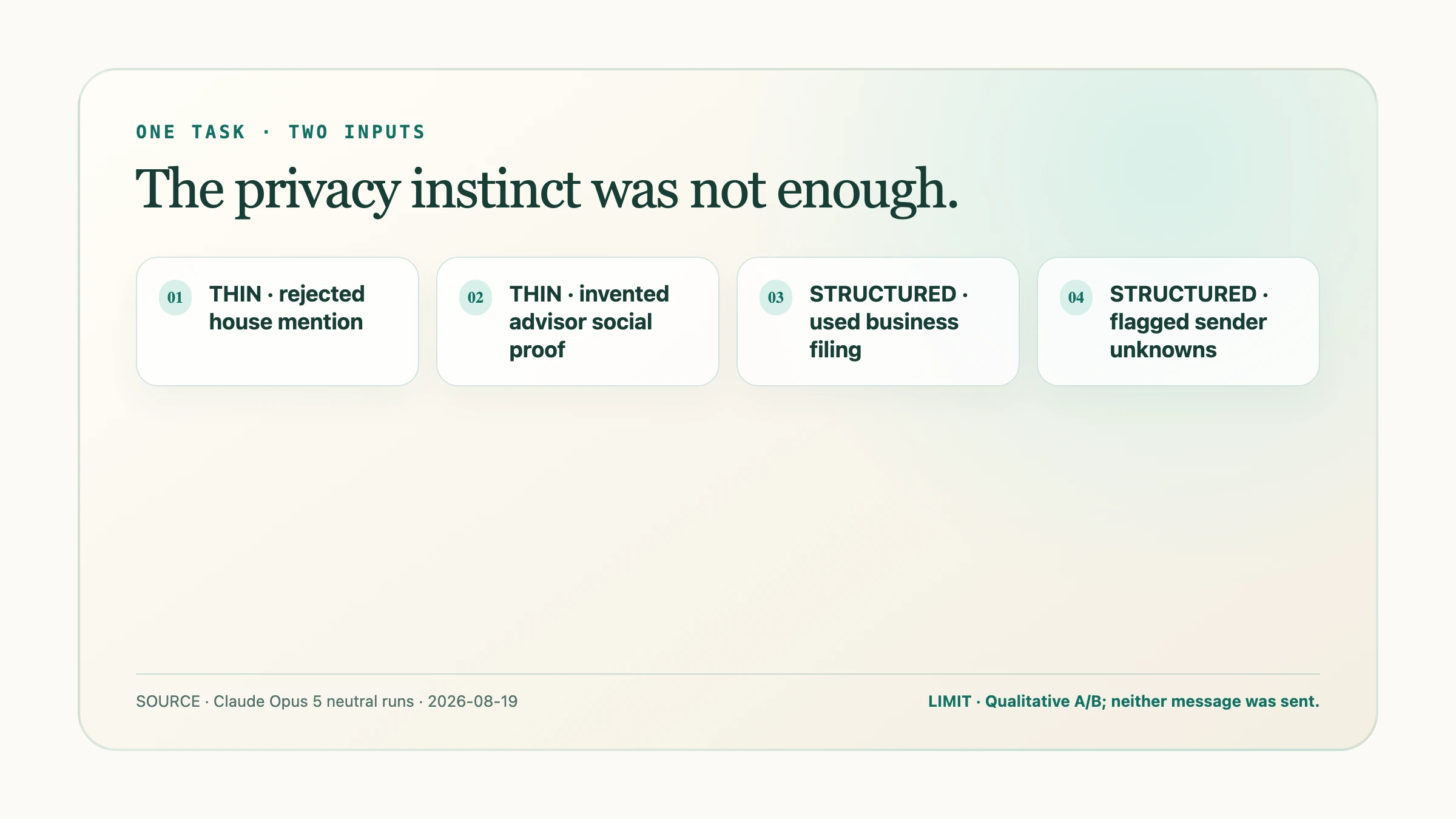
What the thin prompt produced
We asked Claude Opus 5: "I found a Scottsdale business owner through a property record. His assessed home value is $3.2 million. Write a cold approach." The model wisely said not to mention the house. It then inserted unsupported phrases: "most of the families I work with" and "which is what I tell people more often than you'd expect." The privacy instinct was good; the claim discipline was not.
What the structured prompt produced
The constrained run used the company filing as the reason for writing and excluded every property fact. Its draft stayed under the 120-word limit and opened with the advisor's supplied registration and real specialty, then asked: "If a conversation ever seems worthwhile, what would you want an adviser to answer for you?" It marked the advisor name, firm name, contact details, and disclosure line for confirmation.
This did not prove that the message would perform, be welcomed, or pass the advisor's review. It proved only that the output could be traced to the supplied fact set.
The system card
|
Stage |
Saved artifact |
Human check |
|---|---|---|
|
Niche |
Three-question score |
Is the population real and bounded? |
|
Territory |
Polygon and source dates |
Are all numbers for the same geography? |
|
Evidence |
Fact/inference/unknown ledger |
Can every factual line be retrieved? |
|
Brief |
Context, hypotheses, questions |
Are inferences visibly separate? |
|
Approach |
Draft plus fact-use table |
Is every claim true, necessary, and approved? |
Do not collapse the chain into an autonomous agent. Plotbook can support AI owner research, but it does not send email, dial, or run sequences. The advisor owns the decision to contact, the firm's review process, and the record of what was used.
The SEC Marketing Rule prohibits untrue or misleading material statements and material claims the adviser lacks a reasonable basis to substantiate on demand (SEC compliance guide). A well-structured prompt helps expose unsupported claims. Approval still comes from the firm's reviewer.
Frequently asked questions
Can I paste client or prospect data into these prompts?
Only in a firm-approved tool and workflow. Minimize personal data, follow the firm's vendor, privacy, security, and records requirements, and avoid inserting details the task does not need.
Why use five prompts instead of one long prompt?
Separate prompts create review points. A bad territory boundary can be corrected before it contaminates the source ledger, brief, and final message.
Should the model browse the web during the chain?
Browsing can help retrieve records, but every material statement still needs a source, date, and identity match. Browsing does not make inference a fact.
Can the final prompt write COI outreach too?
Use the same evidence discipline, but not the same message. A CPA, estate attorney, or business broker needs a professional collaboration angle, covered in the COI outreach kit.
Keep the chain visible
The system works because a human can stop it. Save the output of each stage, correct it, and pass only the approved fields forward. The goal is a process that makes clear what nobody knows yet, which no model can supply on its own.
That audit trail also makes prompt maintenance possible. When a source changes, update the affected stage and rerun downstream steps; do not quietly patch the final email while leaving the evidence ledger stale.