
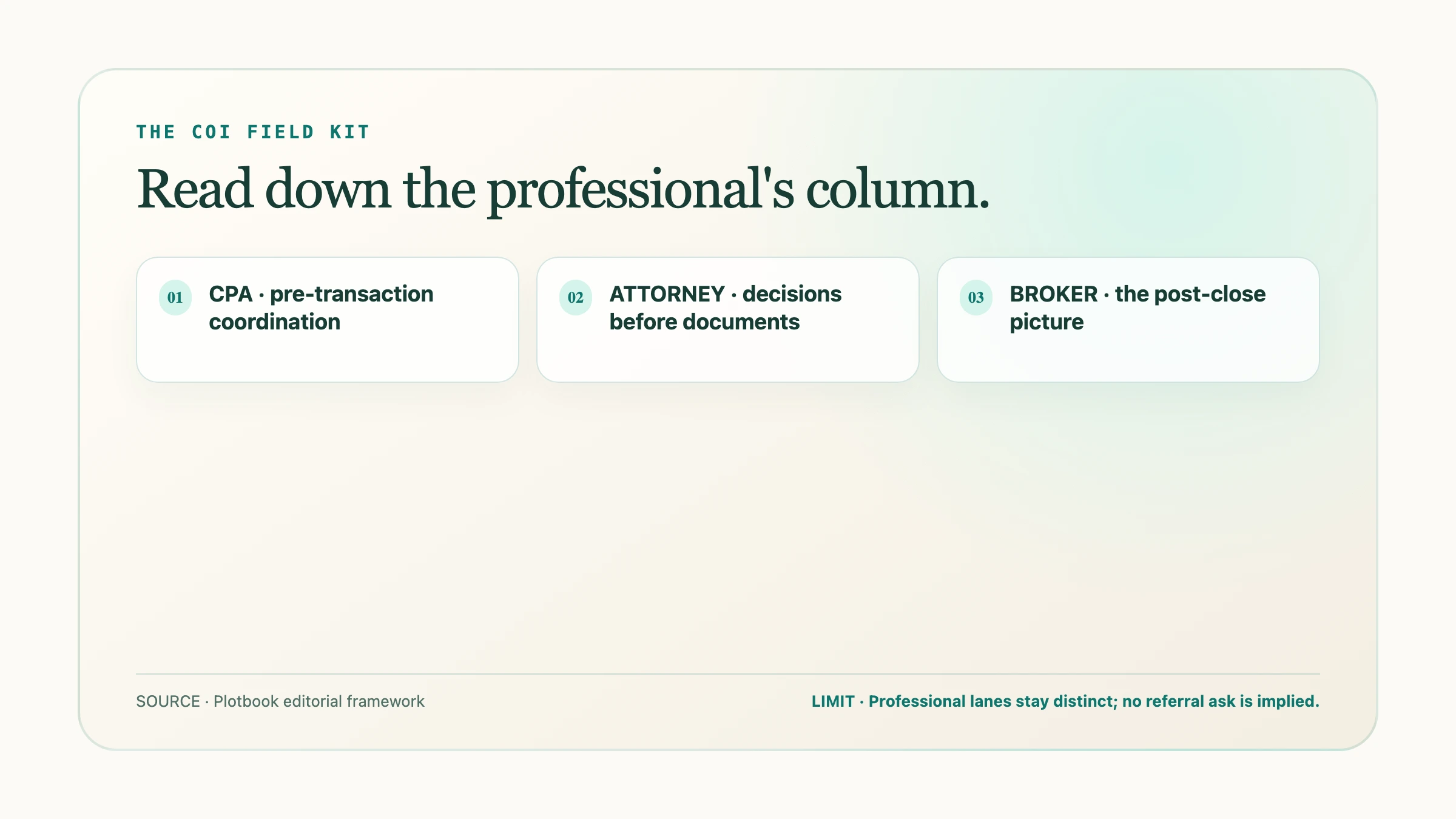
Centers of influence are the professionals whose work already touches your clients: the CPA, the estate attorney, the business broker. A useful relationship with one starts with a shared client problem, not a request to swap financial advisor referrals. The problem differs by professional. A CPA may need earlier planning before a transaction, an estate attorney may need decisions modeled before documents can be signed, and a business broker may need a seller who understands life after the close.
This field kit keeps those three motions separate, and pairs with our guide to AI prospecting for financial advisors. For each professional type it gives one way to find them locally, one research prompt, one first-touch pattern, one co-hosted content offer, and four useful touches across a year.
unknown nodeWhy centers of influence deserve their own motion
COI prospecting needs its own rules. The person receiving the message has clients, professional duties, an incumbent network, and a reputation to protect.
Cerulli's February 2026 public summary of U.S. Advisor Metrics 2025 says client, friend, and family referrals accounted for 54.2% of new advisor clients. Contacts from CPAs, attorneys, and other centers of influence were the second most common source, at 13.9%. The release describes a broad advisor population but does not disclose sample size or fielding dates, so read the split as directional (Cerulli Associates).
Kitces' 2019 marketing survey of more than 800 self-selected planning practices found 60% used centers of influence as a tactic, and COI-sourced clients had the highest average annual revenue per client among the measured tactics. The audience skews independent and planning-centric, and the finding does not say 60% of clients came from COIs (Kitces Report, 2019).
The operating lesson is narrower than either number: professional relationships matter enough to warrant research and patience. They do not become credible because a model writes a polished email.
Find the professionals who already work your territory
Many COI lists start from a licensing directory. That tells you who is licensed nearby. It says little about who is doing the work on the streets you prospect. Each column needs a different starting point:
|
CPA |
Estate attorney |
Business broker |
|---|---|---|
|
Start from firm websites that list transaction advisory or personal financial planning services, then confirm the licence through your state board of accountancy's lookup. |
Start from the preparer line on recorded deeds in your farm area (method below), then confirm the licence through the state bar directory. |
Start from the IBBA broker search, which filters members by location and specialty, then read each broker's current listings for the segment they actually sell. |
The county land record is the only one of the three that shows local legal work on specific properties, so it gets the detail.
Several states will not record a deed unless it names whoever prepared it. We checked the primary text or an official county recorder page for each state below on September 16, 2026:
|
State |
What the recorded instrument must show |
Source |
|---|---|---|
|
Florida |
Name and post-office address of the natural person who prepared the instrument or supervised its preparation, for instruments executed in Florida after July 1, 1991 |
|
|
Kentucky |
A signed statement with the name and address of the individual who prepared it, plus the grantee's mailing address |
|
|
Tennessee |
Name and address of the person or agency that prepared it ("This instrument was prepared by...") |
UT County Technical Assistance Service, citing T.C.A. §66-24-115 |
|
Indiana |
A statement naming the preparer, under IC 36-2-11-15 |
|
|
Michigan |
Name and address of the person who drafted it, for instruments executed after January 1, 1964 |
California is the useful counterexample. Its formatting rule reserves space on page one for the name of the person requesting recording and the address the document is returned to, and says nothing about a preparer (Cal. Gov. Code §27361.6). In states like that, the "when recorded, mail to" block is the only name on the page, and it may belong to a title company, a lender, a law firm, or the owner. The statutes we read carry exemptions (Florida's, for example, excludes court orders and instruments executed outside the state), so a missing line is not automatically an error. Online access also varies: some recorders charge for document images or limit remote search. Check your own state's statute and your county recorder's requirements page before building a process on this.
What the field tells you, and what it does not. The preparer on a purchase deed is often a title agent or closing attorney, not an estate planner. A deed moving a home into a revocable trust is more likely to come from the estate-planning side, but treat that as a hypothesis to confirm on each document, never a rule. Do not expect to find CPAs or business brokers on the preparer line; a deed is legal work. So the land record helps with the attorney column; the CPA and broker columns still come from the public-work research below.
A workable routine for one farm area:
- Pick the higher-value blocks you already prospect. On the Plotbook wealth map, parcels are shaded by assessed value and, at street-level zoom, labeled with the owner of record, so owners that are trusts or LLCs are visible on the map.
- Pull a handful of those parcels' recorded deeds from the county recorder's own search. Plotbook does not read preparer or return-to fields; the recorder's document image is the source.
- Note the preparer name and firm on each. Tally which names recur across trust transfers, not purchases.
- Confirm each recurring name is a licensed attorney through the state bar directory, and check the firm for an affiliated advisory business in SEC IAPD.
Use the tally to decide whom to research, never as material for the message. Do not tell an attorney you saw a named client's deed. The record is public, but citing it turns a professional introduction into surveillance, and it can put the attorney in an awkward spot with a client who never agreed to be discussed.
Research prompt: find the active problem, not a flattering fact
Use the same base prompt, then change the evidence and failure conditions by professional.
From the supplied public facts only, identify one current professional problemwhere this advisor could contribute without replacing the professional.Return: strongest angle, evidence for it, three weaker angles, what not to say,and the one unknown that must be resolved first.Label every inference. Do not assume the professional lacks an advisor,wants referrals, or serves a specific client size.
|
CPA |
Estate attorney |
Business broker |
|---|---|---|
|
Check recent tax or transaction talks, articles, firm service lines, PFS credential, and any affiliated RIA. |
Check recent estate or business-succession programs, published planning topics, bar profile, and affiliated financial entity. |
Check listing focus, closed-deal commentary, association activity, seller education, and any preferred advisor network. |
|
Strong signal: a dated program or article connected to a service the firm actively offers. |
Strong signal: repeated education around a decision clients delay because financial modeling is missing. |
Strong signal: repeated seller-preparation content or a stated focus on a defined company segment. |
|
Reject: "Your clients must need wealth management." |
Reject: "I can help draft or interpret the estate plan." |
Reject: "My planning will make deals close." |
In our neutral CPA test, Claude Opus 5 chose a construction-association talk as the strongest signal because it was public, dated, effortful, and connected to the firm's transaction-advisory service. It rejected a generic "I read your Section 1202 article" opener and a capacity angle based on LinkedIn headcount. We ran the same prompt on Claude Opus 5 and on GPT-5.6 via the Codex CLI on August 19, 2026, both with every tool disabled; the pick described here is Claude's. It was a qualitative comparison, not a performance test. We did not test Gemini or Copilot.
Plotbook's free COI Angle Finder takes a different starting point: pick the professional type and niche, and it describes which public records tend to overlap with that professional's work and how a first touch could open. Treat its output as a draft to verify, like any model output.
The highest-value unknown was whether the CPA firm already had an in-house or affiliated wealth arm. Search the firm name and principals in SEC IAPD, state business records, FINRA BrokerCheck, and the firm's disclosure pages before writing.
The same identity discipline used in researching a prospect before the first meeting applies here: match the professional, firm, location, and date before treating two records as one person.
First touch: one useful question, three different problems
The tested thin first-touch prompt produced readable emails, but it also invented broad claims about what "most" deals or clients do. The versions below remove those claims and leave facts that must be supplied in brackets.
|
CPA |
Estate attorney |
Business broker |
|---|---|---|
|
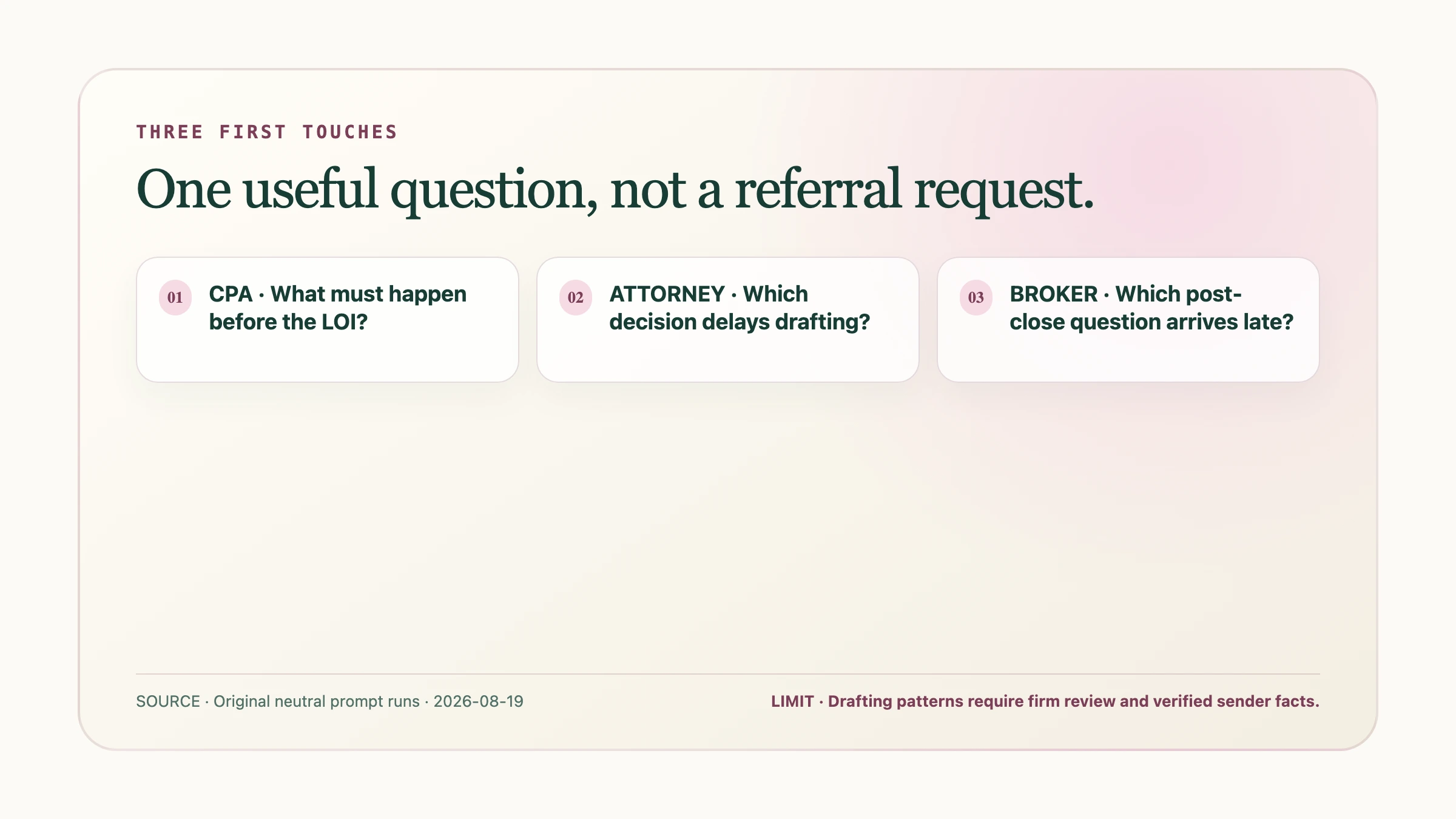
Subject: Before the LOI<br><br>Hi [Name], I saw your [talk/article] on [verified topic]. My practice works with [true niche], and I often own the personal cash-flow and investment questions that need answers before tax options are evaluated. I don't provide tax advice. I'm curious how you prefer that work to be coordinated before a transaction becomes time-sensitive. Open to a short coffee? |
Subject: Modeling before documents<br><br>Hi [Name], your [verified program/article] on [topic] caught my attention. I help [true niche] model spending, liquidity, and asset tradeoffs before legal documents are finalized; I don't draft or interpret those documents. Where do you see financial decisions delaying otherwise sound estate work? If useful, I'd value 20 minutes to compare process notes. |
Subject: The seller's post-close picture<br><br>Hi [Name], I saw your work with [verified company segment]. My role is helping owners understand what sale proceeds need to support before they make transaction decisions; I don't broker or value companies. Which personal-planning question tends to arrive too late in your seller process? I'd be glad to compare notes over coffee. |
These are drafting patterns, not approved copy. Replace every bracket with a verified fact, remove any claim the advisor cannot substantiate, and use the firm's required review and disclosures. Note what the attorney email does not say: nothing about deeds, parcels, or anyone's clients.
For the copy-review layer, use the principles in financial advisor marketing ideas that survive compliance. A professional audience does not make an unsupported claim less material.
Why the questions differ: the CPA owns tax work, the attorney owns legal work, and the broker owns the transaction process. The advisor's relevance is complementary only if the message respects those lines.
Co-hosted content: make the second half of something real
The strongest collaboration is often a companion to work the professional has already chosen to publish or teach.
|
CPA |
Estate attorney |
Business broker |
|---|---|---|
|
Offer: "Before the LOI: what the owner and tax team need from the personal plan."<br>CPA: entity, basis, tax timing.<br>Advisor: spending need, liquidity, concentration, charitable intent.<br>Limit: no public case study without support and approval. |
Offer: "From estate intent to fundable decision."<br>Attorney: legal options and drafting.<br>Advisor: cash-flow scenarios and asset inventory.<br>Limit: advisor does not explain legal effect. |
Offer: "Can the seller afford the deal they want?"<br>Broker: process and transaction mechanics.<br>Advisor: post-close spending and allocation scenarios.<br>Limit: no claim that planning increases close rates. |
Use this generator:
Create a 30-minute co-hosted session outline from the supplied public work.Give each professional a distinct lane. Include three audience questions,one worksheet, and a final section called CLAIMS TO VERIFY.Do not invent a client story, result, tax outcome, legal conclusion, or deal.
The content offer should be small enough to decline without awkwardness. A one-page checklist or 30-minute program is better than proposing a webinar series to a stranger.
Quarterly nurture: four useful touches, no disguised sequence
Quarterly nurture here means four reasons to be useful in a year, each written by hand. An automated drip pretending to be a relationship will be recognized as one.
|
Quarter |
CPA |
Estate attorney |
Business broker |
|---|---|---|---|
|
Q1 |
Share a one-page pre-transaction information checklist and ask what is missing. |
Share a client-decision worksheet; ask which field creates avoidable delay. |
Share a post-close spending-input sheet; ask whether it fits the seller process. |
|
Q2 |
Invite a joint office-hours session on a topic the CPA already covers. |
Offer scenario modeling for an educational case the attorney defines. |
Offer to review the personal-planning section of a seller guide. |
|
Q3 |
Send one verified primary-source update with a two-sentence implication, not an unsourced summary. |
Send a process observation that stays out of legal analysis. |
Send a question collected from owner conversations, with no client identity. |
|
Q4 |
Review what created a useful client handoff and what did not. |
Decide whether a shared event is worth repeating. |
Ask whether the advisor entered early enough to help or became noise. |
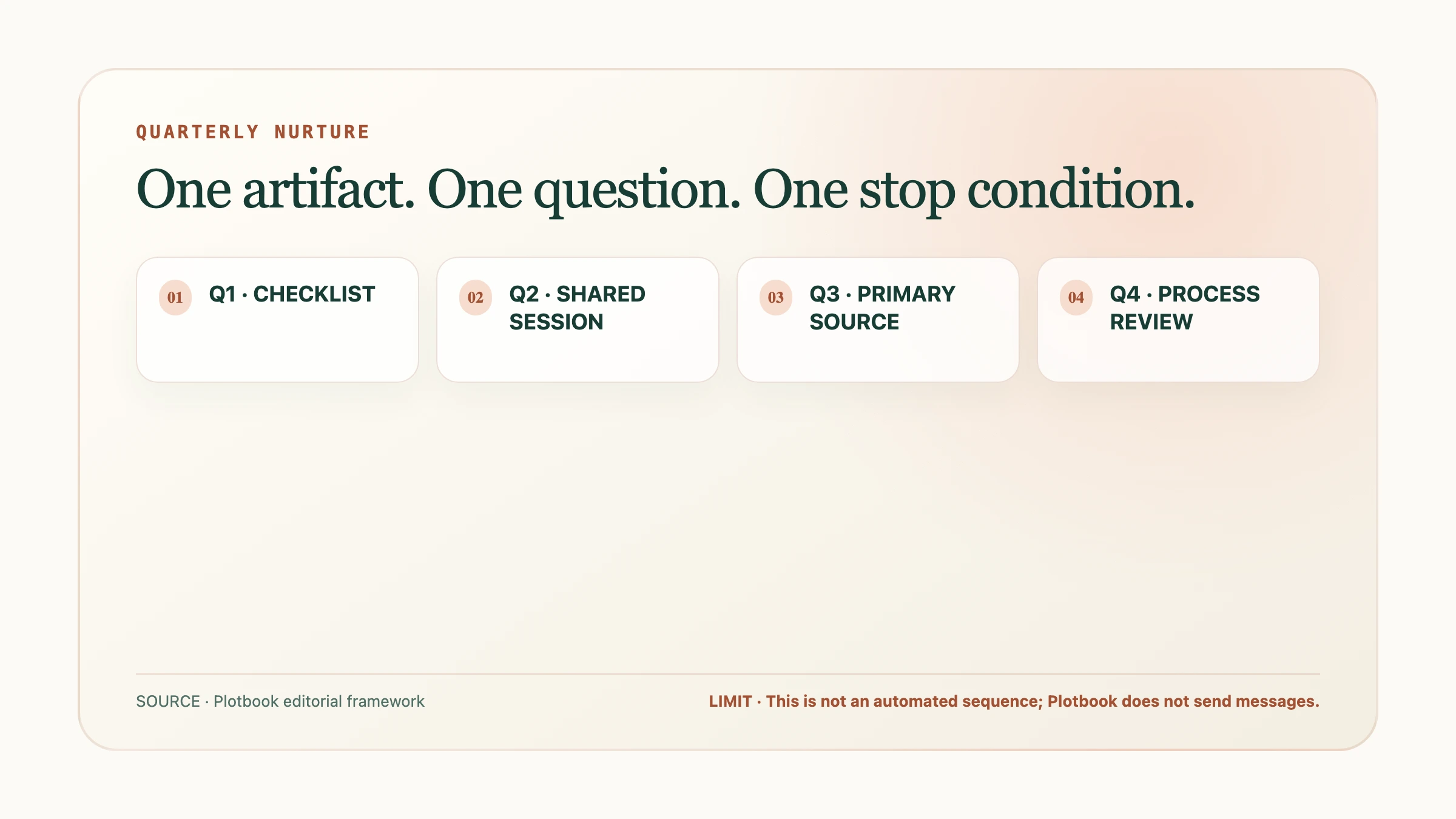
No touch should imply the professional owes an introduction. No sequence should continue indefinitely without a response. Plotbook does not send or automate these messages.
Keep the relationship notes in the same saved-profile workflow used for research context, with the source and date attached. Do not store a private inference as if the professional stated it.
The compliance and conflict gate
Compensation changes the relationship. Under the SEC Marketing Rule, compensated testimonials and endorsements can require clear and prominent disclosures, adviser oversight, a written agreement subject to limited exceptions, and disqualification checks (SEC Small Entity Compliance Guide). The written-agreement exception for de minimis compensation covers $1,000 or less in cash or non-cash compensation during the preceding 12 months; it is not an exemption from every requirement.
The SEC Division of Examinations' December 16, 2025 risk alert, Additional Observations Regarding Advisers' Compliance with the Advisers Act Marketing Rule, covered disclosure, oversight, and compliance practices for testimonials and endorsements, and due diligence and disclosure for third-party ratings (SEC Division of Examinations). Firm policy, state rules, broker-dealer requirements, CPA independence considerations, attorney ethics rules, and the actual arrangement still need review.
Do not propose fee sharing in a first message. Do not call reciprocity "uncompensated" and assume that ends the analysis. Describe any arrangement completely to the firm's reviewer before it becomes practice.
Frequently asked questions
What is a center of influence for a financial advisor?
A center of influence is a professional whose work regularly intersects with the advisor's clients or niche, such as a CPA, estate attorney, or business broker. Influence does not imply a formal referral arrangement.
Where do financial advisor referrals actually come from?
In Cerulli's 2025 summary, existing clients, friends, and family were the largest source of new clients, and CPAs, attorneys, and other centers of influence were second. Treat the exact split as directional, since the public release omits its sample and dates.
How do I find estate attorneys who work in my area?
In states that require a preparer statement on recorded instruments, read the preparer line on recent trust transfer deeds for the neighborhoods you cover, then confirm each name with the state bar and check that they actually practice estate planning. Expect title agents and closing attorneys on purchase deeds.
Should I ask a COI for referrals in the first meeting?
Usually no. First learn how the professional works, where the advisor can contribute, and whether an incumbent or affiliated wealth practice already fills the role.
Can an advisor pay a CPA or attorney for referrals?
Do not infer permission from a generic article. Compensation can trigger securities-law disclosures and agreements plus the other professional's own rules. Have the complete proposed arrangement reviewed before acting.
The field rule
The first test of a COI idea is simple: would the professional receive something useful even if no referral ever followed? If the answer is no, the message is an ask disguised as research. Start from the people already doing the work in your territory, name the lane the advisor can own, and keep the first next step small.
For a broader acquisition mix, compare this relationship-led motion with the guide to how financial advisors win new clients. Treat centers of influence as one deliberate channel among several.