

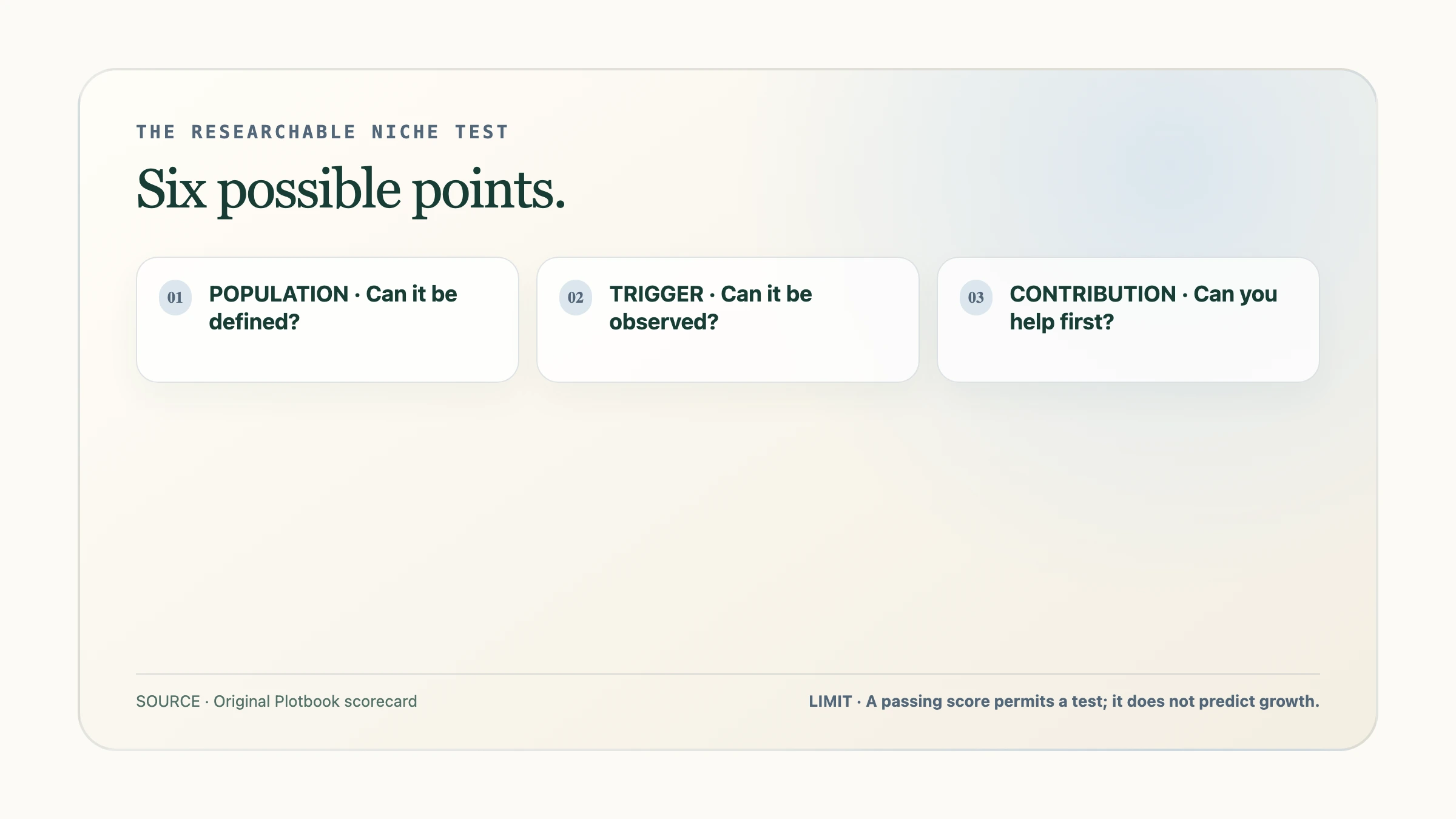
A researchable advisor niche passes three tests: you can define who is in it, observe a real planning trigger without guessing, and contribute something specific before asking for a meeting. "Affluent families" fails all three. A bounded profession, employer population, ownership type, or life-event cohort may pass.
This scorecard is stage one of AI prospecting for financial advisors. It is not a list of the "best" niches. We ran ten candidates through the same test so the weak ideas are visible, not quietly removed from the article.
unknown nodeThe three-question test
Score each question from zero to two.
1. Can you define the population?
- 0: membership depends on a guessed trait such as "wealthy," "worried," or "ready to retire."
- 1: the group is conceptually clear but no complete or stable source exists.
- 2: a public or permissioned source defines the population with a date and geography.
2. Can you observe a planning trigger?
- 0: the trigger is private intent or a model prediction.
- 1: a source shows context but not the event itself.
- 2: a dated filing, transaction, vesting schedule, professional milestone, or public announcement establishes the event.
3. Can you contribute before asking?
- 0: the only offer is a portfolio review or generic consultation.
- 1: the advisor has relevant knowledge but no niche-specific artifact or process.
- 2: the advisor can provide a concrete checklist, decision model, briefing, or coordinated professional workflow.
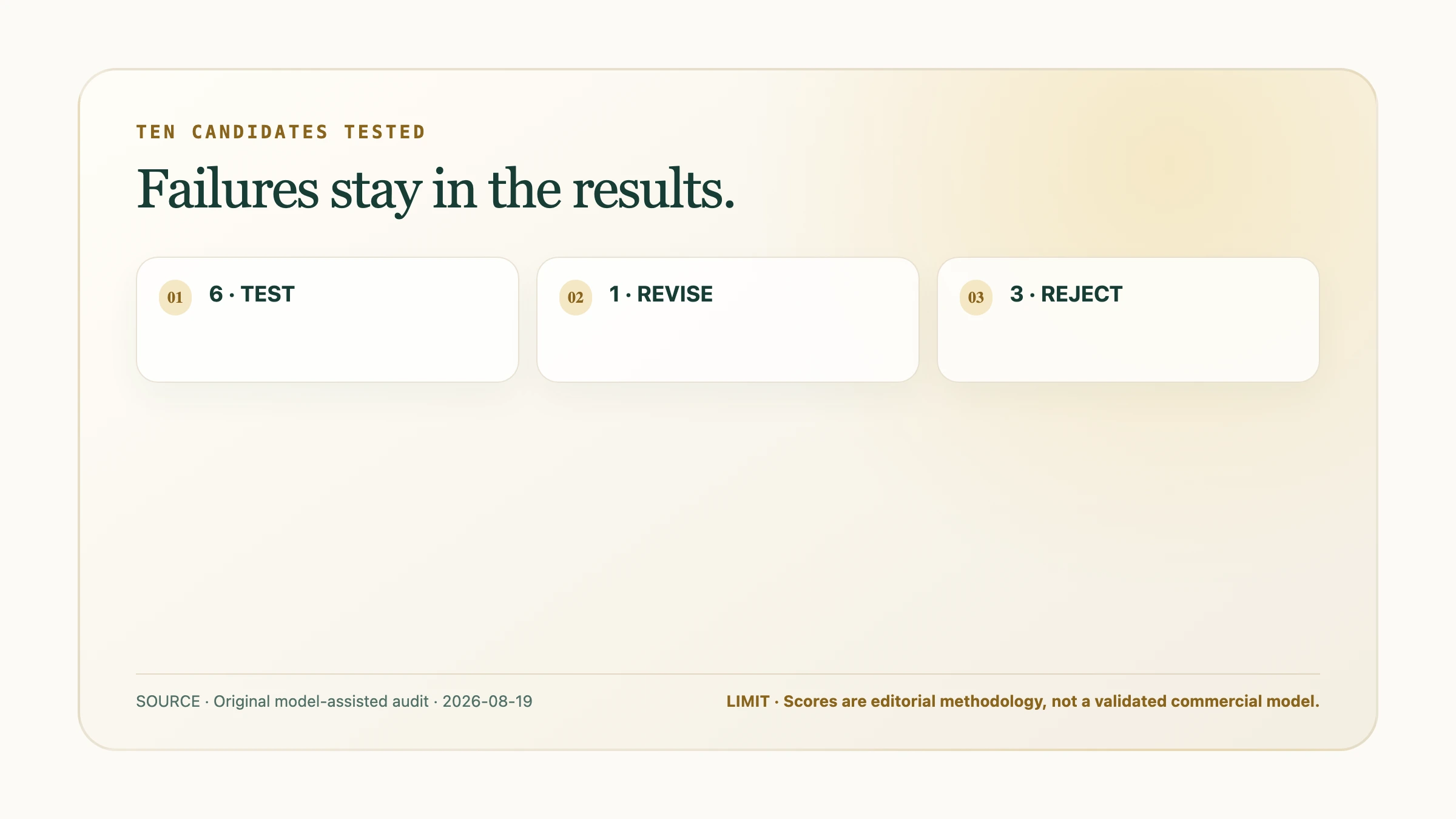
Decision: 5–6 points = TEST; 3–4 = REVISE; 0–2 = REJECT. A passing score is permission to test a market, not proof that the market will convert.
The scorecard also prevents a common reversal: choosing a content angle first and inventing a market around it. Sources come before the editorial calendar. If the same ten names cannot be found twice by two researchers using the written definition, the population is not yet defined.
Kitces' 2024 marketing survey found niche focus more common among high-growth practices than among other practices (Kitces Report, 2024); our guide to AI prospecting for financial advisors covers the figures and what that correlation can and cannot show.
The ten-candidate scorecard
We used Treasure Valley, Idaho as the common territory so geography did not change between candidates. On August 19, 2026, we asked Claude Opus 5 and GPT-5.6 to suggest niches for a Boise advisor, then to judge whether a list of common advisor niches could actually be researched. Both ran from an empty temporary folder with no access to our files. Claude ran with every tool disabled, so its answers came from general knowledge. GPT-5.6 ran in OpenAI's Codex with its built-in web search on and used it: six searches for the niche suggestions and thirteen for the researchability test. We did not test Gemini or Copilot.
Several candidates below come from those suggestions (equity-compensated employees, federal workers, contractors, medical practice owners, founders); the rest are common advisor-marketing ideas, included so the failures are visible. The scores are ours, assigned conservatively with the rubric above. The models' role was to show where plausible-sounding local detail outran its sources.
|
Candidate niche |
Population |
Trigger |
Contribution |
Score |
Decision |
|---|---|---|---|---|---|
|
Public-company employees with disclosed equity plans |
2 |
2 |
2 |
6 |
TEST |
|
Owners of contracting firms preparing for a sale |
2 |
1 |
2 |
5 |
TEST |
|
Medical practice owners |
2 |
1 |
2 |
5 |
TEST |
|
Federal employees nearing retirement eligibility |
2 |
1 |
2 |
5 |
TEST |
|
University faculty with optional retirement-plan choices |
2 |
1 |
2 |
5 |
TEST |
|
Founders who have raised private capital |
2 |
1 |
2 |
5 |
TEST |
|
High-income young families |
0 |
0 |
1 |
1 |
REJECT |
|
Country-club members |
0 |
0 |
1 |
1 |
REJECT |
|
People living in expensive homes |
1 |
0 |
1 |
2 |
REJECT |
|
Executives "likely" to have concentrated stock |
1 |
0 |
2 |
3 |
REVISE |
The score is deliberately conservative. A public source can identify a population without proving that each member is a suitable prospect. A trigger can be real without proving intent. An artifact can be useful without earning a meeting.
Why the first six pass
Public-company employees with disclosed equity plans
The employer and plan are definable from company filings and plan documents. SEC proxy statements can disclose executive compensation and equity arrangements; Form 4 covers transactions by directors, officers, and more-than-10% owners. The planning contribution can be a dated vesting and concentration checklist. The score does not justify guessing an employee's holdings.
The SEC describes Form 4 as a transaction report for a limited population, generally due within two business days; it is not a directory of all shareholders (SEC Investor Bulletin). FEC contribution search can corroborate reported geography and professional context but cannot establish net worth (FEC individual contributions).
Contracting-firm owners preparing for a sale
State corporate records and industry directories can define owners; transaction intent is harder. A public listing, announced transaction, or owner-stated plan can establish timing, but firm age alone cannot. That is why trigger receives one point. The advisor can contribute a pre-LOI personal planning checklist alongside CPAs and attorneys.
Medical practice owners
Professional-license and business-entity records can define practice owners in many states. Ownership structure, retirement-plan design, and succession can create recurring work. A license does not establish earnings, sale plans, or dissatisfaction with an advisor.
Federal employees nearing retirement eligibility
The population and benefit rules are defined, and retirement eligibility can be calculated from facts the employee supplies. Because no public filing establishes the date for a given person, trigger receives one point. Do not source an employee's private service record without permission or imply agency endorsement. The contribution is a benefits election and income-transition worksheet.
University faculty with plan choices
An employer directory and published plan documents can define the population and benefit structure. The plan's eligibility or election windows may provide timing, but an individual's holdings remain private. The advisor's useful contribution is a plan-choice comparison built from the official documents.
Founders who have raised private capital
Form D names issuer-side officers, directors, and promoters and includes offering details. It does not name individual investors or purchasers. The source can define founders connected to a financing, while liquidity remains unproven. The contribution is a founder planning checklist; it makes no claim about current wealth.
Why the last four fail
High-income young families: undefined twice
"High-income" needs a threshold and "young" needs an age definition. IRS ZIP data can describe aggregate adjusted gross income by place, but not name high-income households. The life stage and planning need are private. This is a persona for messaging, not a researchable prospect population.
Country-club members: private roster dependence
Membership could be specific, but the source is usually private and contract-bound. Building a market around leaked, scraped, or purchased rosters creates a provenance problem before planning value is considered. Reject unless the club itself invites an approved educational relationship and members opt in.
People living in expensive homes: one signal mistaken for a niche
Assessor data can define properties above a threshold, but a home value does not establish investable assets, income, age, planning need, or intent. The Federal Reserve's 2022 Survey of Consumer Finances reported real median family net worth of $192,900 and a top-decile median of $3,794,600, with primary residence included in net worth (Federal Reserve, 2023). Those national distribution statistics cannot turn one property's value into one household's balance sheet.
Use property as a territory signal and follow how net worth estimates should be presented as ranges. Do not make the property value the outreach hook.
Executives likely to have concentrated stock: revise "likely"
Job title alone is not the trigger. Revise the niche to a covered group with disclosed holdings or transactions, or to employees who self-identify concentration during an opt-in event. The useful planning problem is real; the proposed discovery method was not.
What the model got wrong in our source audit
Both models produced local detail that sounded researched. The audit found three recurring problems.
First, they named private or unstable sources as if availability were obvious: employer directories with unknown completeness, plan features without current documents, and professional groups that did not publish member rosters. Second, they treated a plausible planning issue as a visible trigger. Third, they proposed timing claims (grant seasons, retirement windows, transaction cycles) without a dated primary source.
What fixed it was a source requirement: every population, trigger, and contribution needed a retrieval path and a field marked NOT ESTABLISHED. This is the first prompt in the five-part advisor prospecting prompt system.
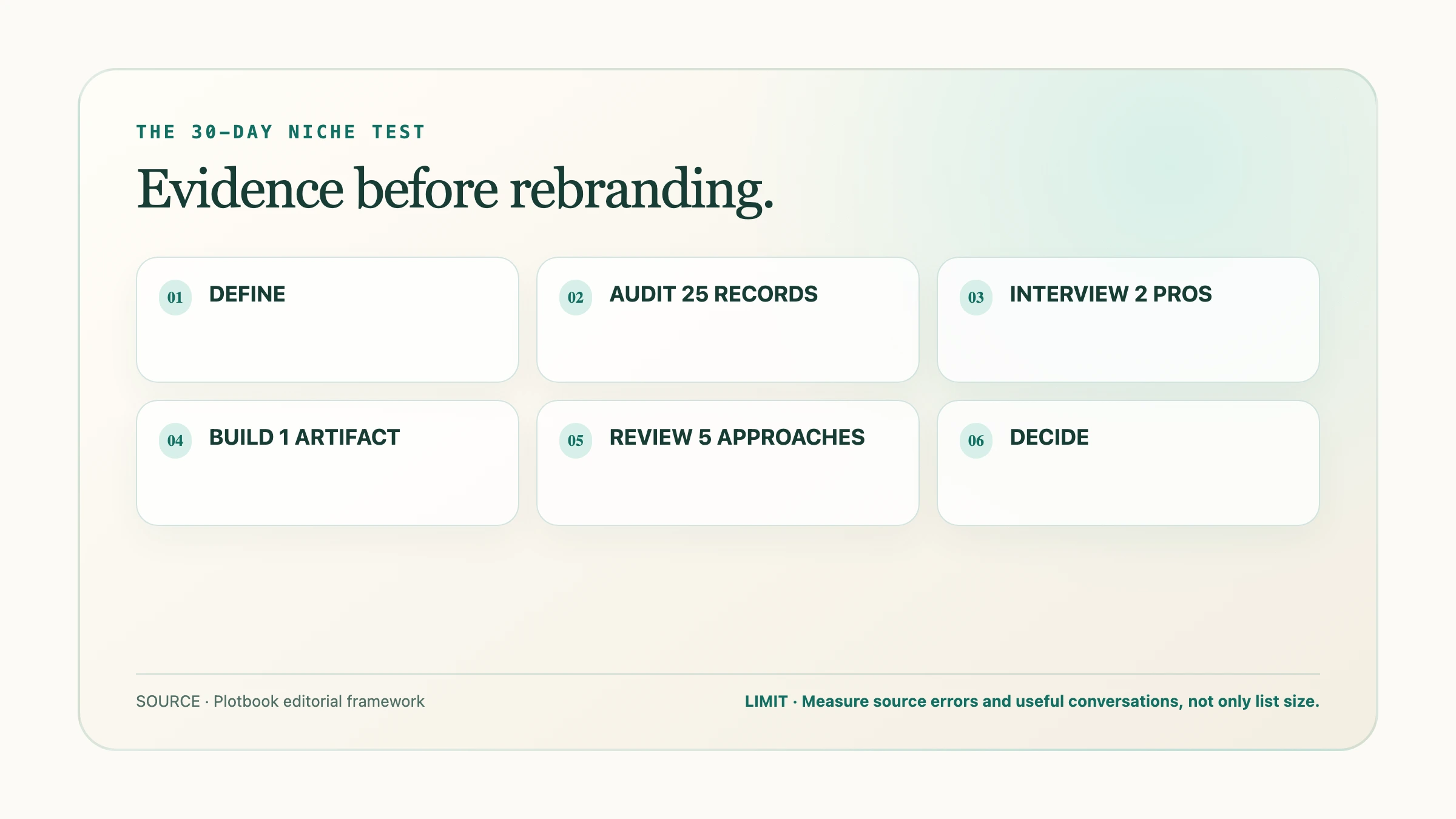
Run a 30-day niche test
Do not rebrand the practice after one scorecard. Run a bounded test.
- Define one territory and one source-backed population.
- Verify 25 records manually, recording false matches and missing fields.
- Interview two professionals who already serve the niche.
- Build one ungated artifact that answers a repeated question.
- Draft five approaches from verified professional context, then route them through the firm's review process.
- Measure replies, useful conversations, source error rate, and artifact usage. List size alone says little.
Plotbook can help with property-led territory research and owner research, but no tool makes an unbounded persona into a defensible niche.
Frequently asked questions
What is niche marketing for financial advisors?
It is a practice and communication strategy built for a defined client population with recurring planning needs. A useful niche affects services, research, education, and referrals, well beyond website wording.
Does a financial advisor need one niche only?
No. The Kitces definition used in the cited survey allowed up to three niche markets. The practical limit is whether the practice can build real expertise and specific workflows for each one.
Is a geographic area a niche?
Geography is a territory. It becomes a niche only when combined with a defined population or problem. "Families in Phoenix" is a territory label; "owners of Phoenix manufacturing firms planning succession" is closer to a niche.
Can AI choose my advisor niche?
AI can generate candidates and help structure the test. It cannot validate local source coverage, buyer willingness, advisor credibility, or firm approval without evidence and human work.
The decision rule
A niche is worth testing when the advisor can say who belongs, what observable event changes the planning conversation, and what useful thing the practice can contribute now. If any answer depends on guessed wealth, private intent, or an unavailable list, revise the niche before building content around it.