

If a prospecting database says a stranger is worth exactly $8.7 million, the precision is doing more work than the evidence.
Private assets are not a public balance sheet. Property records, professional history, business interests, and public filings can support a useful range. They rarely support a single authoritative number. The job of a wealth estimate is to help you prioritize research, not to manufacture certainty. It should sit beside the source trail that established the person's identity, not replace it.
unknown nodeWhat a net worth estimate is
Net worth is assets minus liabilities. That definition is simple. Estimating it for someone who has not handed you a financial statement is not.
An outside researcher may be able to observe real estate, public securities, company ownership clues, career history, or public transactions. Debt, private-company value, trusts, family ownership, and liquidity can remain partly or completely hidden.
A defensible estimate therefore has three parts:
- A range, not a point value
- The signals used to build the range
- A confidence level that reflects the quality and agreement of those signals
Without all three, the output is difficult to evaluate and easy to misuse.
Even official measures have to define their boundaries. The U.S. Census Bureau's Wealth of Households: 2024 defines wealth as assets owned minus debts owed, but its published measure excludes equity in pension plans and home furnishings. The report estimated median household wealth at $204,900, the 10th percentile at $0, and the 90th percentile at $1.81 million (U.S. Census Bureau, July 2026). Those figures describe a population distribution, not a shortcut for estimating a named person.
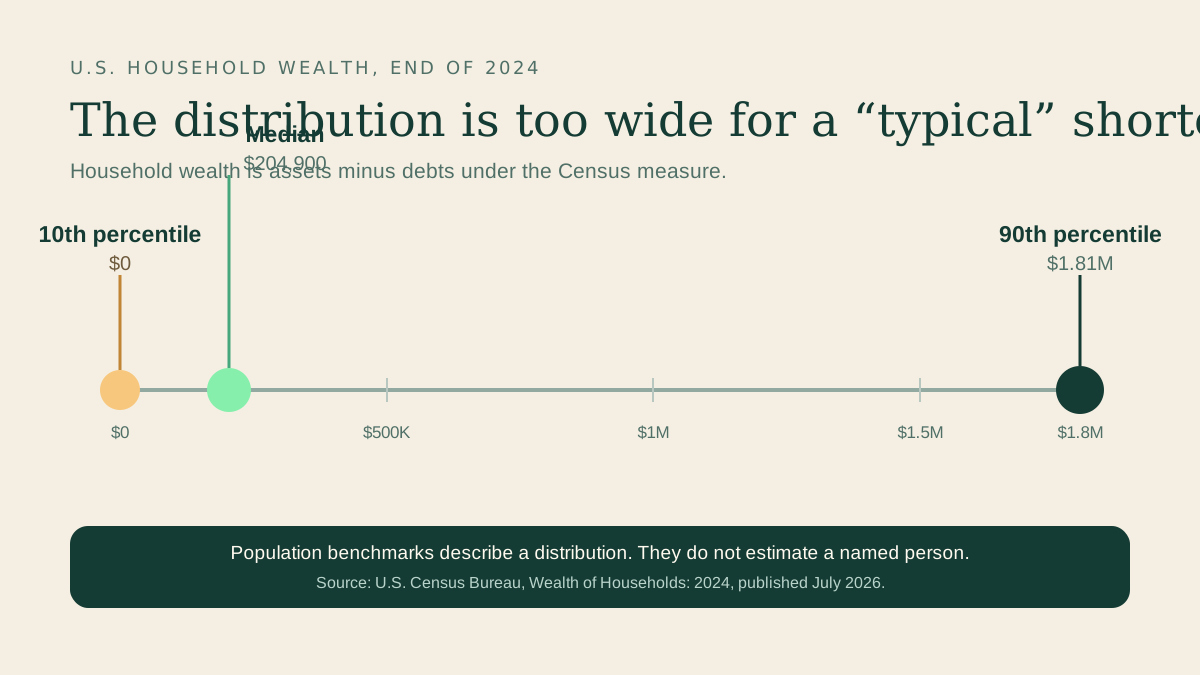
Source: U.S. Census Bureau, Wealth of Households: 2024. The underlying 2025 Survey of Income and Program Participation measured wealth at the end of 2024.
Net worth, total assets, income, and investible assets are different
One number cannot answer every prospecting question. Four measures are more useful when they stay separate.
Net worth
Estimated net worth is the value of assets minus estimated liabilities. It is the broadest summary and often the least directly observable.
A person can own valuable assets and carry substantial debt. A business owner can also have a high paper value with little accessible liquidity. Treat net worth as a directional band, not a bank statement.
Total assets
Total assets estimate the gross value of property, business interests, financial holdings, and other assets before liabilities.
This figure can be much higher than net worth. Keeping it separate makes the debt assumption visible instead of burying it inside a single number.
Annual income
Income is a flow over time. It can come from salary, business earnings, investments, or other sources. A high-income professional and a retired business owner can have similar net worth with very different current income.
Do not infer income from a job title alone. Compensation varies by company, geography, seniority, ownership, and career stage.
Investible assets
Investible assets are the portion of wealth that may be available for financial management. A primary residence is usually relevant to household context, but its full value is not automatically investible.
For a wealth advisor, this can be the most commercially relevant estimate and the easiest one to overstate. Real estate concentration, business equity, debt, and illiquid holdings all widen the uncertainty.
The definition changes with the purpose. Capgemini's 2026 World Wealth Report uses at least $1 million in investible assets for its high-net-worth-individual category and excludes the primary residence, collectibles, consumables, and consumer durables. The SEC's individual accredited-investor test uses net worth over $1 million while excluding the primary residence. Neither is a universal accounting definition. They demonstrate why every estimate should state what its label includes (Capgemini Research Institute, June 4, 2026; U.S. Securities and Exchange Commission, updated June 13, 2024).
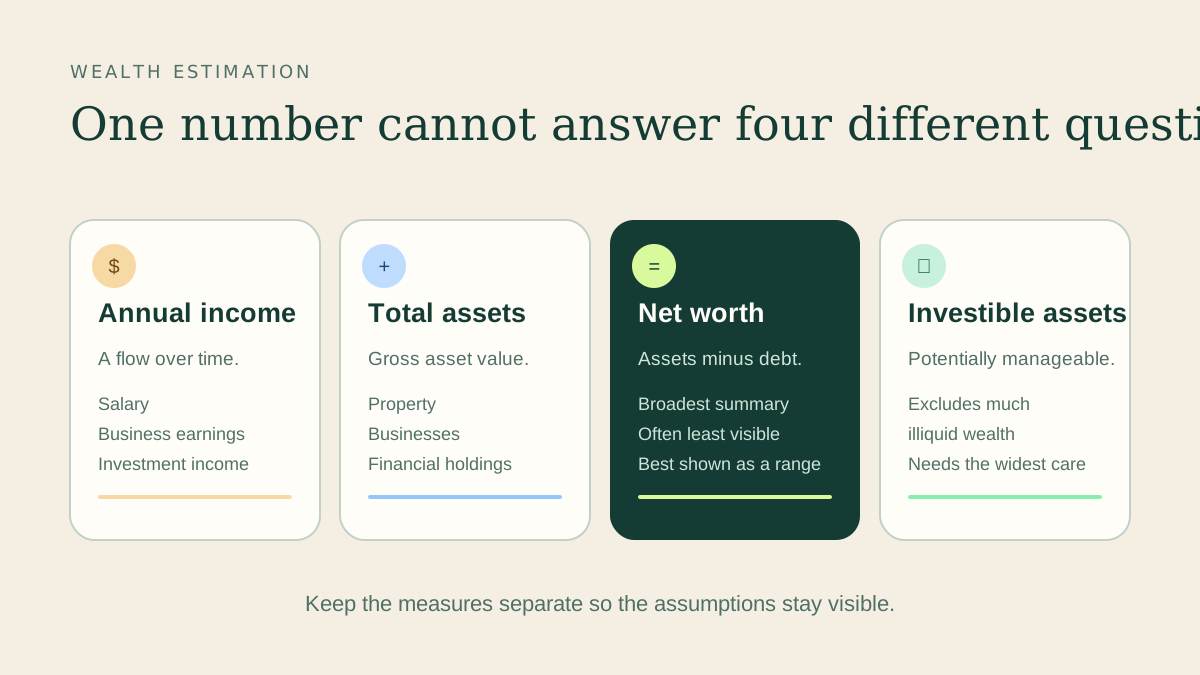
Each measure answers a different question. Keeping them separate prevents a primary residence or private business from silently becoming "investible."
Property value is a signal, not a net worth shortcut
Property records are useful because they tie an owner to a real asset in a specific place. They are not enough to calculate net worth.
Assessed value is set for property-tax purposes. Depending on the county, it may trail market conditions or follow local assessment rules that make it a poor substitute for sale price. Even a current market value says nothing by itself about the mortgage balance, co-owners, liens, or how much of the household's wealth is tied up in the property.
Use property as one anchor:
- Is the parcel owner-occupied or held as an investment?
- Does the owner appear across multiple properties?
- Is ownership personal, joint, in a trust, or in an entity?
- Does the tax-bill mailing address suggest another property or business?
- Does the professional history make the broader estimate plausible?
A $5 million home can belong in a high-priority research queue. It cannot, by itself, tell you the owner's liquid assets.
The International Association of Assessing Officers says market value cannot be observed directly and that appropriately screened and adjusted sales are normally the most objective indicators. It also warns that ratio-study statistics describe groups of properties and cannot establish the appraisal level of an individual parcel (IAAO Standard on Ratio Studies, approved April 2013 and still recommended while a 2026 revision is in draft).
Area-level price indexes have a similar limit. The FHFA House Price Index uses tens of millions of repeat transactions to measure average price change. It is not a current appraisal of a named house (Federal Housing Finance Agency, updated November 25, 2025). A prior sale adjusted by an index can improve a rough starting value, but property condition, improvements, rights, and local comparables still matter.
Better estimates combine independent signals
The strongest inputs come from sources that answer different questions. Several copies of the same stale profile do not count as independent corroboration.
Useful signal groups include:
- Property: assessed value, use type, ownership structure, mailing address, and additional parcels
- Professional: current role, career seniority, tenure, and verified company affiliations
- Business: disclosed ownership, public transactions, leadership roles, and credible company information
- Public filings: securities disclosures, political contributions, and other records when they clearly match the same person
- Household context: co-ownership and address history, handled carefully and only where the data is licensed or public
The purpose is not to collect the largest possible pile of facts. It is to test whether different evidence points in the same direction.
Confidence and wealth are independent dimensions
A high estimate can have low confidence. A modest estimate can have high confidence.
Suppose a public-company executive has disclosed compensation, verified share ownership, and a clearly matched property. The available range may be well supported even if it is not enormous.
Now consider the principal of a private holding company with several entity-owned properties and no disclosed company value. The likely range may be higher, but the confidence should be lower because the largest inputs are inferred.
Combining amount and confidence into one "wealth score" hides that distinction. Keep them visible so a researcher can decide whether to act, verify, or wait.
A confidence label should describe evidence coverage unless the score has been statistically calibrated. "High evidence coverage" is defensible when several independent sources agree. "92% likely to be correct" is a different claim and requires validation data that many prospecting products do not disclose.
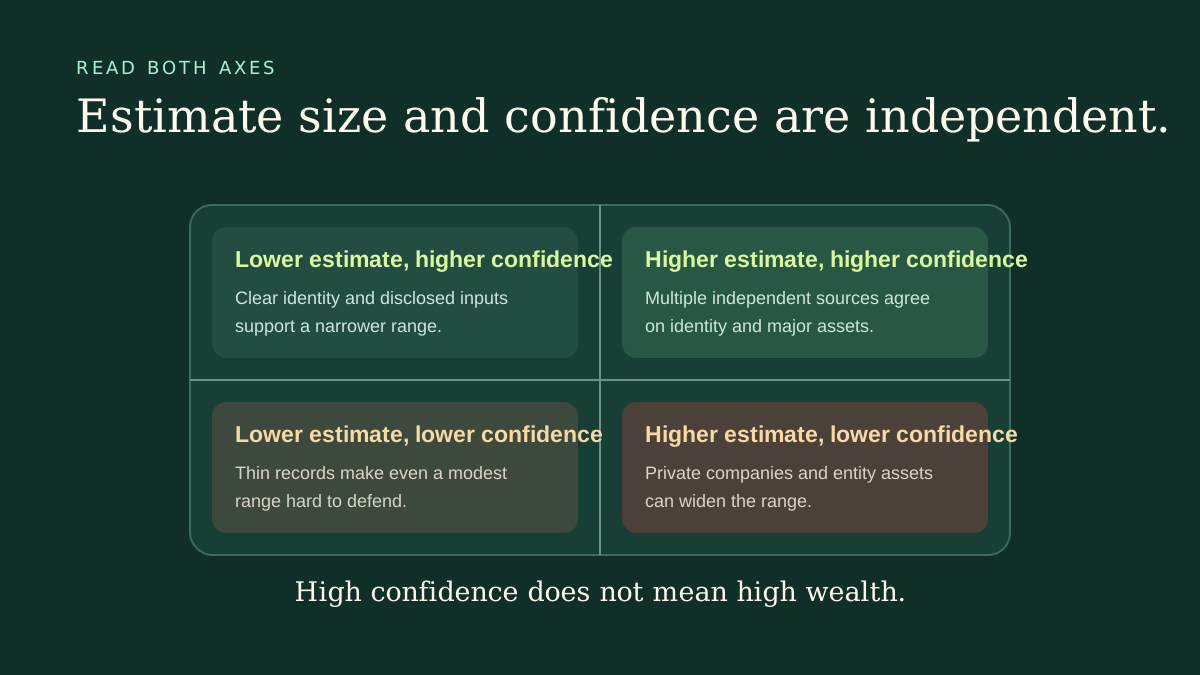
Read estimated value and evidence confidence as separate dimensions.
What a useful wealth estimate should show
A responsible third-party estimate follows a visible sequence:
- Resolve the person or household behind the asset.
- Gather observable assets and any supportable ownership percentages.
- Attach an as-of date to every source.
- Value each asset with a method appropriate to that asset.
- Subtract known or supportable liabilities.
- Keep unobserved financial assets outside the known subtotal.
- Build low, base, and high scenarios from documented assumptions.
- Assign evidence quality separately from estimated value.
- Recalculate when ownership, market, or source data changes.
The range should widen when the largest inputs are inferred, stale, or illiquid. Confidence should fall when the identity or ownership evidence is thin. Those are separate adjustments, which is why one score should not hide both.
Before you trust an estimate, ask whether the product or researcher gives you:
- A minimum and maximum rather than one exact number
- Separate ranges for net worth, total assets, income, and investible assets
- A confidence score or plain-language confidence level
- The property and identity record used as the starting point
- A summary of the reasoning
- Source links or source names
- A way to report incorrect information
- Clear language that the output is an estimate
If the system cannot tell you why it believes the number, the number is hard to defend in a prospect review or compliance conversation.
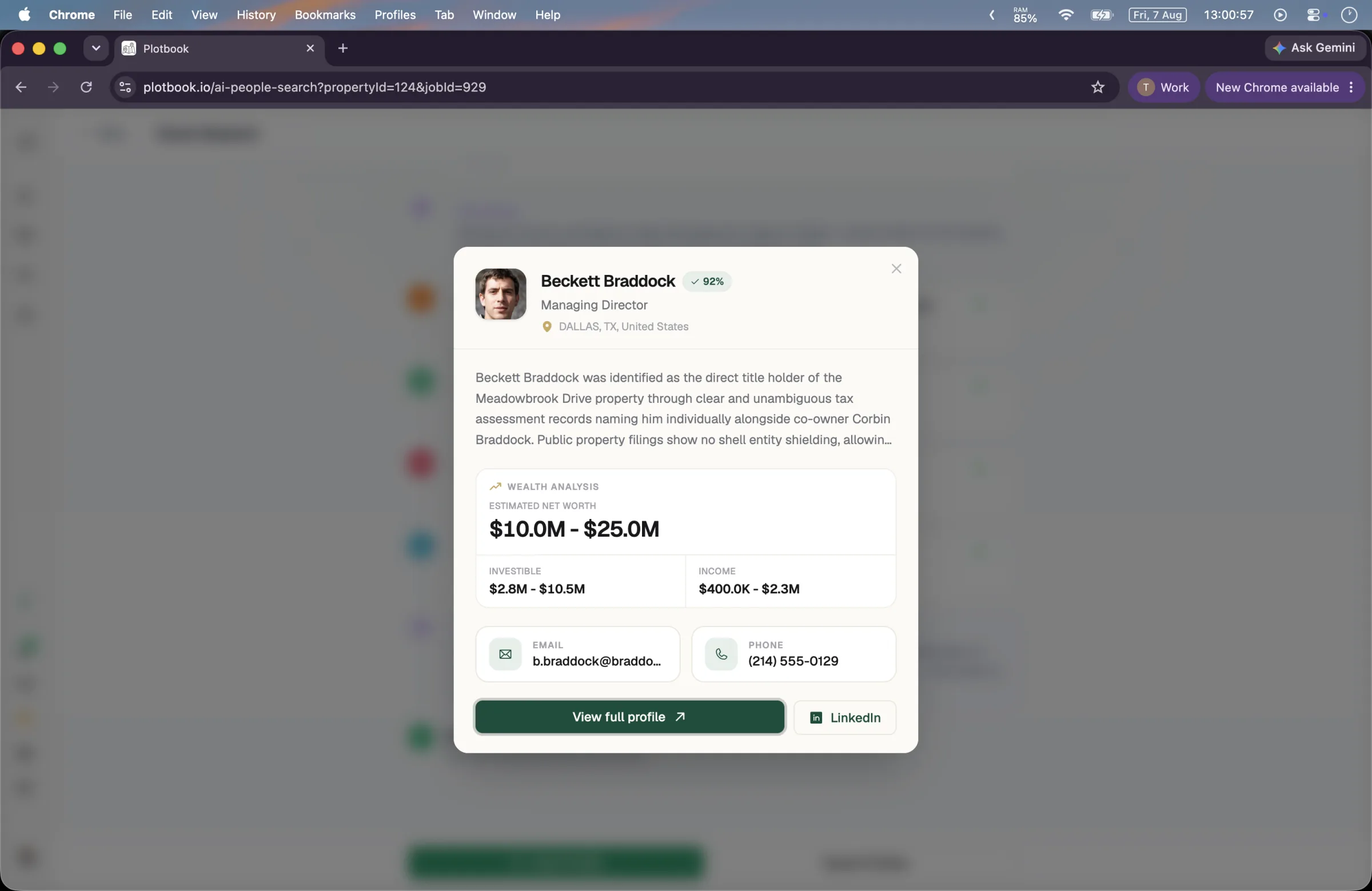
Plotbook interface with illustrative demo data. The range and research summary stay visible together; the figure is not a customer result.
How to use a wealth estimate in prospecting
Use the range to order work, not to script a conversation.
A practical workflow looks like this:
- Start with a territory, referral, or known property.
- Confirm the person's identity before evaluating wealth.
- Review the range and confidence together.
- Check which asset types drive the estimate.
- Verify high-impact assumptions before outreach.
- Save the sources and notes with the prospect record.
- Keep estimated wealth out of client-facing claims unless your compliance process explicitly allows it.
The estimate can answer, "Which ten records deserve another hour of research?" It should not answer, "What do I already know about this person's finances?"
Where wealth estimates break down
Some profiles will remain uncertain even after careful research.
Private-company ownership is difficult when the person's stake and the company's value are undisclosed. Trusts can separate legal title, beneficial interest, and control. Real estate can be held through layers of entities. Public profiles can be outdated, and people with common names are easy to misidentify.
The IRS's own fair-market-value guidance says a closely held business usually requires expert help and consideration of financial data, prospective earnings, company history, industry outlook, management, asset value, goodwill, and comparable businesses (IRS Publication 561, December 2025). If ownership percentage, private financials, control rights, and marketability are unknown, a narrow business-value range is hard to defend.
There is also a timing problem. A credible estimate today can become stale after a sale, financing, divorce, inheritance, or business transaction. The research date belongs beside the range.
These are not edge cases to hide. They are reasons to use ranges and preserve confidence.
How Plotbook presents wealth estimates
Plotbook starts from a property or person record, resolves the identity, and then produces four ranges: net worth, annual income, investible assets, and total assets. Each completed owner research profile also carries a confidence score and a research summary.
The linked parcel contributes property value and use type, while the owner research contributes professional history, business context, public sources, and corroborated contact details. The estimate remains a range because the underlying data does not justify false precision.
You can review the result in Saved Profiles, keep the property and research summary attached, and choose which wealth fields to include in a CSV export. For a public example, open the sample report.

Illustrative product visual. The identity and values are demo data, not a claim about a real person.
Inspect the range before you use it
See how Plotbook wealth estimation works, then compare the displayed range, confidence, parcel, and research summary in the sample report. The useful test is whether the evidence is clear enough for you to decide what needs verification next.
Frequently asked questions about net worth estimates
Can you calculate net worth from a home value?
No. A home value does not reveal mortgage debt, other assets, liabilities, co-ownership, or liquidity. It is one signal in a broader estimate.
Why use a net worth range instead of one number?
The source data contains uncertainty. A range makes that uncertainty visible and avoids presenting inferred private finances as an exact fact.
What is the difference between net worth and investible assets?
Net worth is assets minus liabilities. Investible assets are the portion that may be available for financial management. Home equity and private-company ownership can contribute to net worth without being readily investible.
Does a high confidence score mean high net worth?
No. Confidence describes how well the evidence supports the identity and estimate. It does not describe the size of the estimate.
A credible estimate keeps its uncertainty attached
Net worth looks simple only after every asset and liability is known. A third party rarely has that complete view. The responsible process resolves the person first, dates each source, separates observable assets from inferred ones, subtracts supportable liabilities, and presents low and high scenarios with an evidence-quality signal.
That does not make a wealth estimate useless. It makes the correct use clearer: prioritize records, identify assumptions, and decide where human verification is worth the time. The range is doing its job when it tells you both what may be true and how much remains unknown.
For the discovery step that comes before estimation, compare property-first and list-first prospecting.