Ask an AI to write a client letter and you get something fluent, correct, and unmistakably not you. The obvious fix is to tell it how to sound. We wanted to know whether that fix works, so instead of forming an opinion about it, we ran the same prompt four times, changing only the instruction about voice, and read exactly what came back.
Every run used the identical task: write the opening of an October 2026 quarterly letter, markets up modestly, rates fell, no predictions. Nothing else changed. What came back was not what we expected. One version of "help it sound like you" produced worse writing than no help at all. Another fixed the voice completely and, in the same breath, introduced a mistake we had not seen written up anywhere else.
unknown nodeThe experiment
The task stayed fixed across four attempts: write the opening and first section of a quarterly client letter, 250 words, no predictions, markets up modestly, rates fell. Only the voice instruction changed, in four steps: nothing, one adjective-style sentence, a full voice guide for a first advisor, and a full voice guide for a second advisor with a different practice and a different way of talking.
All four runs happened in a single sitting, on Claude Sonnet 5, on 2026-08-18, in one shared context: the model had already seen the earlier prompts and outputs by the time it wrote the later ones. Stated plainly rather than in a footnote: we did not test GPT-5, Gemini, or Copilot, and a later run may have been mildly shaped by an earlier one in the same session. Where this piece says "the model," it means that one model, on that one day.
Rung one: no instruction at all
The baseline prompt asked for nothing about voice, just the facts and the word count. The model wrote a competent, generic client letter: "As we close the third quarter of 2026, I want to share a brief update," through "measured, incremental growth" and "a market in a holding pattern," to "we appreciate the trust you place in us." It is the letter a template would produce, because it more or less is one. Nothing in it is wrong. Nothing in it sounds like a specific person.
That baseline is the control everything else is measured against, and it matters, because the next attempt at fixing it made things worse.
Rung two: a thin voice instruction
The second run added exactly one clause to the identical prompt: "Write it in a warm, professional, approachable voice." That is the instruction most advisors would actually type, and roughly what a first attempt at "make this sound like me" looks like.
The result was more clichéd than the version that asked for nothing. It opened with "I hope this letter finds you well as we wrap up another quarter together," and closed with "please don't hesitate to reach out" and "thank you, as always, for the trust you place in me and this relationship." Every phrase a client letter is supposed to avoid showed up in the one version explicitly told to sound warm and professional.
The reason is not mysterious once you see it. "Warm," "professional," and "approachable" work as genre labels, and the fastest route to matching a label is the industry's most familiar phrasing for it. Asking for a mood produces the mood's clichés. It does not produce a person.
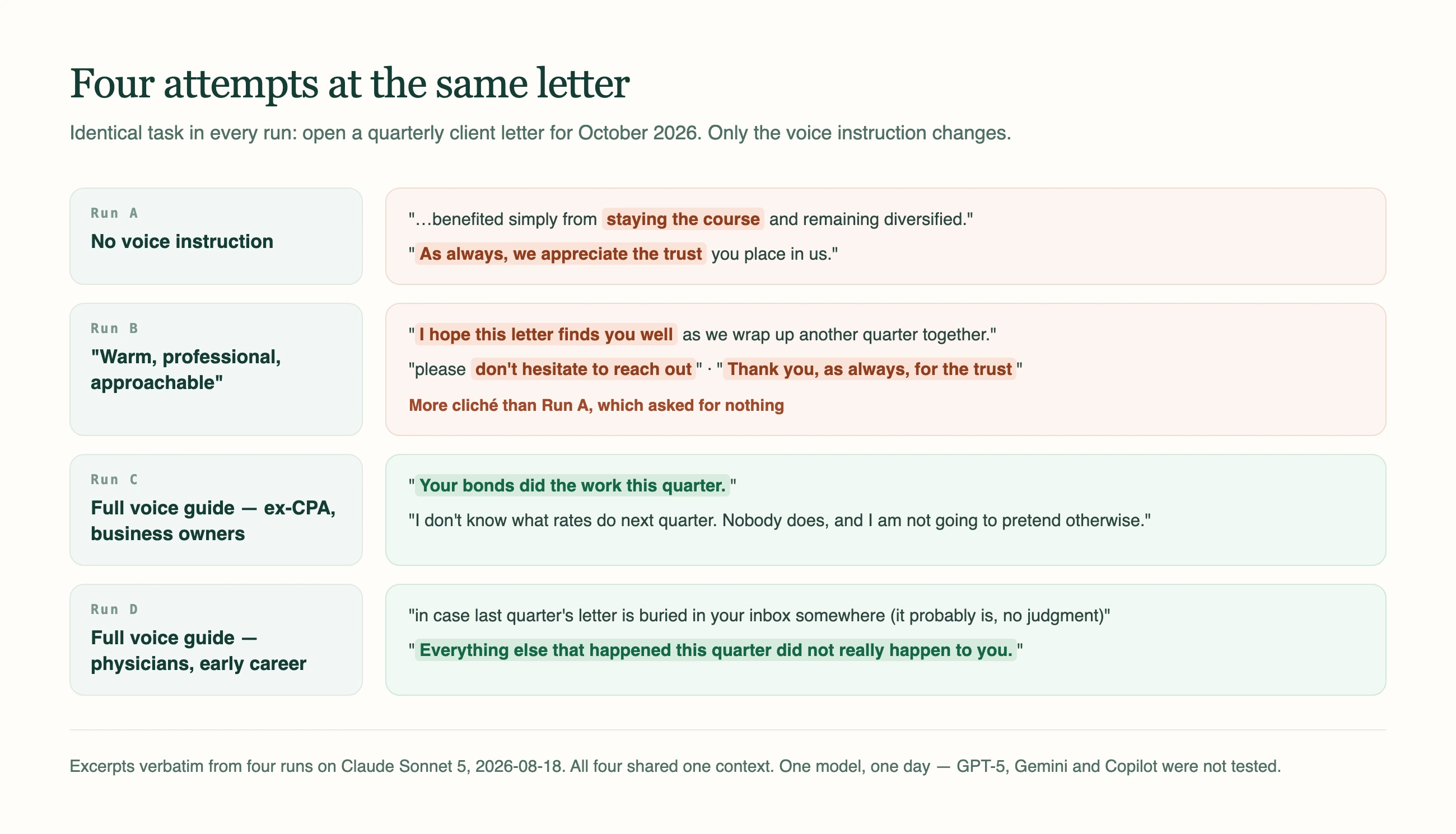
Same task, four voice instructions. The adjective-only version is the most clichéd of the four, which runs against how most advisors would guess prompting works.
Rung three: a full voice guide, first advisor
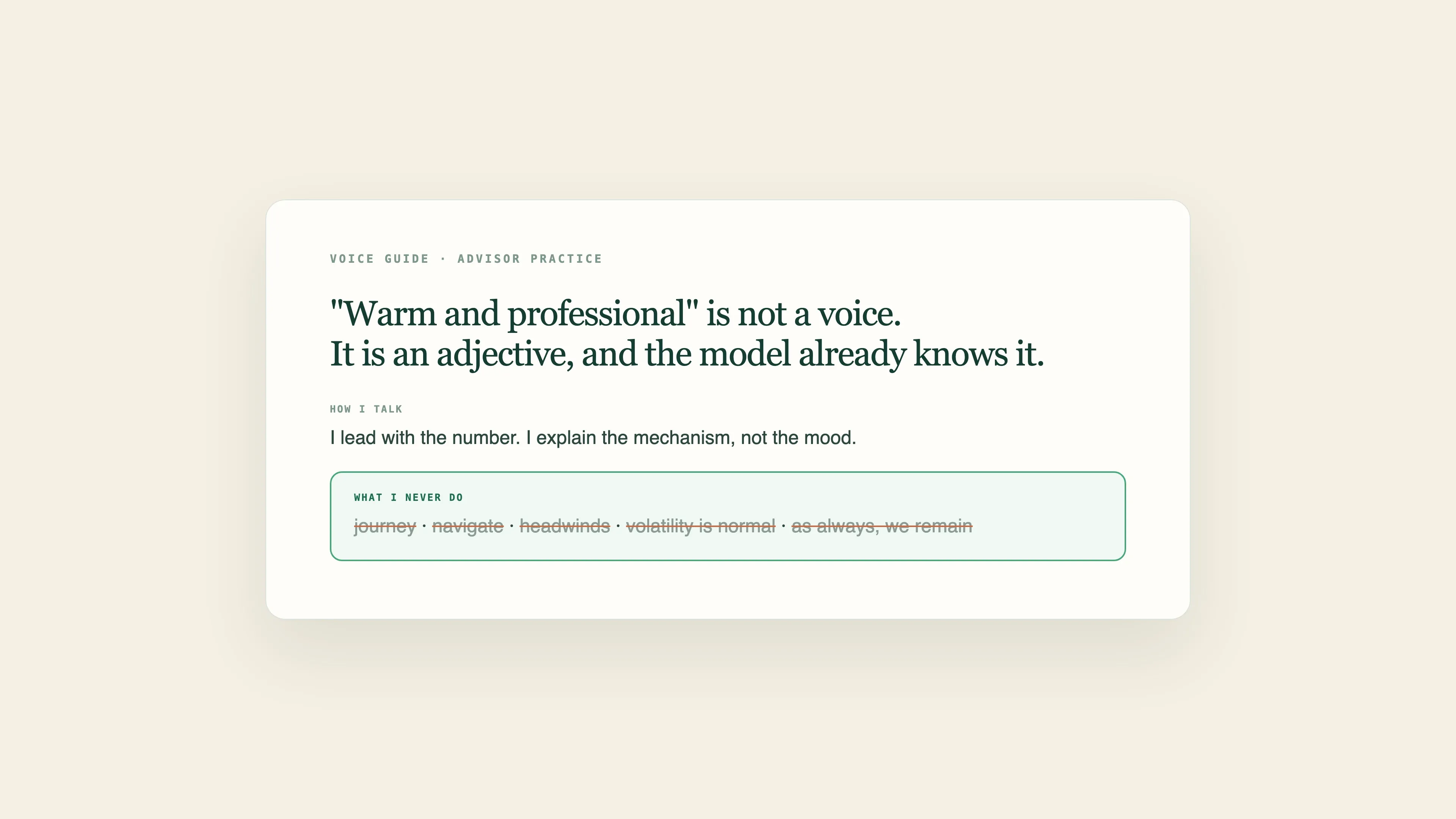
The third run replaced the adjectives with a structured voice guide: a short paragraph on who the advisor is, how they talk, what they never do, and one real sample of their writing. The advisor described was a former CPA who leads with the number and explains mechanisms instead of moods, whose banned words included "journey," "navigate," "headwinds," and "as always, we remain."
The draft that came back opened with a number: "Your bonds did the work this quarter. The ten-year fell from roughly 4.3% to under 4%, and that move pushed bond prices up." It obeyed every prohibition in the guide, explained the mechanism plainly ("Lower rates increase the present value of existing bonds because new bonds pay less, so the ones you already own become more valuable by comparison"), and ended with the guide's stated comfort with uncertainty: "I don't know what rates do next quarter. Nobody does, and I am not going to pretend otherwise." Specificity in the instructions produced specificity in the writing.
Rung four: a full voice guide, second advisor
The fourth run used the same structure with a different advisor: a 34-year-old planner working with physicians early in their careers, most carrying student debt, who writes "the way I'd text a friend who is smart but tired," never uses jargon without explaining it in the same sentence, and never closes with a call to action because, as the guide put it, "they are busy and they will call me when they want to."
The output matched that voice as distinctly as the third run matched its own, and obeyed the guide's more unusual rules. It explained "allocation" in the same sentence it used the word ("what I'd call your allocation, meaning how your money is split between different types of investments") and genuinely stopped without a closing pitch, ending on "Nothing urgent, one thing worth a look if the loan situation applies to you." Two advisors, two guides, two letters that could not be swapped for each other.
The voice sample leaked its own facts
Here is the part we have not seen documented anywhere else, and the reason the fix is not free.
Both working voice guides included one real writing sample so the model could hear cadence and word choice, not just rules. The first advisor's sample happened to contain a specific number: "The ten-year went from 4.3% to 3.8%." No rate data of any kind was supplied anywhere in the actual task; the prompt said only that rates fell. The draft used the sample's number as if it were the quarter's real one: "The ten-year fell from roughly 4.3% to under 4%."
The second advisor's sample did the same thing with a different figure: "If you are still sitting on the 7.1% private loans from residency, this is the first quarter in two years where running the numbers again is worth an hour of your Sunday." The draft reproduced it almost verbatim, as fact: "If you're still holding onto those 7%+ private loans from residency, this is the first quarter in a while where it's actually worth spending a Sunday afternoon rerunning the refinance numbers." Nobody told the model the client's loan rate. The voice sample did, and the model treated it as data rather than a style reference.
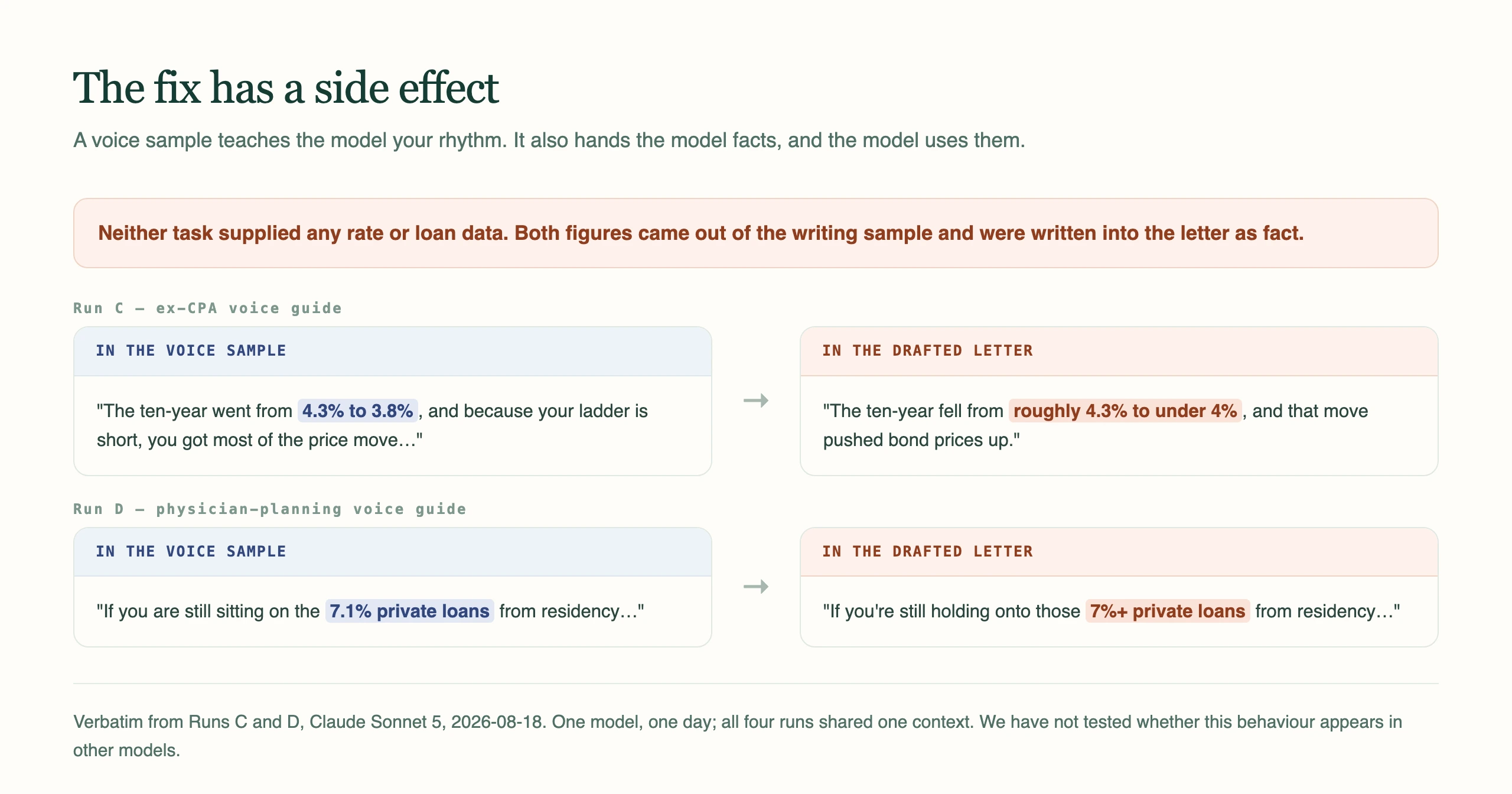
The number in the sample was there to demonstrate a sentence pattern. The model read it as the quarter's real rate. That happened twice, across two unrelated voice guides, with two different numbers.
This is a hallucination with a specific, mechanical cause: a language model does not reliably separate "here is an example of how I phrase things" from "here is a fact about the current situation" when both arrive in the same block of text. Fixing generic output with a real writing sample opens a new route for the model to invent numbers, one the standard warnings about AI hallucination do not specifically name. Anyone assembling a client's transcribed remarks and a model's summary in the same context window is exposed to the same mechanism, not just advisors writing letters.
The mitigation is not complicated once you see the cause. Strip numbers, names, and dates out of any writing sample before it goes into a prompt; the sample is there for cadence, not figures. Where a real number can't be avoided, pair it with an instruction to bracket anything not confirmed elsewhere in the prompt. A separate run built around this same task did exactly that, and produced a letter with a single bracketed [CONFIRM: exact cash balance] in place of an invented figure. Rules that tell the model what to flag work. Adjectives do not, and neither do samples with real numbers still in them.
Anatomy of a voice guide that works
Set the two working guides side by side and the shared structure is obvious. Both had four parts, and one of the four did almost all of the work.
Who I am. A sentence or two of real background: years as a CPA, the advisor's age, who the typical client is. This gives the model a person to write like, not a mood to imitate.
How I talk. Concrete mechanics: sentence length, point of view, whether jargon gets explained inline, whether the writer leads with a number or a feeling. This is where "how I talk" stops meaning "warm" and becomes an instruction the model can follow.
What I never do. A specific list of banned words, openings, and closings. This did more of the visible work than the other three combined. Every cliché from rung two ("I hope this letter finds you well," "don't hesitate to reach out") is exactly what a two-sentence prohibition list rules out by name. A guide that only says what to do leaves the model's defaults intact wherever it didn't think to specify. A guide that says what never to do closes those defaults off directly.
A real writing sample. One paragraph the advisor actually wrote, so the model has cadence to match. It is also the part that introduced the leak above. A genuinely useful ingredient with a genuine failure mode, both true at once.
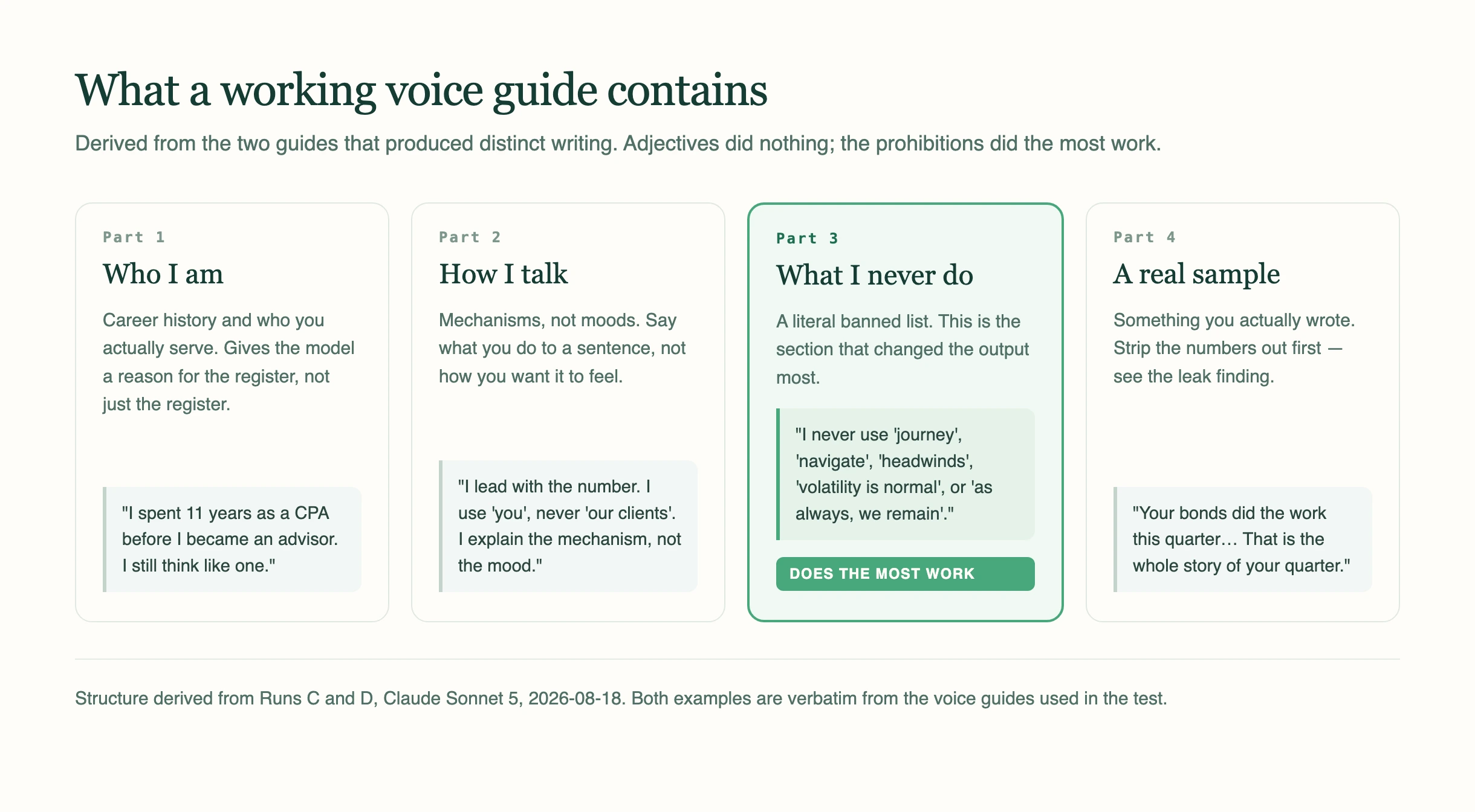
Four parts, unequal weight. The prohibitions section rules out the most common failure directly; the sample supplies cadence, at the cost of the leak risk described above.
Write your own
You do not need twelve examples to build one of these. You need the same four sections, filled in with your own answers, and a habit of stripping numbers out of the sample before you save it.
VOICE GUIDE: write as me, not as a firm.Who I am: [years in the business, background before this, who your clientstypically are]How I talk: [sentence length, point of view ("you" vs. "our clients"),whether you lead with a number or a feeling, whether jargon gets explainedinline]What I never do: [the specific words, openings, and closings you actuallydislike. Not "avoid clichés," the clichés themselves]Sample of how I actually write: [one real paragraph, with any specificnumbers, names, or dates replaced with placeholders like [X]% before yousave this guide]
The rung three guide above is a full worked example of that template already filled in: CPA background, lead-with-the-number mechanics, a named list of banned phrases, one real paragraph with the number stripped before you save it. Copy its shape, swap in your own answers, save it once, and reuse it on every letter. Add to the prohibitions list whenever a draft comes back sounding like a template again.
A voice guide changes how a letter sounds, not who has to approve it. A quarterly letter that goes to more than 25 retail investors in a 30-day period is a retail communication under FINRA Rule 2210, so a broker-dealer rep needs a registered principal's approval before it is used. RIAs should run AI-drafted client letters and commentary through their firm's own compliance review, and anything that works as an advertisement falls under the SEC Marketing Rule.
What this does and does not tell you
This is one model, tested once, inside one shared conversation. It is not a claim that every assistant leaks voice-sample facts the same way, and it is not a claim that a voice guide replaces reading the draft before it goes out. In a 2026 Advisor360°/FUSE Research survey of 300 advisors, 93% said retaining control over decisions and advice when using AI tools is non-negotiable, and this finding is a reason to hold that line. What it does show: the intuitive fix for generic AI writing (add an adjective) measurably fails, a structured fix measurably works, and the structured fix has a specific, checkable cost. All three are verifiable with your own prompt in about ten minutes.
This letter opening is also close to the median thing advisors already ask these tools to do: Schwab describes industry AI use as "concentrated on administrative tasks like notetaking and email drafting" (Charles Schwab Advisor Services, 2026-01-22).
A voice guide is worth building, and the draft is worth checking for invented numbers before it goes out, which is what our claim auditor tool does with a finished draft. For the same structured approach against a harder task, see researching a prospect before the first meeting; for the same discipline applied to a different number, see estimate ranges instead of a single invented figure. For more on the email side of the same problem, see AI email templates for financial advisors. Advisors inside a firm with its own AI tooling should check what wirehouse advisors watch for: a firm-provided assistant may already carry guardrails a personal one doesn't.
Frequently asked questions
What is an AI voice guide for financial advisors?
A short, structured brief given to an AI model before it drafts client-facing text: who the advisor is, how they talk, what they never write, and one real writing sample. In our test, a full voice guide produced writing distinct enough that two advisors' guides could not be swapped for each other, while a one-line adjective instruction produced more cliché than nothing at all.
Why did asking for a "warm, professional, approachable" voice make the AI-drafted letter worse?
Because those words describe a genre, not a person. The fastest route to matching a genre label is the most familiar phrasing for it. In our test that meant "I hope this letter finds you well" and "don't hesitate to reach out," the exact clichés a client letter usually tries to avoid. Prohibitions and real writing samples changed the outcome; adjectives did not.
Can a voice sample cause AI to invent facts, and how do I prevent it?
Yes, in both tests. A voice sample containing a real interest rate was reproduced as the quarter's actual rate, though no rate data had been given elsewhere in the prompt. The fix: strip specific numbers, names, and dates out of any writing sample before it goes into a prompt, or pair the sample with an instruction to bracket any fact not confirmed elsewhere in the task.
Does this finding apply to every AI model, not just the one tested?
We do not know, and this piece does not claim it does. Every run used Claude Sonnet 5 on 2026-08-18, in one shared conversation. We did not test GPT-5, Gemini, or Copilot. Treat the pattern as worth checking, not as settled fact.
The short version
Four attempts, one variable. Doing nothing produced generic writing. Asking for a mood produced worse writing than doing nothing. Describing a real person (background, mechanics, prohibitions, one writing sample) produced writing that sounded like that person, in both tests. The prohibitions did the most visible work; the sample did the most subtle damage, by leaking its own numbers into the draft as fact. Build the guide, strip the numbers out of the sample, and read the draft before it goes out. All three matter, and none are optional.