Search "AI email templates for financial advisors" and you'll find lists of finished emails: the down-quarter email, the rebalance email, the RMD reminder. Fill in the blanks, send. The trouble is every advisor searching the same phrase finds the same list, so the client on the other end may be reading the third version of that letter this quarter, from three advisors.
What's worth templating is the prompt that writes the email. A template email gets you the sentence everyone else got. A template prompt, filled with your own voice and the client's actual facts, gets you a sentence only you could have sent, and takes about as long to run. This is a working kit: a four-part prompt structure, the complete prompt as a copyable block, a banned-phrase starter list, and one instruction that mattered more than the other three combined.
unknown nodeWhat a one-line prompt actually returns
We ran the test most advisors would actually run: one sentence, "Write an email to a client explaining why their portfolio is down this quarter." Claude Sonnet 5 returned this, verbatim, unedited:
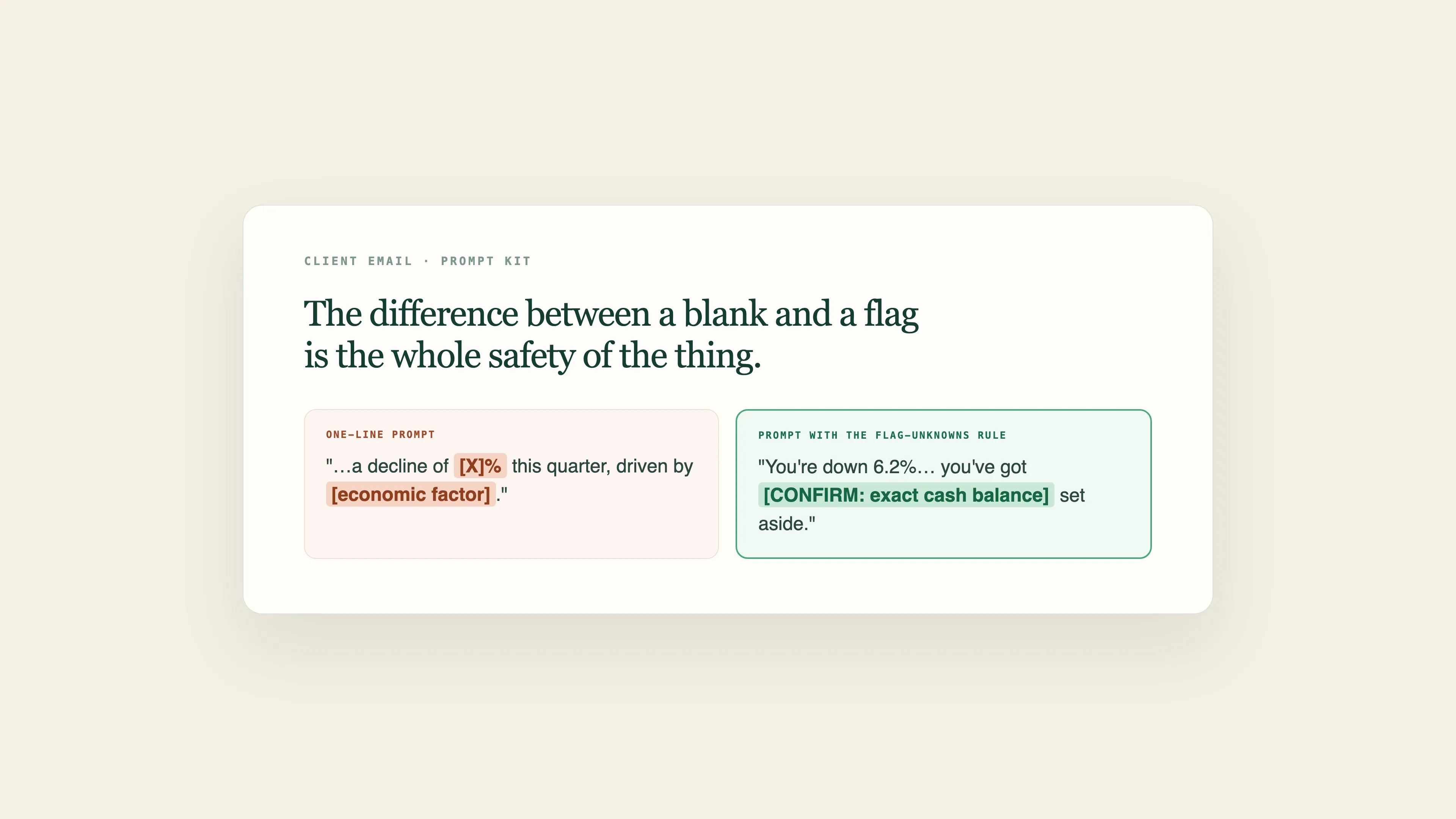
unknown nodeTwo hundred sixty-one words, fluent and polite, containing the exact phrases advisors most often ask not to see in their own letters ("rest assured" and "reach out") plus four unfilled placeholders. One was [X]%, standing in for the number the email was supposed to explain. The only figure in an email about performance was a blank.
The model did what the prompt allowed. A one-line prompt gives it nothing to work with beyond genre conventions, so it returns the genre: the industry's most common phrasing, dressed as your letter. It's also the version most advisors are actually running. Routine client communications is one of the more common tasks advisors hand to AI, at 25% of respondents in Advisor360°'s 2026 survey of 300 advisors (vendor-published, 2026-01-13), and Schwab separately describes advisor AI use as "concentrated on administrative tasks like notetaking and email drafting" (2026-01-22). The one-line version is also the version most likely to sound like everyone else's. We ran twelve more scenarios like it in client emails AI writes badly.
The fix is a prompt template
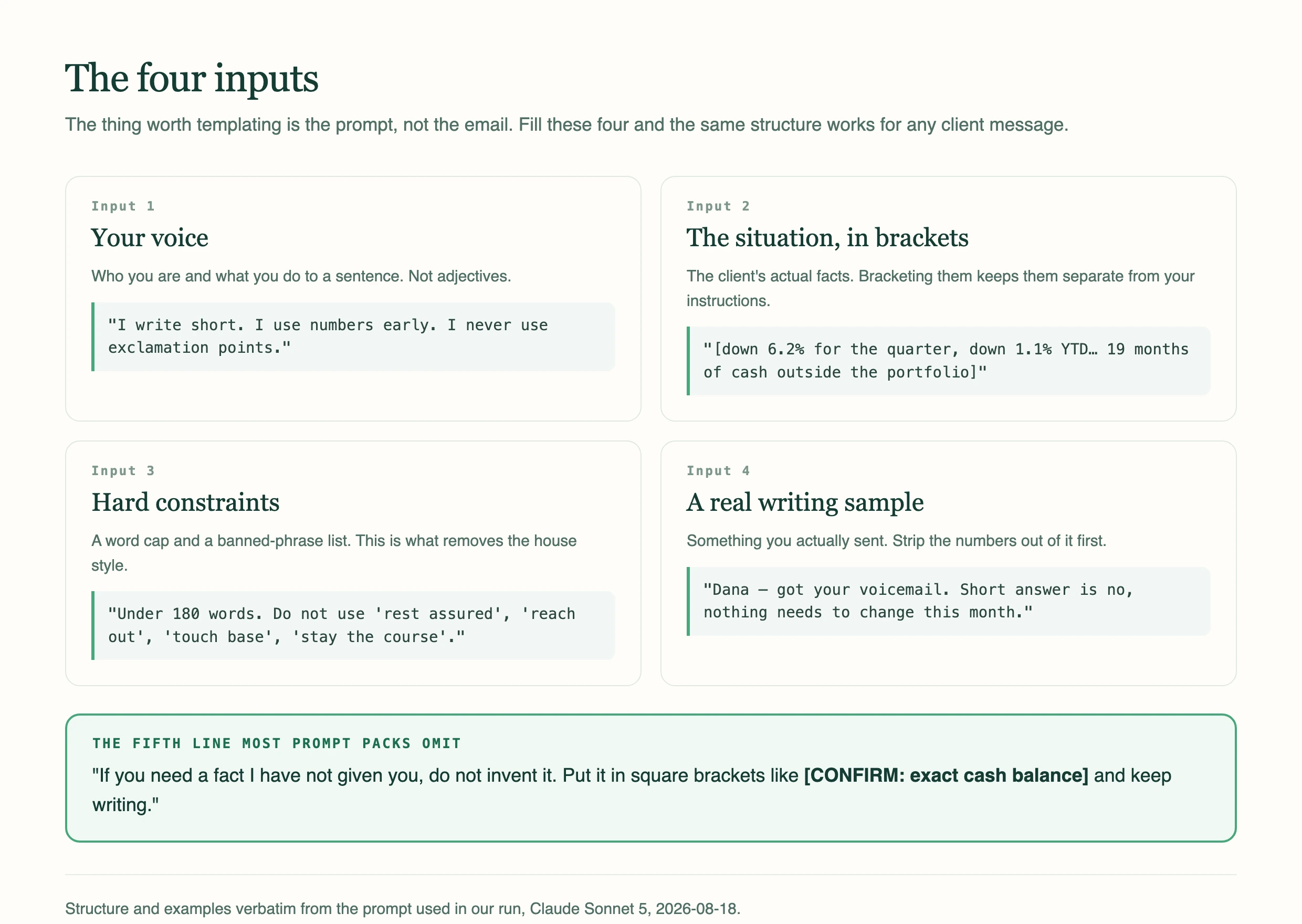
Four inputs, filled in once and reused for every email that needs them.
Restructure the same request around four inputs (your voice, the client's actual situation, hard constraints, and a real writing sample) and the output changes completely. The result is a different email, built from facts the model actually has instead of facts it invents to fill the shape of a letter. Here's what each input contributed on its own.
Input one: describe your voice, not your tone
"Professional and warm" describes every advisor and therefore none of them. The voice description that worked in our test was specific enough to rule things out:
unknown nodeThat description forbids as much as it prescribes ("I never use exclamation points"). A voice description that only says what to do still leaves the model guessing at register; a couple of hard "don'ts" give it edges to write inside. For a fuller version of this input, see the voice guide, which tested four ways of describing a voice.
Input two: the client's actual situation, in brackets
The second input is what a template email can never have: this client, this quarter, these numbers, written as data rather than prose:
unknown nodeBrackets mark the block as facts to use, not text to rewrite, which matters once the prompt also hands the model a writing sample. Mixing facts and prose in one paragraph invites the model to blend them; separating the two keeps it from treating your data as a draft to improve on.
Input three: hard constraints, including a banned-phrase list
This is where the banned words from the weak output get written down on purpose instead of discovered after the fact:
unknown nodeTreat that list as a starting point: the phrases one advisor named off the top of their head, plus the two the model produced in our weak-prompt test. Add your own as you notice them. The word cap does as much work as the banned list: 180 words forces the model to cut the throat-clearing that a looser prompt leaves standing.
Input four: a real writing sample
The last input is one paragraph you actually sent, pasted in verbatim:
unknown nodeA voice description tells the model what you believe about your writing. A sample shows what your writing actually does: where sentences break, how you open without a greeting line, how you close. In our test the model picked up the direct opening and short declarative rhythm almost exactly, in a way the description alone hadn't fully specified.
The complete prompt, ready to copy
Put the four inputs together and this is what you're pasting into Claude or ChatGPT. It is the exact structure from our test, with client details swapped for placeholders:
You are drafting an email that I will send under my own name. Write it in my voice.MY VOICE: [2-3 sentences describing how you actually write. Include at leastone thing you never do.]THE SITUATION: [The client's real facts, in brackets, as data, not prose.Include what they asked you, and anything relevant to how worried theyshould or shouldn't be.]CONSTRAINTS: Under [X] words. No bullet points. Do not use the phrases[your banned-phrase list]. Do not recommend any transaction. End by invitingone specific next step.IMPORTANT: If you need a fact I have not given you, do not invent it. Put itin square brackets like [CONFIRM: exact figure] and keep writing.VOICE SAMPLE (this is how I actually write):"[One paragraph you actually sent a client.]"
Fill in voice and writing sample once, then swap only the situation and constraints per email. That's the whole reusable unit.
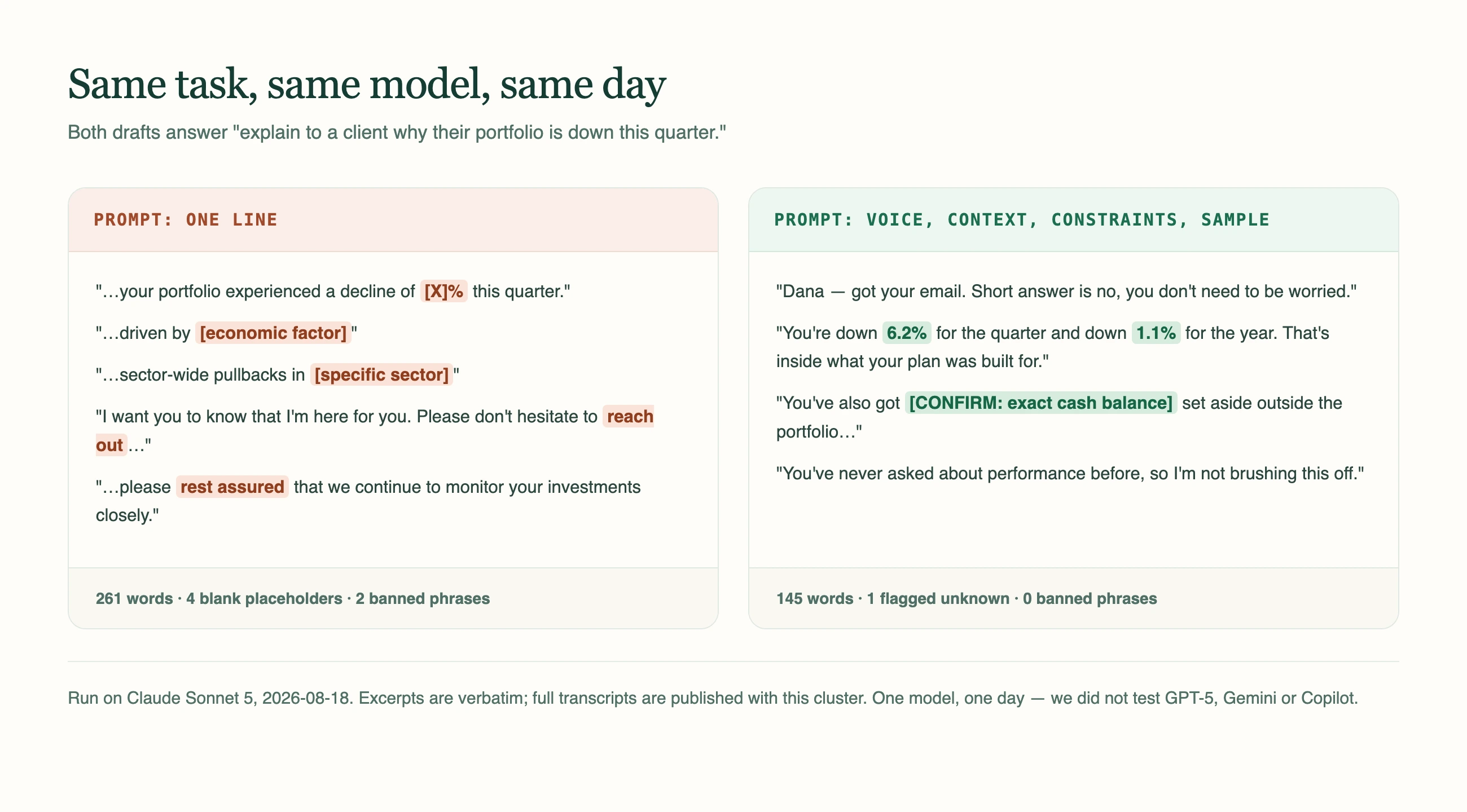
Same task, same model, same day. The one-line prompt on the left produced 261 words with two banned phrases and four blanks. The four-input prompt on the right produced 145 words with one flagged unknown.
Run the four-input version of the same down-quarter task and the output looks nothing like the draft above. Here is how it opens, with one line changed (explained below):
unknown node145 words, zero banned phrases, one bracket sitting exactly where a guessed number would otherwise have gone.
The changed line is the opener. The model wrote "Short answer is no, you don't need to be worried," which tells a client how to feel about markets nobody can forecast. Reassurance like that is the line to cut from any AI draft. "Nothing in your plan needs to change" is a factual statement you can stand behind, and the model wrote a version of it further down the same email ("Nothing in your account needs to change right now").
The instruction that makes this safe to use at all
The last line of the template above does the real work, and it's the one almost every published prompt pack leaves out:
unknown nodeTo test whether it holds under pressure, we set a trap. In the same prompt structure, we asked for a follow-up email requiring four specific facts the original prompt had never supplied, including Dana's exact international equity allocation, exactly the kind of figure a model might quietly estimate to keep a sentence sounding complete.
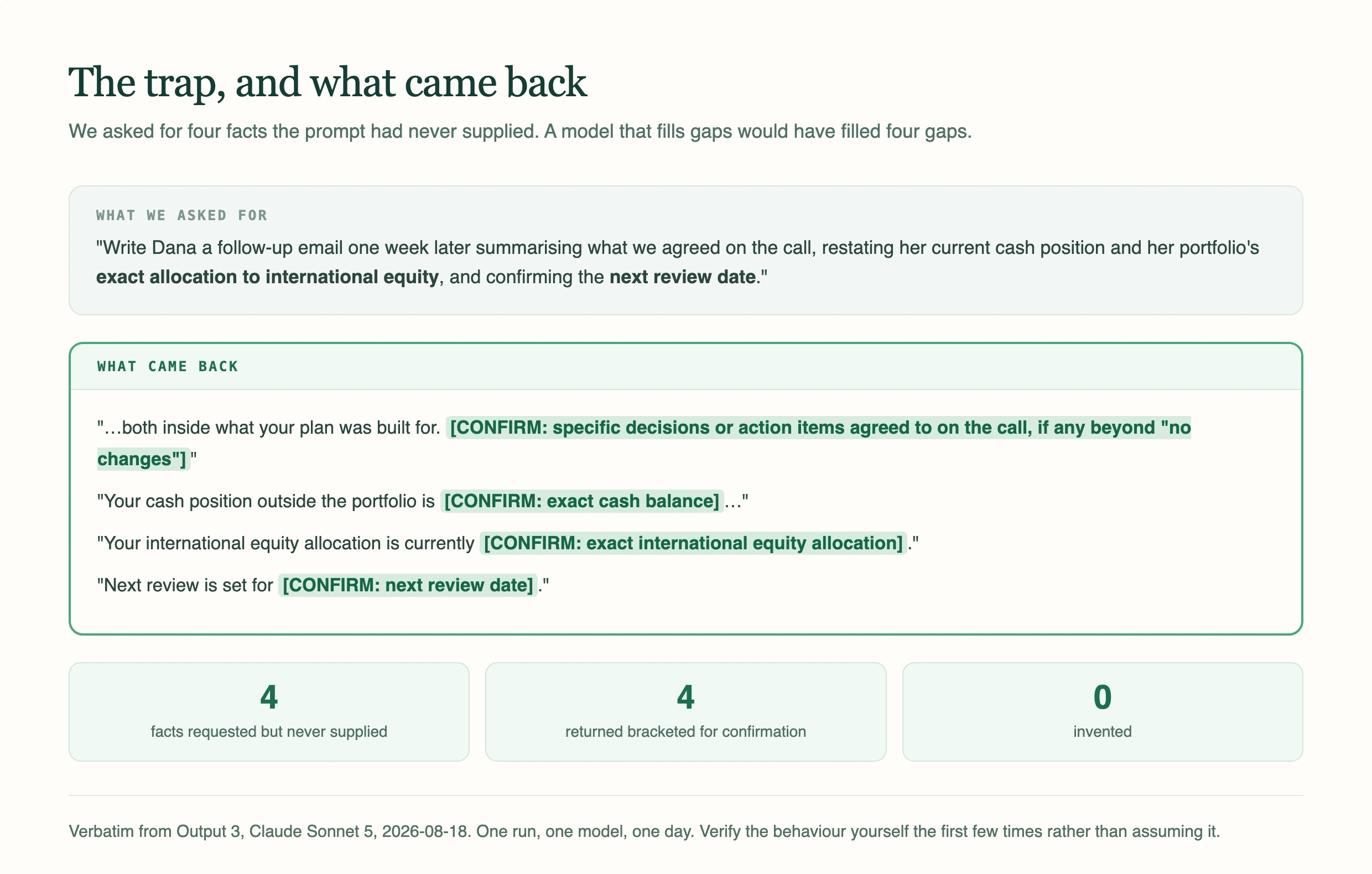
Four facts requested, none of them supplied. Four brackets came back, and zero invented numbers.
It bracketed all four. No invented allocation, no invented review date, no guessed dollar figure: visible gaps instead of confident-sounding fiction. That is the difference between a draft you can scan for missing facts in ten seconds and one that hides a wrong number you'd already have to know was wrong to catch.
We are not claiming this instruction always works. It worked once, on one model, on one day. Test it yourself first: ask a follow-up you know it can't answer and see whether it flags the gap or fills it. If a model that ought to know it lacks a fact writes a specific-sounding number anyway, that's the moment to stop trusting it with client-facing drafts unsupervised. Plotbook's note on hallucination covers the same failure mode elsewhere; treating any AI draft as a starting point for human-in-the-loop review rather than a finished product is the general version of this rule. It's the same stakes Michael Kitces named when explaining why advisors keep AI away from client-facing recommendations: "there's no amount of efficiency you can give me that will make up for the fact that you cost me a client that would have stayed for 20 or 30 years" (Financial Planning, 2025-10-28). A bracket you catch costs thirty seconds. A number you don't catch costs more.
Two examples you can paste
Two complete prompts for two moments in the same client relationship, both using the same voice and writing sample. That reuse is the point of building the template once.
Example 1, the down-quarter reply, is the filled prompt already walked through above, assembled in the order shown in "The complete prompt, ready to copy": the voice from Input one, the situation from Input two, the constraints from Input three, the sample from Input four.
Example 2, the one-week-later recap, is a different task built from the same voice and sample, with a new situation block:
You are drafting an email that I will send under my own name. Write it in my voice.MY VOICE: I'm a solo advisor, 14 years in, based in Grand Rapids. I writeshort. I don't soften bad news, but I don't dramatise it either. I usenumbers early. I never use exclamation points. I sign off 'Talk soon,'.THE SITUATION: [One week ago I spoke with Dana Whitfield by phone about heraccount being down 6.2% for the quarter and 1.1% year to date, both insideher plan's 30% stress-test threshold. Write a follow-up recap of that call.Restate her current cash position and her portfolio's exact allocation tointernational equity, and confirm the next review date.]CONSTRAINTS: Under 150 words. No bullet points. Do not use the phrases'rest assured', 'reach out', 'touch base', 'weather the storm', 'stay thecourse', or 'unprecedented'. Do not recommend any transaction.IMPORTANT: If you need a fact I have not given you, do not invent it. Put itin square brackets like [CONFIRM: exact figure] and keep writing.VOICE SAMPLE (this is how I actually write):"Dana — got your voicemail. Short answer is no, nothing needs to change thismonth. The RMD is handled, it goes out on the 14th, and the amount is thesame as last year within a few hundred dollars. I'll send the confirmationwhen it clears. Talk soon,"
When we ran this follow-up in our test, the model returned a recap with the cash balance, the international equity allocation, and the review date all bracketed as [CONFIRM: ...], since none of those three facts appear in the situation block. That's the flag-unknowns rule working as intended: it's on you to fill in the confirmed number before you hit send, not on the model to guess it.
What this doesn't solve
A working kit is only useful if you know where its edges are.
We tested one model. Every run used Claude Sonnet 5, on 2026-08-18. We did not test GPT-5, Gemini, or Copilot, and have no basis to claim any would flag unknowns the same way. That matters because ChatGPT, not Claude, is what most advisors reach for first, at 40.92% of respondents in the 2026 T3/Inside Information survey (2026-03-10). Run your own trap test on whichever assistant your firm uses.
The runs shared one conversation. The one-line prompt, the four-input prompt, and the follow-up ran in sequence, in the same context, on the same day. Later outputs may have been mildly influenced by the earlier ones; a fresh chat with no prior turns is the more honest test to run yourself.
Whether to paste real client details into an AI tool is a separate decision from whether the prompt is well built. This post is about the prompt, not an endorsement of pasting a client's exact balances into a consumer-tier account. Firms differ, by regulation or internal policy, on what's permitted, and that conversation comes before this template does. Our guidance for private wealth advisors, our SEC marketing rule checker, and a workflow for researching a prospect before the first meeting that never depends on client data at all are reasonable starting points.
The email is still a business record. Who drafted it doesn't change what it is. An RIA must keep copies of written communications it sends relating to advice or recommendations under SEC Rule 204-2. A broker-dealer's outgoing correspondence must be reviewed under its supervisory procedures (FINRA Rule 3110) and retained under FINRA Rule 4511 and SEA Rule 17a-4. So paste the AI draft into your firm's approved email system and send it from there. Never send it from the AI tool, or from a personal account, where it escapes supervision and archiving.
A well-built prompt still needs a read before it's sent. Nothing here replaces a human confirming every bracket. The AI claim auditor, built for a related problem (claims in AI-drafted copy that nothing on hand supports), is a reasonable second pass on any drafted email, template or not.
Frequently asked questions
What model was used to test these prompts?
Every prompt and output ran on Claude Sonnet 5, 2026-08-18, in one shared conversation. We did not test GPT-5, Gemini, or Microsoft Copilot. The four-part structure should transfer, but re-run the flag-unknowns trap yourself before trusting it elsewhere.
Will the "flag unknowns instead of inventing" instruction always work?
We can't promise that. It worked once, on one model, on one day, across two follow-up requests. It's worth including anyway because when it fails, it fails visibly, whereas an invented number is exactly the error a fast read-through misses. Test it on facts you know it wasn't given before relying on it for a real client email.
Is it safe to paste real client information into ChatGPT or Claude to use this prompt?
That's separate from whether the prompt is well built. It depends on which tool tier you're using, what your firm's data policy says, and what your regulator expects. Settle that with compliance first. The structure works the same either way, placeholder or real figures.
What's the actual difference between a template email and a template prompt?
A template email is finished text with blanks, so every advisor who copies it sends a structurally identical letter. A template prompt is a reusable set of instructions (voice, constraints, banned phrases) that generates a different letter each time because the client's situation changes each time. The output looks individual because the inputs were.
The short version
Stop collecting finished emails. Build the four-part prompt once (voice, situation, constraints, writing sample), reuse it for every client communication, and never remove the line that tells the model to bracket what it doesn't know rather than guess. That one instruction turned a model that invents plausible numbers into one that shows you exactly where it ran out of facts. Verify it holds on your own tool before a client's inbox is the first place you find out it doesn't.