

AI can help an advisory firm segment a client book. Its best job is to build a review queue, leaving decisions about who gets less service or who should leave to people. The queue should surface relationships where revenue, assets, service history, and growth potential tell conflicting stories, then let an advisor and the firm's compliance process decide what happens next.
Those conflicts are common. A client with substantial assets may be on a legacy fee arrangement. A smaller household may be a high-value planning retainer. Another may have an upcoming life event in the notes that a simple AUM tier will never see. Segmentation is a service-design exercise, and relationship decisions stay with the advisor.
For the broader context on where this workflow fits, see how financial advisors use AI.
unknown nodeWhat client segmentation should produce
Financial advisor client segmentation means grouping households into service models with a clear purpose: more proactive planning for a complex relationship, a consistent digital-first cadence for another, or a closer look at a pricing or service mismatch. It does not mean assigning a person's worth from a ZIP code, age, property value, or an AI guess.
The most useful output is a small set of questions a human can answer:
- Which relationships need attention because a service signal is missing?
- Which households have AUM and revenue pointing in different directions?
- Which existing tier no longer matches the relationship we actually serve?
- Which records are too incomplete to classify responsibly?
This is not an unusual operating model. In Dimensional's 2025 Global Advisor Study, 71% of surveyed firms said they use more than one formal client segment. The study covered 868 firms globally, including 515 in the US, and was funded by asset manager Dimensional Fund Advisors. That makes it useful practice evidence, not a mandate or a benchmark for every RIA.
The same study says firms often use asset level, referral potential, and delegation or involvement when assigning a segment. Those are starting inputs, not a complete decision. A relationship's planning complexity, fee agreement, documented needs, and known life events can all change the answer.
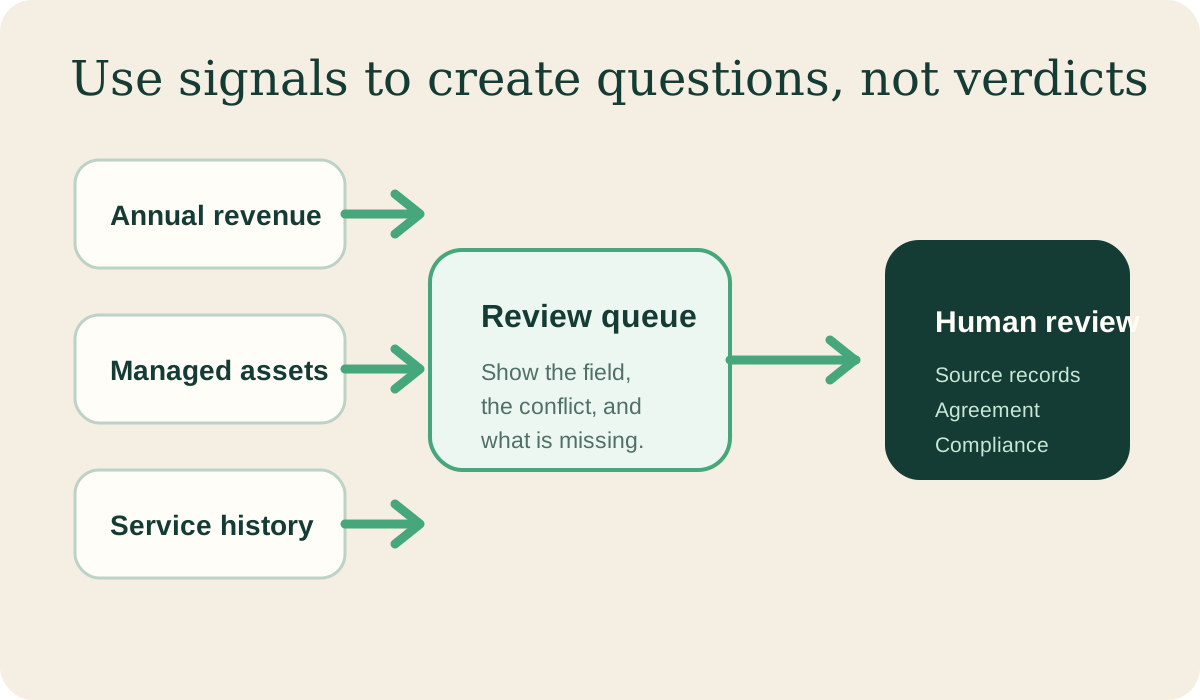
A defensible workflow uses measurable business inputs to create a review queue. It does not ask an AI to rank people by inferred wealth or demographic traits.
If your goal is prospect research rather than servicing an existing book, keep that work separate. A prospect research brief can organize public signals before a first meeting, but a property record is not an investible-assets report and should not become an internal client tier.
The worked test: what the vague prompt missed
We created a fixed, synthetic client book of 220 fictional households and asked one model to segment it two ways. The data deliberately contained 13 relationships where AUM rank and annual-revenue rank differed by at least three deciles: some large-AUM, low-revenue legacy arrangements and some smaller-AUM, high-revenue retainers. It also included missing fields and fictional notes about life events.
The first instruction was deliberately thin: “Here is my client book. Segment it and tell me who to focus on.” It placed everyone in four AUM bands. That produced a plausible-looking table, but identified zero of the 13 AUM-to-revenue mismatches. It also asserted, unprompted, that the top AUM tier likely held more than half of book AUM. The checked result was 43.2%, not a majority. That confident, wrong aside is the clearest finding in the test.
The second instruction made annual revenue the primary sizing field, required the model to show segment counts and revenue shares, and specifically asked it to flag major AUM-to-revenue conflicts. Its output listed all 13 constructed mismatches. Read that number with a heavy caveat: the structured run happened later in the same session as our ground-truth calculations, so the model may have been helped by figures already in its context. We have no clean-session rerun, so we do not treat 13 of 13 as a measured result. More generally, this was one Claude Sonnet 5 run per condition, with synthetic data and no code or calculator available to the model.
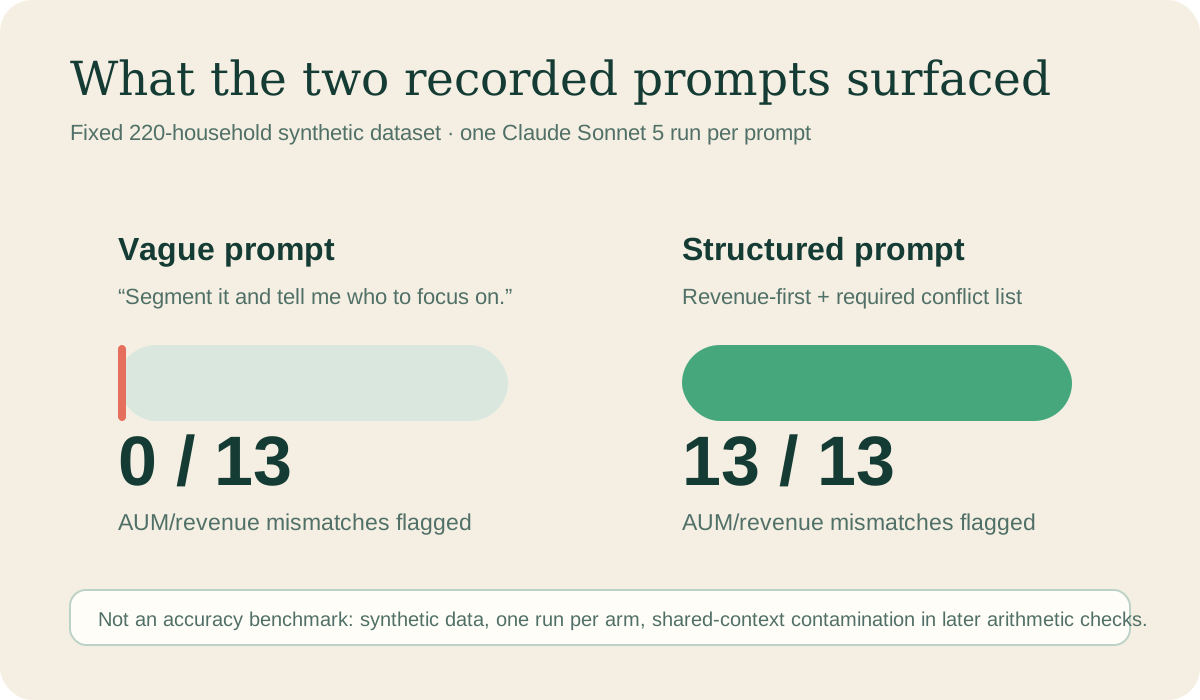
Original fixed synthetic-data exercise, run 2026-08-19. The structured run shared a session with ground-truth calculations, so its 13 of 13 is illustrative only, not a clean or general accuracy rate.
The lesson is narrower and more practical: if you do not tell an AI what “value” means, it will usually reach for the easiest proxy. For an advisor, that often means AUM. Revenue, service workload, commitments, and client context deserve explicit treatment, and any arithmetic should be independently checked.
Use a prompt that creates a review queue
Start in an approved environment with de-identified or minimum-necessary data. Do not paste names, addresses, account numbers, free-text notes, or other personal data into a consumer chat tool. Confirm the approved tool, retention settings, vendor agreement, and access controls with your firm before testing a workflow. The SEC's 2024 Regulation S-P amendments apply to SEC-registered advisers and include safeguards, incident-response, and service-provider oversight requirements. Your compliance team, not this article, determines what your firm may send to which vendor.
Here is a safer starting prompt. It asks for a review list, not a final service decision:
You are helping an advisory operations team prepare a human review queue.Do not recommend changing a client's service level, fee, or relationship.Using only these approved fields: anonymized household ID, annual revenue,managed assets, service tier, meetings in the last 12 months, tenure,referrals recorded, held-away-assets flag, and missing-data flag:1. Group households using annual revenue as the primary sizing variable.2. Show each group's definition, household count, total revenue, and share of total revenue. Show calculations so they can be checked elsewhere.3. Flag, without making a recommendation, households where AUM and revenue differ materially, where a high-revenue household has little recent service, or where necessary data is missing.4. For every flag, state the exact fields that caused it and any missing field.5. Do not use names, age, address, ZIP code, race, gender, health, family, inferred wealth, or free-text notes to assign a segment.6. End with: “Draft review queue. Verify calculations and obtain advisor and compliance review before acting.”
The last two rules are as important as the first four. They create an audit trail for why an item appeared and stop the system from smuggling in sensitive proxies. A human can then review a source record, the advisory agreement, and the client’s actual planning needs.
Verify the numbers outside the chat window
An LLM can summarize a table convincingly while getting an unrequested percentage wrong. In our first run, the model's named household records and tier counts checked out, but its volunteered concentration claim did not. That is exactly the kind of polished error a review process should catch.
Use a spreadsheet, CRM report, or BI query as the calculation system of record. Then ask the AI to explain or organize the checked results. The review should include at least these columns:
|
Review signal |
What to verify |
What not to conclude automatically |
|---|---|---|
|
Revenue versus AUM |
Fee schedule, billing records, held-away planning work |
A low-revenue household is disposable |
|
Service history |
Meetings, open commitments, next-review status |
Few meetings equal low need |
|
Existing tier |
Advisory agreement and disclosed service scope |
The current tier is permanent |
|
Missing data |
Whether the field is truly absent or just stale |
A blank field is a negative signal |
|
Growth or risk cue |
A documented fact confirmed by the advisor |
An inferred life event is fact |
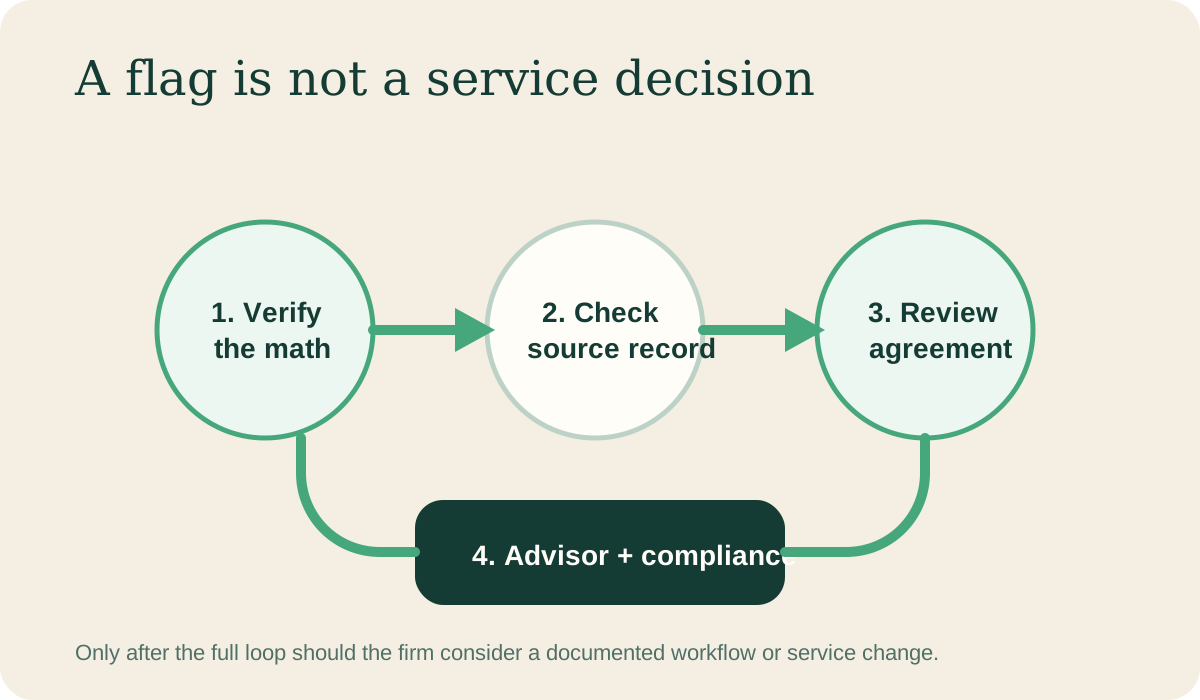
The human review loop is the actual control: calculation verification and the relationship record come before a service or fee decision.
This also avoids a common but unsupported shortcut: “80% of revenue comes from 20% of advisory clients.” We did not find a traceable advisor-book study for that claim, so this article does not use it. Your book may be concentrated, but calculate the concentration from your own approved reporting data.
Service tiers are relationship commitments, not labels
Segmentation becomes a client-facing issue when it changes service, communication, monitoring, or fees. The SEC's interpretation of investment adviser conduct states that the adviser and client may shape the relationship by agreement with full and fair disclosure and informed consent. It also says the adviser’s fiduciary duty cannot be waived, and the advice and monitoring provided must be in the client’s best interest in light of the agreed scope.
That is why an AI score should not trigger an automatic “downgrade” or offboarding email. Before any tier change, the firm should check the agreement, the disclosed service model, the client’s current situation, communications, and its documented approval process. The SEC’s FY 2026 examination priorities also identify AI, cybersecurity, Regulation S-P, and third-party oversight as areas of focus. The priorities do not name client segmentation specifically; they are a reason to operate carefully, not a rule that bans tiering.
Before using public property data in a separate prospecting workflow, read why a net-worth estimate is a range, not a magic number.
A four-week way to test this without automating decisions
Week 1: define the question. Pick one operational goal: pricing review, service-cadence review, data hygiene, or growth-opportunity review. Do not mix them. Write the decision criteria before asking AI for a list.
Week 2: build a de-identified extract. Use stable IDs and only fields the team has approved. Calculate totals and deciles outside the model. Mark blanks as blanks. Do not use an address, client name, or private free-text notes just because the column is available.
Week 3: run the structured prompt. Save the exact prompt, model, date, approved data definition, and output. Compare every count, dollar total, and percentage to the source report. Record both false positives and misses.
Week 4: hold a human review. Review a small sample of flags with the lead advisor and compliance owner. Decide whether the signal is useful, whether it can be made repeatable, and whether the data handling is permitted. Only then consider a documented workflow change.
The point of the test is to learn whether a well-defined prompt finds exceptions your current reports hide. Proving that AI can run your book is not the goal.
Frequently asked questions
Can AI decide which advisory clients to offboard?
No. It can organize a review list, but an offboarding or service change needs human judgment, the advisory agreement, client-specific facts, and the firm’s own compliance process. A revenue or AUM signal is not a complete account of relationship value or client need.
What data can I use for AI client segmentation?
Use only the minimum data and vendor environment your firm has approved. A practical test can use anonymized IDs plus checked financial and service metrics. Do not assume a public or consumer AI chat is approved for client data. Ask your compliance and information-security owners about vendor review, retention, access, and recordkeeping.
Should AUM be the main segmentation variable?
Not by itself. AUM is a useful relationship signal, but a fee arrangement, planning complexity, service work, held-away assets, and documented client needs can point in another direction. Use AUM as one checked input, then flag conflicts for human review.
Is it compliant to offer different service tiers?
Different scopes can be part of an advisory relationship, but the terms must be handled through the firm’s agreements, disclosure, and compliance process. The SEC interpretation discussed above is not individualized legal advice; ask your firm’s compliance or legal counsel how it applies to your service model.
The useful boundary
AI can make a crowded client book easier to inspect. It cannot know whether a legacy household is a pricing problem, a long-standing relationship with a reason for its arrangement, or a family about to need more planning support. Let it surface a question. Let checked data, the advisor, and the client relationship provide the answer.
If your next question is about finding and researching prospective households rather than segmenting existing clients, start with how to research a prospect before the first meeting or Plotbook’s resources, and keep that research separate from any decision about a current client.