
Most advisors now use AI, and almost nobody has counted what they use it for.
That is the honest summary of the 2026 survey season. Adoption has been measured carefully and repeatedly: 52% of advisors responding to the T3/Inside Information survey use at least one search or generative AI tool, up from 41% the year before (T3 Technology Hub, presented 2026-03-10, n=2,906). Schwab put RIA adoption at 63%, more than double its 2023 reading (Charles Schwab Advisor Services, released 2026-01-22, n=533).
Then the question changes from do you use it to what do you use it for, and the independent data stops. Not thins out: stops. The only percentage-level answer published in 2026 came from a wealthtech vendor.
This piece reads the surveys as an advisor should: what was asked, who was asked, who paid, and which number tends to pick up a source it does not have.
unknown nodeWhat the 2026 surveys actually measured
Three sources carry most of the weight, and they measure different things.
T3/Inside Information ran the largest sample: 2,906 respondents, presented at the T3 conference on 2026-03-10. Its finding is adoption plus tool share. Among advisors using AI, ChatGPT leads at 40.92%, then Microsoft Copilot at 20.51%, Google Gemini at 13.63%, Perplexity at 6.95%, Anthropic at 6.16% and Grok at 6.13%.
Two caveats travel with those numbers and rarely survive the trip into a headline. The six named tools sum to 94.3%, not 100. The rest sits in smaller tools and rounding, so this is a partial distribution rather than the whole. And the survey's own category label is "Anthropic", not "Claude". Small distinctions, but they are the difference between citing a source and paraphrasing one.
Schwab Advisor Services surveyed 533 RIAs custodying with Schwab, fielded by Logica Research between 2025-10-07 and 2025-10-26. It found adoption more than doubled since 2023 to 63%, that 82% of current AI users rely on generative AI tools most often through individual experimentation rather than firm-wide systems, and that only about 1 in 10 have fully integrated AI into business strategy.
Advisor360° surveyed 300 advisors through FUSE Research Network in autumn 2025 (Advisor360°, released 2026-01-13). It is the only one that asked what the tools are used for.
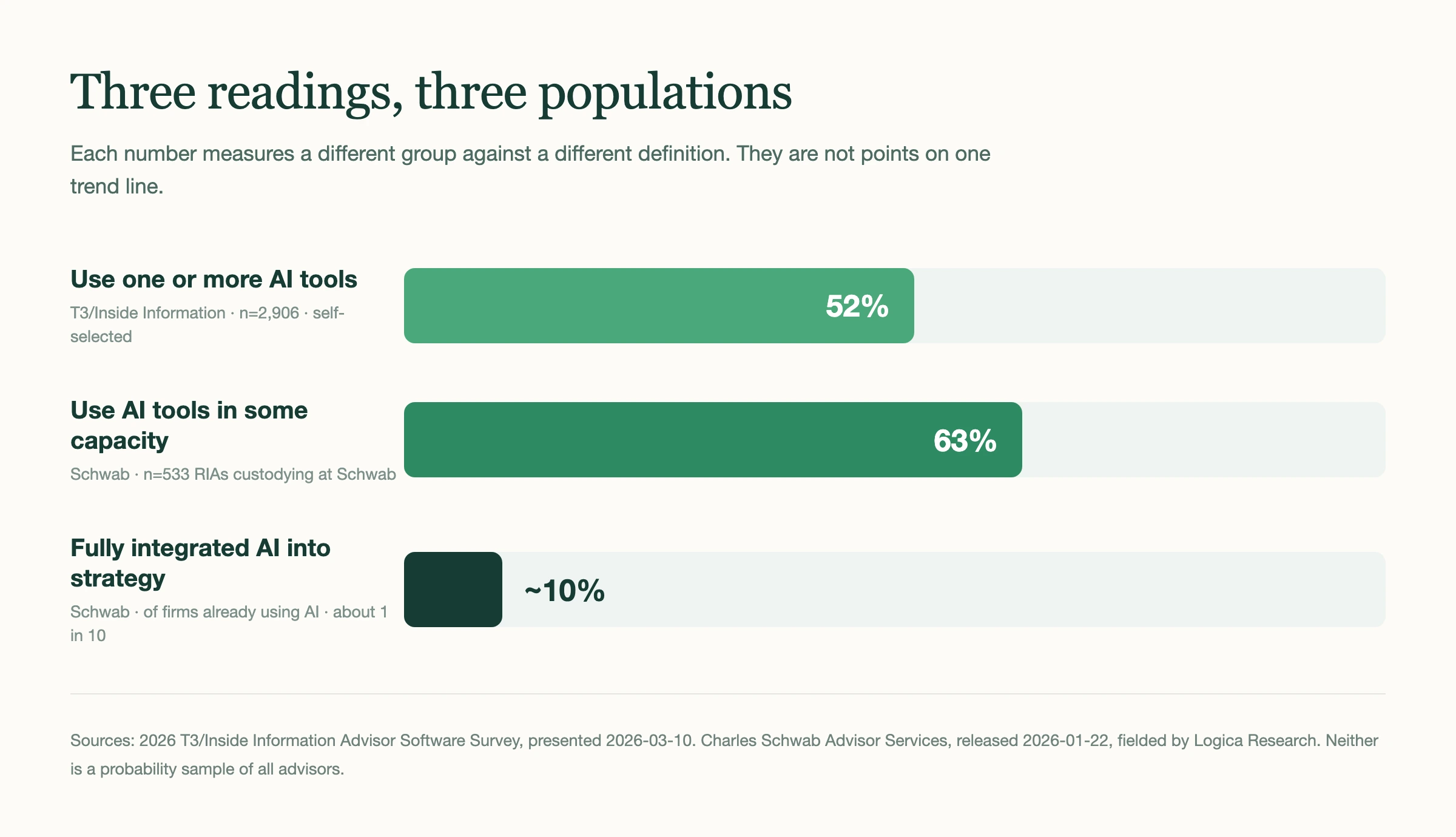
Three readings, three populations, three definitions of "using AI". Sources: T3/Inside Information 2026 (n=2,906); Charles Schwab Advisor Services 2026 (n=533).
The three numbers are not competing estimates of one quantity. They measure different populations against different definitions, and stacking them into a single trend line is the most common error in coverage of this topic.
Who was asked, and what that does to the number
None of these is a probability sample of American financial advisors, and each skews in a direction worth naming.
T3/Inside Information is self-selected: it surveys a planning community that opts in, which is a population already more engaged with practice technology than the profession at large. The correct phrasing is "of advisors who responded", never "of advisors". Anyone writing the latter has added precision the survey did not supply.
Schwab's sample is RIAs who custody with Schwab. That is a real and useful population, but it is not the independent-advisor universe, and Schwab is a custodian with a commercial interest in advisors adopting technology. The fieldwork was done by an independent research firm, which matters; the framing and the release are still Schwab's.
Advisor360° sells software to advisors. Its survey is competent and its methodology is disclosed. It is also marketing, and the finding that advisors need better tools is not a finding that runs against the publisher's interest.
None of that makes any of these numbers wrong. It makes them numbers with a direction, and an advisor deciding where to spend an hour deserves to know which way each one leans.
What advisors actually use AI for
Here is the breakdown, and here is the problem with it.
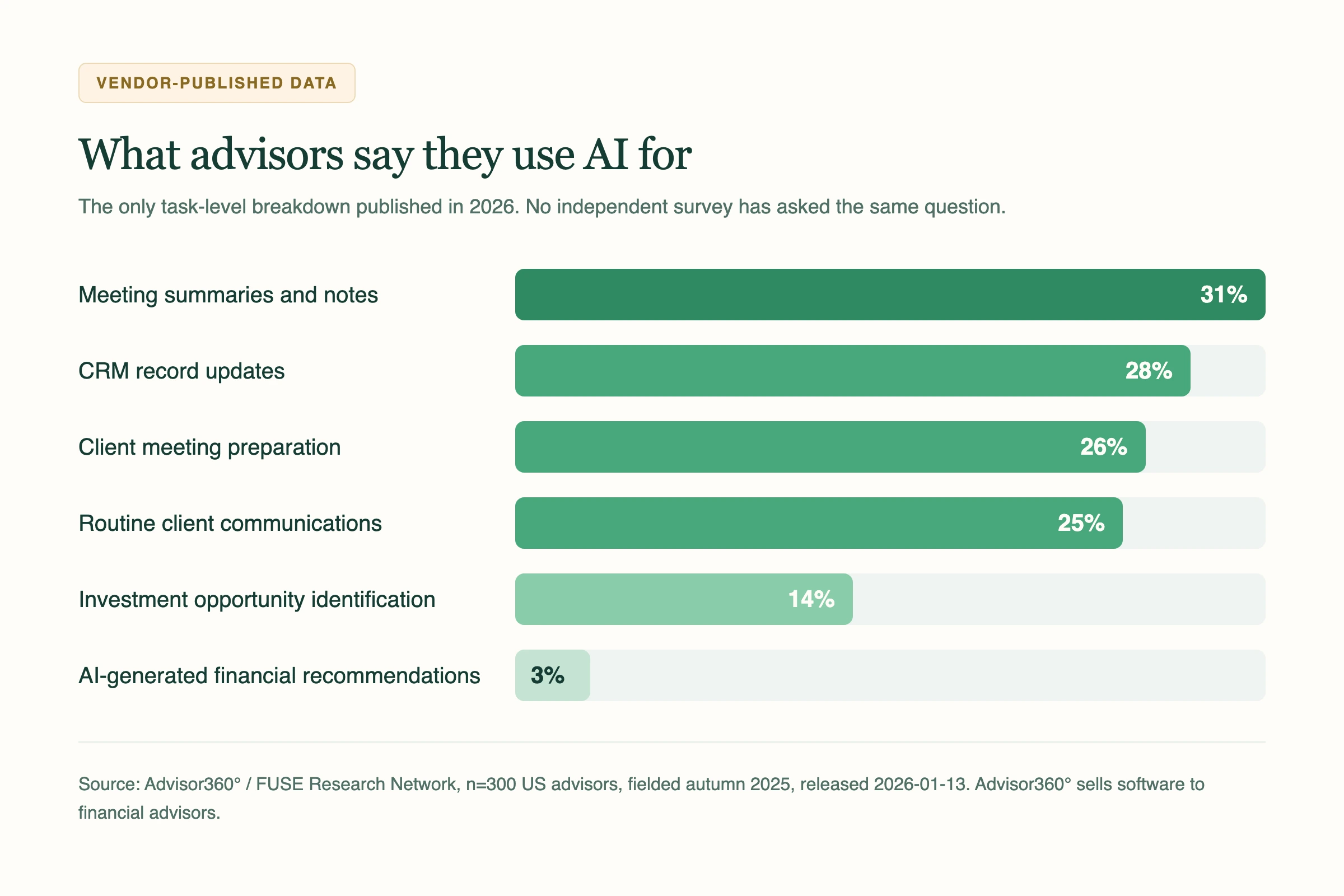
The only task-level breakdown published in 2026. Source: Advisor360° / FUSE Research Network, n=300, fielded autumn 2025. Advisor360° sells software to advisors; this is vendor-published data and is labelled as such.
Meeting summaries and notes at 31%. CRM record updates at 28%. Meeting preparation at 26%. Routine client communications at 25%. Investment opportunity identification at 14%. AI-generated financial recommendations at 3%.
The shape of that list is credible and matches what Schwab described qualitatively: use "concentrated on administrative tasks like notetaking and email drafting". The 3% on recommendations is the most reassuring number in the whole survey season, and the reason for it is not mysterious. Speaking at the ADVISE AI conference in October 2025, Michael Kitces put the calculation plainly: "Because if it says something wrong and loses me a client, there's no amount of efficiency you can give me that will make up for the fact that you cost me a client that would have stayed for 20 or 30 years, paying me thousands of dollars a year" (Financial Planning, 2025-10-28).
But the shape is all we have, and it comes from one vendor and 300 people. T3 asked which tools, not which tasks. Schwab described the pattern in words and published no percentages against it. There is no independent counterweight to check the vendor's numbers against.
That gap is the actual state of knowledge in this category, and it is worth saying plainly rather than papering over: we know how many advisors have opened ChatGPT far better than we know what they typed into it.
The number that gets misattributed
One figure deserves separating out, because it is easy to repeat wrong.
The Schwab release reports that among current AI users, 82% rely on generative AI tools, most often through individual experimentation rather than firm-wide systems. That is accurate. It is also, in the release, plain study reporting. It sits in the body text, immediately before commentary from Lisa Salvi, Schwab's Head of Business Consulting and Education.
It is not a quotation from her. Salvi's quoted remarks in that release concern firms needing a clear vision, upskilling their people, and building data foundations. She does not state the 82% figure.
We found the misattribution in our own research notes before we found it anywhere else, which is the reason it is called out here rather than quietly corrected. A statistic that acquires a human name travels further and gets challenged less. If you are citing the 82%, cite the study.
What happens when you actually do the top task
The task at the top of the list is drafting client communication. We wanted to know what that produces in practice, so we ran it.
On 2026-08-18 we ran a set of client-email tasks on Claude Sonnet 5 and kept every output verbatim, including the bad ones. One caveat first: we tested one model on one day. We did not test GPT-5, Gemini or Copilot, and where this section says "the model" it means that one.
Asked the way most advisors actually ask ("Write an email to a client explaining why their portfolio is down this quarter"), the model returned 261 words containing the phrase "rest assured", the phrase "reach out", and four unfilled placeholders, one of which was [X]% standing in for the return itself. It was fluent, it was polite, and the only number in it was a blank.
Then we set a trap: a follow-up request for four specific facts the prompt had never supplied, including an exact allocation figure. The model bracketed all four rather than inventing any of them.
That is the useful version of "advisors use AI for email drafting". The 25% in the survey covers both of those runs. They are not the same activity, and no survey currently distinguishes them.
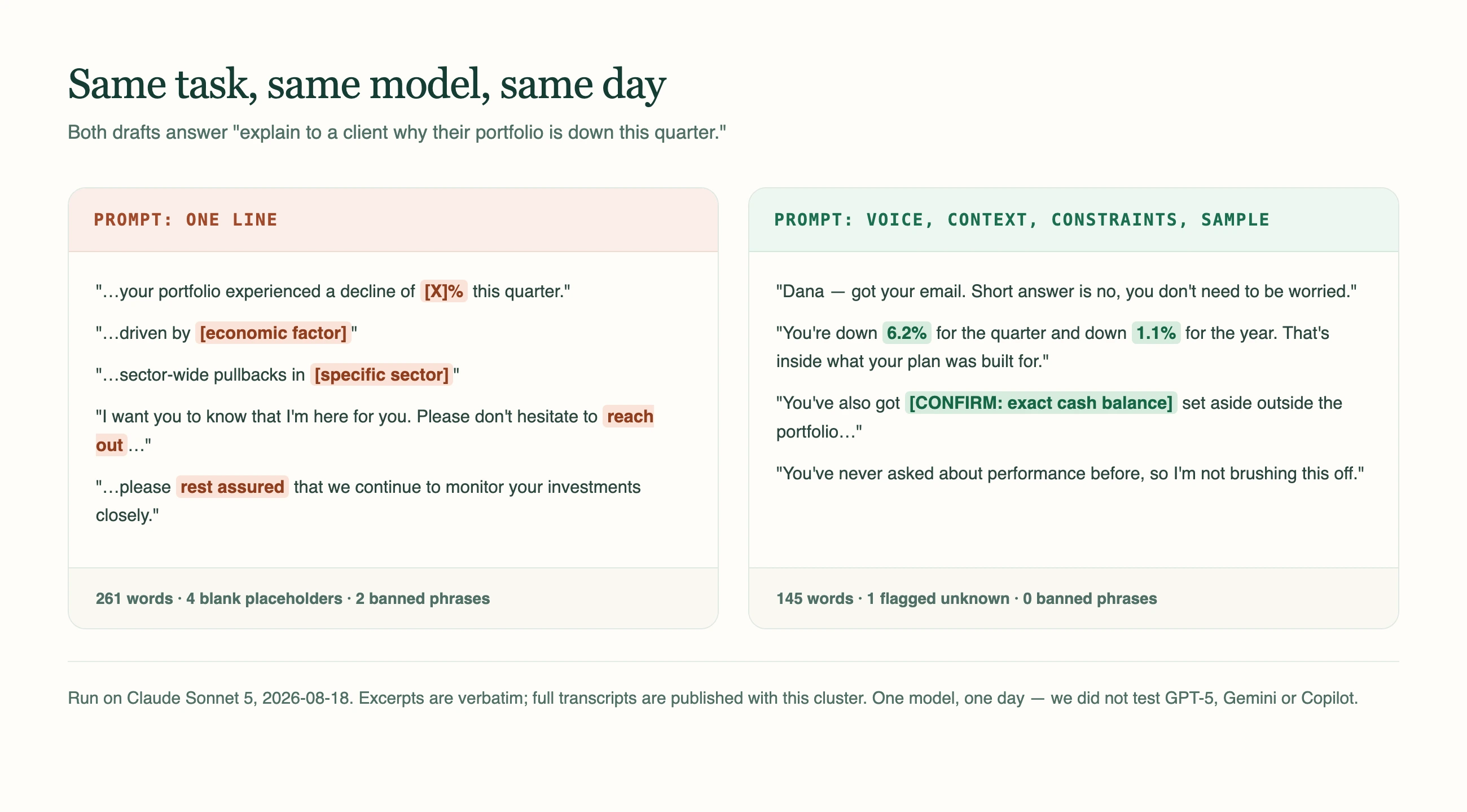
Same task, same model, same day. The difference is the prompt.
What none of the surveys ask
Reading all three together, the unasked questions are as telling as the answers.
Nobody asks what the output was used for. Drafted-and-sent, drafted-and-rewritten, and drafted-and-discarded all count identically as "uses AI for client communications".
Nobody asks what it got wrong. Advisor360° found 46% lack confidence in AI outputs and 93% insist on final say, which are proxies for a problem but not measurements of it. There is no published error rate for advisor AI use. If you see one cited, ask which survey it came from, because we could not find it.
Nobody asks about the client-data question. Whether advisors are pasting client information into consumer AI tiers is the most consequential unmeasured behaviour in this category.
Nobody separates the firm's tools from the advisor's own. An advisor inside a national firm using an internal assistant and a solo advisor with a personal ChatGPT subscription are two different jobs, two different compliance positions, and one survey row. If you are that advisor inside a national firm, the split matters more to you than any headline number; we cover that position in AI research for wirehouse advisors.
How to read the next survey
The next round arrives in spring. Four questions make it readable:
- Who responded, and how were they reached? Self-selected community samples measure engaged advisors, not advisors.
- Who paid? Vendor-funded research is not disqualified, it is labelled.
- Is it adoption or is it depth? "Uses AI" and "has integrated AI into how the firm works" are different questions. In Schwab's data, 63% of RIAs use AI, but only about one in ten of those users has fully integrated it into business strategy.
- Does a named human get credited with a number they did not say? It happens more than it should.
Applied honestly, this year's data supports one confident claim: most advisors have tried these tools, few have changed how their practice runs, and the detail of what they do with them is still mostly unmeasured. Anyone telling you more precisely than that is extrapolating.
If it helps to see how a specific research task holds up, our pre-meeting research workflow walks through one, and the AI claim auditor checks drafted client-facing copy for claims nothing can verify. For how we handle the same problem inside our own product, see how the research agent works and our note on hallucination.
Frequently asked questions
What percentage of financial advisors use AI in 2026?
52% of the 2,906 advisors responding to the 2026 T3/Inside Information survey reported using at least one search or generative AI tool, up from 41% the year before. Schwab separately found 63% of 533 RIAs using AI tools in some capacity. Both are self-selected or custodian-specific samples rather than probability samples of all advisors, so treat them as directionally strong rather than precise.
What do financial advisors actually use AI for?
The only published task-level breakdown puts meeting summaries and notes at 31%, CRM record updates at 28%, meeting preparation at 26%, routine client communications at 25%, investment opportunity identification at 14%, and AI-generated financial recommendations at 3%. That data is from Advisor360°, a wealthtech vendor, with a sample of 300. No independent survey has published comparable figures.
Do advisors use AI to give investment advice?
Very few report doing so. In the one survey that measured it, 3% reported using AI for AI-generated financial recommendations, against 31% for meeting notes. Use is concentrated in administrative work, and 93% of respondents said they insist on final say over AI output.
Which AI tools do financial advisors use most?
Among advisors using AI in the 2026 T3/Inside Information survey: ChatGPT 40.92%, Microsoft Copilot 20.51%, Google Gemini 13.63%, Perplexity 6.95%, Anthropic 6.16%, Grok 6.13%. Those six account for 94.3% of reported use, with the remainder spread across smaller tools.
Is advisor AI adoption data reliable?
Adoption figures are reasonably reliable and consistent across sources. Task and outcome data is not. It comes from a single vendor-funded survey of 300 advisors. Error rates, client-data handling, and the split between firm-provided and personally purchased tools are all currently unmeasured.
The short version
Adoption is settled and depth is not. Most advisors have used these tools; about one in ten AI-using firms have changed anything structural because of them. The tasks sit in administration, the client-facing edge is thin by choice, and the percentages describing any of it come from one vendor and 300 people.
The gap between "uses AI" and "uses AI well" is where the entire practical question lives, and no survey currently measures it. Until one does, the honest move is to read the adoption numbers as adoption numbers, label the task data as vendor data, and test the tasks yourself. The results are more specific than any survey will be about your own practice.
Next: what a voice guide actually changes, and the territory teardown for advisors who would rather start from the public record than from a prompt.