Runbook
The deed says “Holdings LLC”. Now what
Above a certain value, most property stops being held in a person's name. The deed names a holding company, a family trust, or an estate, and every instant lookup tool returns nothing useful, because the residential records genuinely do not contain a human for that address. This runbook is the other path: what the research pass does, what evidence it is allowed to accept, and how to read a result that comes back thin.
Before you start
Know which deeds are worth the run
The research pass is the most expensive single action in the product, so the qualification you do before starting it is worth more than anything you do during it.
What you need
A deed that actually names an entity
Read the owner label on the parcel first. If it names a person, stop — the instant Owner Lookup answers that for 5 credits and answers it better, because residential records are the right source for a human at an address. Research is for the cases where that path structurally cannot work.
A reason this specific owner matters
Entity-held property is common enough that you cannot research all of it. The run is worth its cost when the parcel is genuinely in your territory and genuinely at your value threshold, and not otherwise.
Tolerance for an honest failure
Some entities are built specifically to defeat this, and the run will tell you when it has hit one rather than inventing a plausible name. That is the design. If you need a name for every parcel, this is the wrong tool and so is every other one.
What you end up with
A person, with the reasoning attached
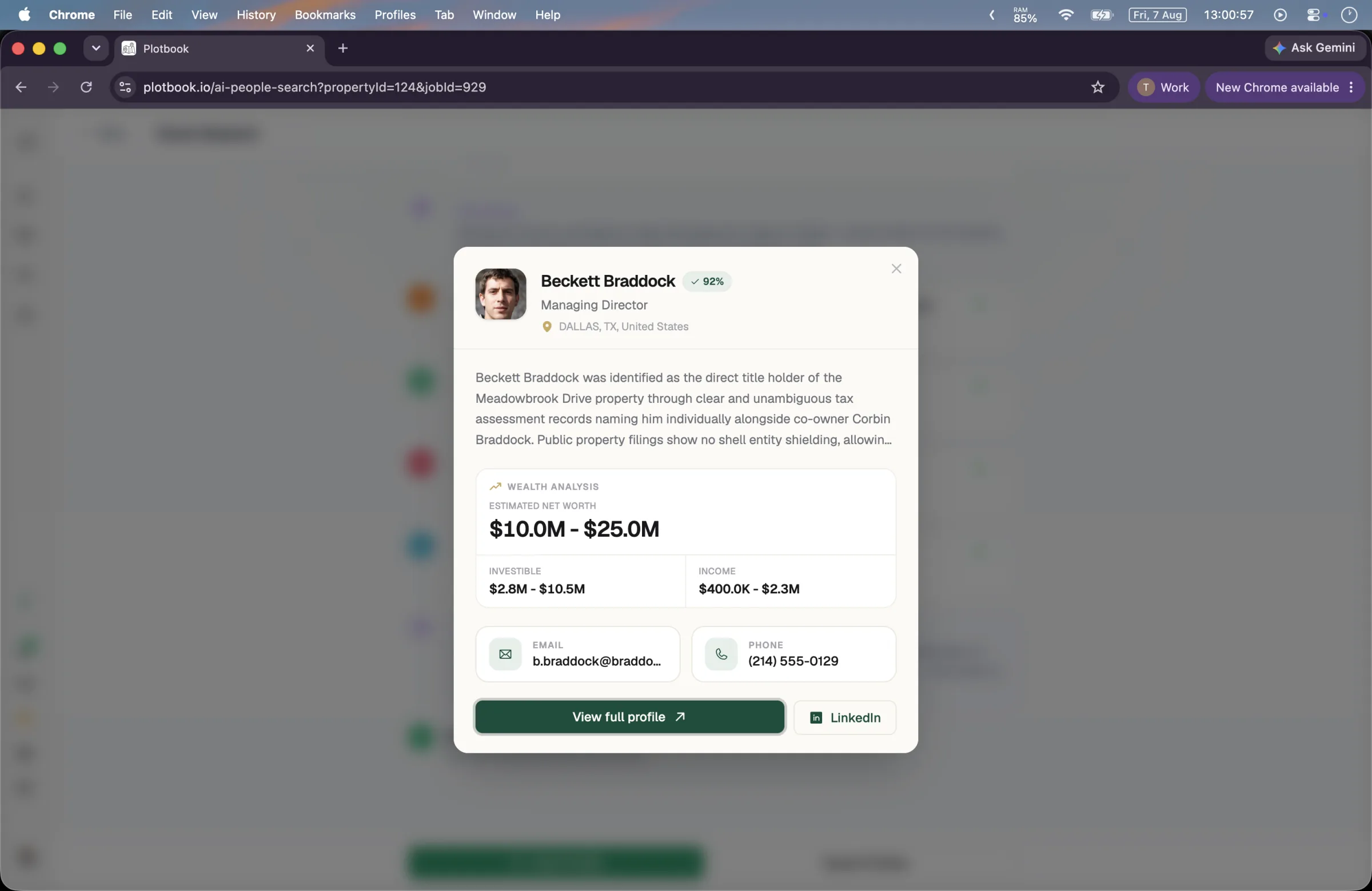
When it lands, you get a name, title, organization, city, contact details where they exist, employment and education history, and a research summary explaining how the identification was reached, plus a confidence score and the number of corroborating sources.
A stated tier, including the bad ones
Every run reports what it actually achieved: a full profile, an identification without contact detail, entity-only when it could characterize the company but not name a human, or nothing. A thin result reads as thin instead of reading like an answer.
An auditable timeline you can re-read
The run is recorded step by step — every classification, search, and record read, with the source links it worked from. It survives a reload and stays attached to the job, so you can check the reasoning a week later rather than trusting a conclusion.
The run
Five steps, and most of them are the agent’s
Your part is short: qualify the deed, start the run, and judge the output. The middle is the agent working, and it is worth understanding what it is doing there, because that is what tells you whether to believe the answer.
- 1No credits
Read the deed and the mailing address
Open the parcel and read the owner string carefully. The entity type in the name tells you which playbook the run will use.
An LLC, a corporation, a trust, an estate, and a partnership are five different research problems, and the run treats them differently. A trust goes looking for a trustee in county records and then for the beneficial owner in the open web. An estate goes looking for an executor and heirs. A corporation goes to registry filings for officers. Knowing which one you are looking at sets your expectation for what a good answer even looks like.
The other thing worth reading before you spend anything is whether the tax bill goes somewhere else. Property records carry a mailing address alongside the situs address, and when those differ the owner is absentee — which is both a signal about the owner and a second thread the run will pull on.
- Person, LLC, corporation, trust, estate, partnership, and institution are classified deterministically, before any AI reasoning runs.
- Institutional owners — banks, government bodies, HOAs, REITs — short-circuit immediately. No research, no charge.
Watch for: A deed reading “Smith Family Trust” is a trust, not a person named Smith. The surname in an entity name is a hint about who to corroborate against, never an identification on its own.
- 225 credits charged only on success
Start the research run
Use the deep research card in the property drawer. Your balance is checked up front, but nothing is charged yet.
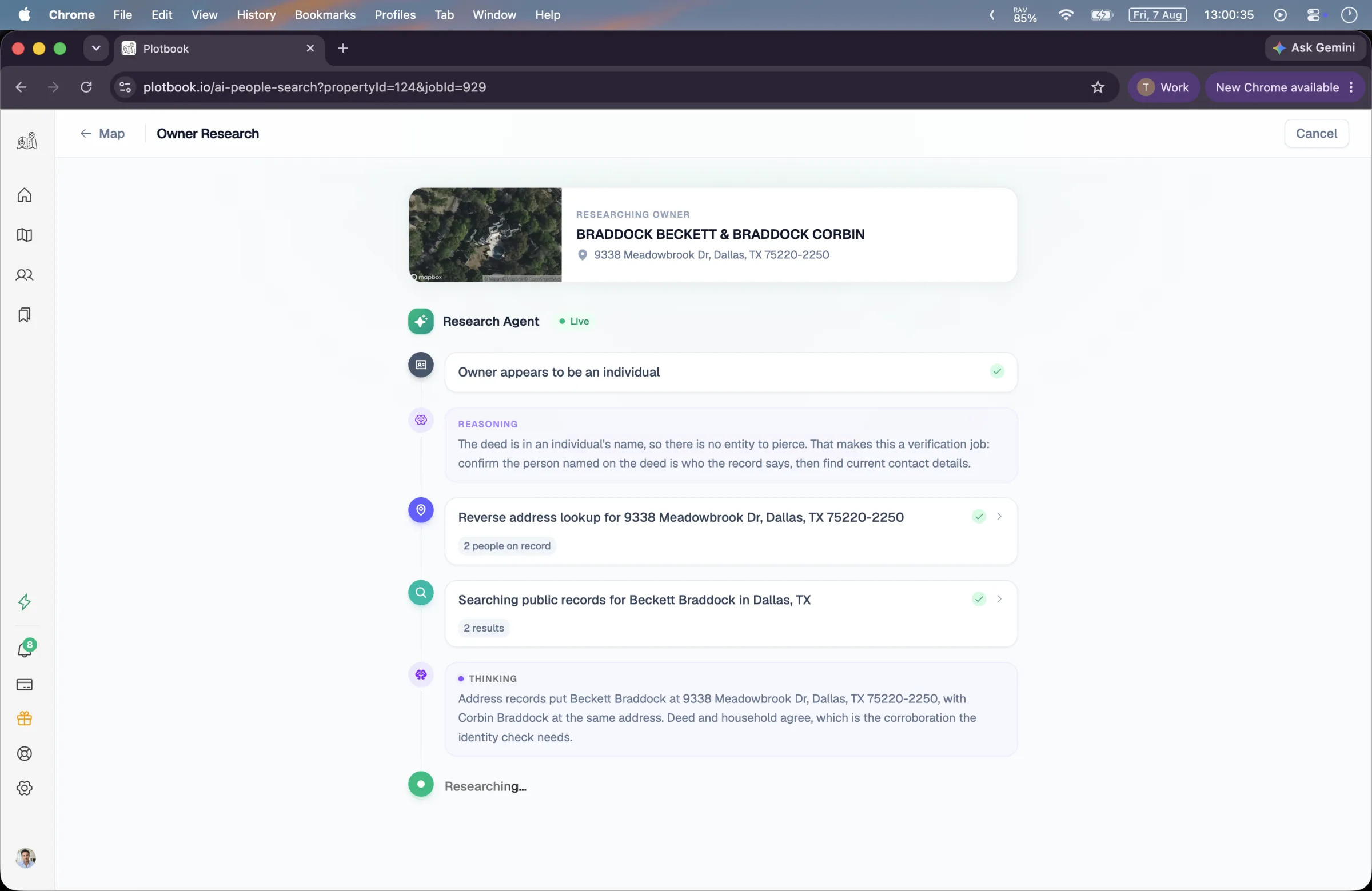
Two things happen before the model does any reasoning at all, and both are deterministic code rather than inference. The owner string is classified into an entity type, and reverse-address lookups run against residential records for the property — and, when the mailing address differs, against that address too. Those seeds are what the model starts from, so its first move is made on real records rather than on a guess.
The run then continues in the background. You can close the tab, navigate away, or start the next one; it keeps going and surfaces in the notification bell when it lands. Coming back to a run in flight re-attaches to it rather than starting a second one, and you can cancel mid-run.
- 3No credits
Follow the registry and county trail
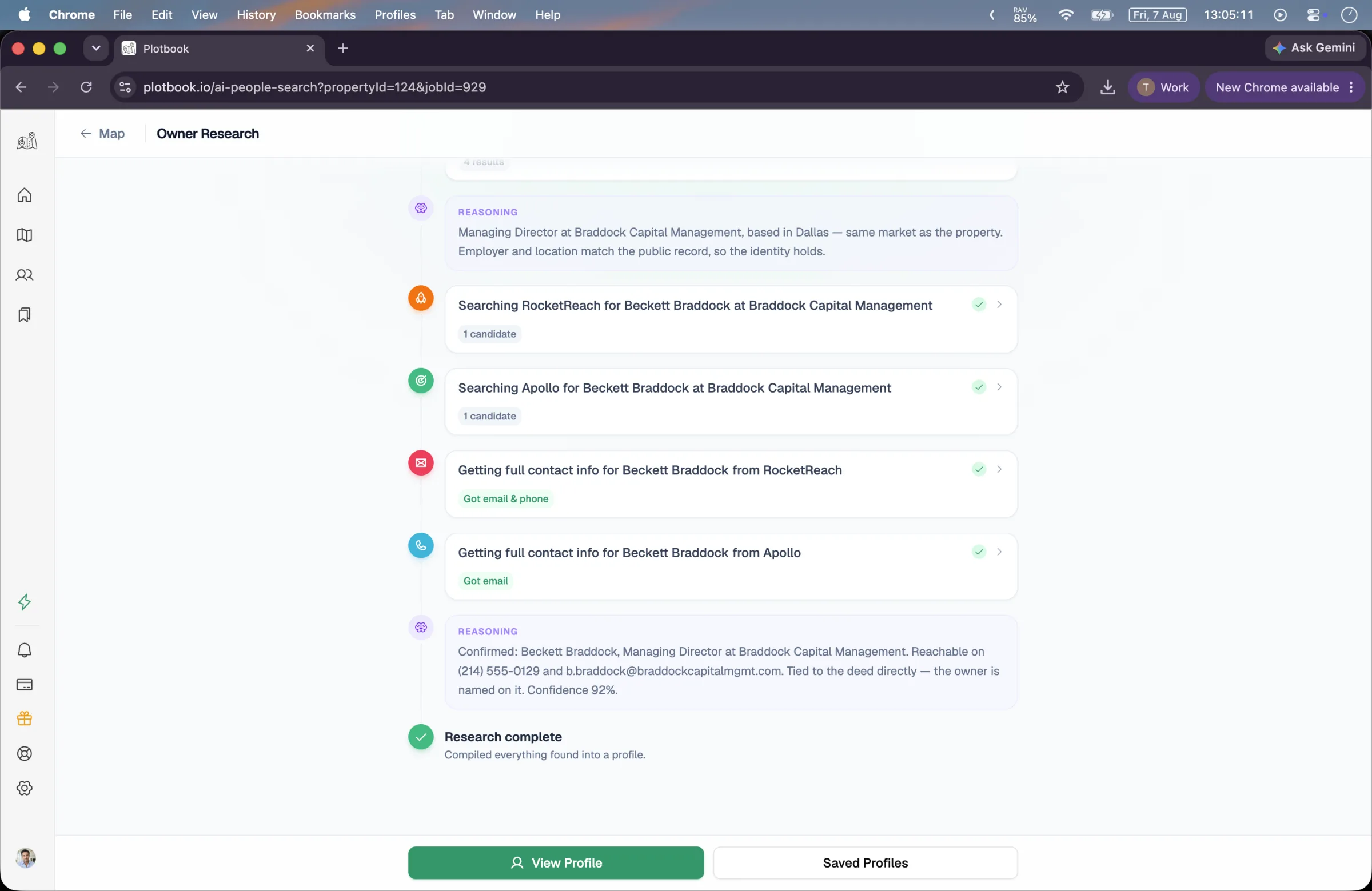
Watch the timeline, or read it afterwards. Every search, record, and source link is listed in order.
For an LLC or corporation, the run works registry aggregators looking for members, managers, officers, the organizer, and the registered agent. This is where the anonymity states matter: in Wyoming, Delaware, New Mexico, and Nevada the filing is often designed to name nobody but a commercial agent, and the run is explicitly instructed never to treat a commercial registered agent as the owner. It pivots instead — to the mailing address, to county records, to the open web, to whoever signed something.
For a trust or an estate it goes to county appraisal and assessor records for a trustee, then makes an open-web pass for press or filings naming the beneficial owner, and labels the difference between a trustee and a principal rather than blurring them.
Alongside all of it, the run can cross-reference federal campaign-finance filings, which are public and carry name, city, employer, occupation, and amounts. Those are useful twice over: as a way to confirm an identity against an independent record, and as a wealth signal in their own right.
One thing this is not: a direct connection to any Secretary of State system. The registry evidence is text read from public aggregator sites through a search tool. It is genuinely useful and it is not an official API, and anyone telling you otherwise about any product in this category is worth a second look.
- Eleven tools across people search, professional and residential contact databases, registry aggregators, county property records, open-web search, and federal campaign finance.
- Before it commits to naming anyone, the run has to corroborate the person against city, age, address, or employer from an independent source.
- No SEC filings, no structured Secretary of State API. Neither exists in the product.
- 4No credits
Judge the result by its tier
Read the research summary before you read the name. It states which tier the run actually reached.
This is the step people skip, and it is the one that protects you. A run reports whether it produced a full profile, an identification without contact details, an entity-only characterization where it could describe the company but not name a person, or nothing at all. The name at the top of a full profile and the name at the top of an entity-only result are not the same kind of claim, and the summary says which you are holding.
Then check the corroboration count and the confidence score, and open the sources. The whole point of an auditable timeline is that you can disagree with it. If the identification rests on one source and you know the market well enough to doubt it, you now have the specific link to go argue with.
Watch for: An entity-only result is not a failed run and it was still charged, because it did the work and returned real information about the entity. What it did not do is name a human. Read the tier.
- 5No credits
Keep the result
Nothing to do. A research result saves itself into your prospect book with the property attached.
Research profiles auto-save, which is why there is no separate save charge on this run. A wealth estimate is written afterwards from the parcel value and type, any other properties the person is recorded as owning, and their career and organization, arriving as four ranges with a confidence score rather than as figures.
Re-running the same property later returns the saved profile instantly instead of charging again. If you specifically want a fresh pass — because something material changed, or because the first run came back thin — you can force one.
What one pass costs
One entity deed, end to end
This run is unusually easy to price because it is essentially one billed action. The lines that cost nothing are worth reading anyway, since they are the ones people assume they are paying for.
A single parcel whose deed names an LLC, researched from the map through to a saved profile with a wealth estimate.
- Reading the parcel and the deed owner
- Free
- The map, the owner label, and the property drawer with its assessed value, address, owner, and use type. Unbilled on every plan.
- Deterministic classification and address seeds
- Free
- The entity-type classification and the reverse-address lookups that run before the agent does. Part of the run, not a separate charge.
- The research run
- 25
- Charged only when it succeeds. Failures, cancellations, no-result runs, and institutional owners are never charged.
- Saving the profile
- Free
- Research results save themselves. The 10-credit save applies to results you keep from an instant lookup or a people search, not to these.
- The four wealth ranges
- Free
- Written automatically after the profile exists. No separate charge.
- Re-opening the same property later
- Free
- Returns the existing saved profile rather than re-running. You are never charged twice for the same property by accident.
- Total
- 25
- Credits for the worked example above, at the same prices the app bills from.
So the decision is a clean one: 25 credits, risked only on success, against the value of knowing who is behind a specific holding company. On Professional’s 2,500 monthly credits that is a hundred entity deeds if you spent the entire allowance here, which nobody does — in practice this runs alongside the cheaper instant lookups on the person-named deeds nearby.
Where it goes wrong
The entities that win
Some of these are solvable with a better search and some are not solvable at all, and the difference is worth knowing before you spend.
A Wyoming LLC with a commercial agent and nothing else
The anonymity states exist precisely to make this fail, and sometimes they succeed. When the filing names only a registered agent, the run pivots to the mailing address, county records, and the open web — but if the mailing address is also the agent's and nothing was ever written about the property, there is no trail to follow and the run says so.
A trust that was never written about
County records name a trustee more often than not, and a trustee is a real lead. The beneficial owner is a different question, and it is only answerable when something public connects them — a filing, a news story, a transaction. Plenty of family trusts have no such record, and the run will label a trustee as a trustee rather than promote them.
A common name that cannot be disambiguated
The run is required to corroborate an identity against city, age, address, or employer before committing to it. When the candidate is a common name in a large metro and nothing independent lines up, that gate does its job and refuses, which reads as a disappointing result and is the correct one.
You wanted a runtime and there isn't one
The research budget is adaptive rather than fixed, so a straightforward entity resolves quickly and an obstructed one genuinely takes minutes of real work across registries and records. Plotbook publishes no advertised research time because there is no honest one to publish. Runs are durable instead: close the tab, get a notification.
Variations
When the deed says something else
The same run, adjusted for what is actually printed on the parcel.
- 01
A trust rather than an LLC
Expect the trail to run through county records first rather than registry filings, and expect a trustee as a common outcome. Read the role label carefully: a trustee who is an attorney is a professional acting for the family, not the family.
- 02
An estate
The run looks for the executor and the heirs. This is often the most productive entity type to research, because probate is a public process and estates are frequently a moment when property is about to move.
- 03
An absentee owner with an out-of-state mailing address
This is a good sign, not a bad one. The mailing address is a second, independent thread the run pulls on with its own reverse-address lookup, and out-of-state mail on a high-value parcel is one of the more reliable ways an entity gets connected back to a person.
- 04
A whole street of entity deeds
Start them and walk away. Runs are durable and notify on completion, so the efficient pattern is to queue several and come back to the notification bell rather than watching any one timeline. Each is charged independently, and only on success.
Questions
What people ask about this run
Keep reading
The research agent
The mechanism underneath this runbook: the tools, the gates, and the tier contract.
Build a lead list
Where this run sits inside the larger loop of working a territory.
Find owner contact details
The other half: once you have the name, how to reach the person.
AI owner research
The feature page, with the live timeline shown in full.
Point it at a holding company you can check
There is almost certainly an entity-held property in your market whose owner you already know. That is the run worth doing first, because it tells you what the answers are worth.
New subscribers start with 7 days and 100 credits. We email you before the trial ends.