

A business owner, an employee with equity compensation, and a recent inheritor do not need the same first ten questions. They do need the same foundation before an advisor draws a conclusion. That is the problem with asking AI for “discovery questions for a business owner”: the output often sounds tailored while leaving out ordinary facts that make advice defensible.
This question bank uses two layers. First, gather the baseline financial profile. Then add a short client-type module that exposes a deadline, document, decision-maker, or source of concentration a generic script can miss. For the wider picture of where AI fits in an advisory practice, see how financial advisors use AI.
unknown nodeBuild the call in two layers
The baseline has a regulatory and fiduciary reason. Regulation Best Interest defines a retail customer investment profile to include age, other investments, financial situation and needs, tax status, objectives, experience, horizon, liquidity needs, risk tolerance, and other disclosed information. FINRA Rule 2111 uses the same core factors and says firms should use reasonable diligence to obtain and analyze them unless a factor’s lack of relevance is specifically documented. SEC Regulation Best Interest FINRA Rule 2111
Those rules are addressed to broker-dealers and FINRA members, and an RIA’s obligations depend on its relationship and advice. They are still a helpful reminder that a lively discovery call should produce a complete picture rather than a memorable anecdote. SEC guidance says an adviser needs a reasonable understanding of a retail client’s objectives and should make reasonable inquiry into financial situation, sophistication, experience, and financial goals. SEC IA-5248
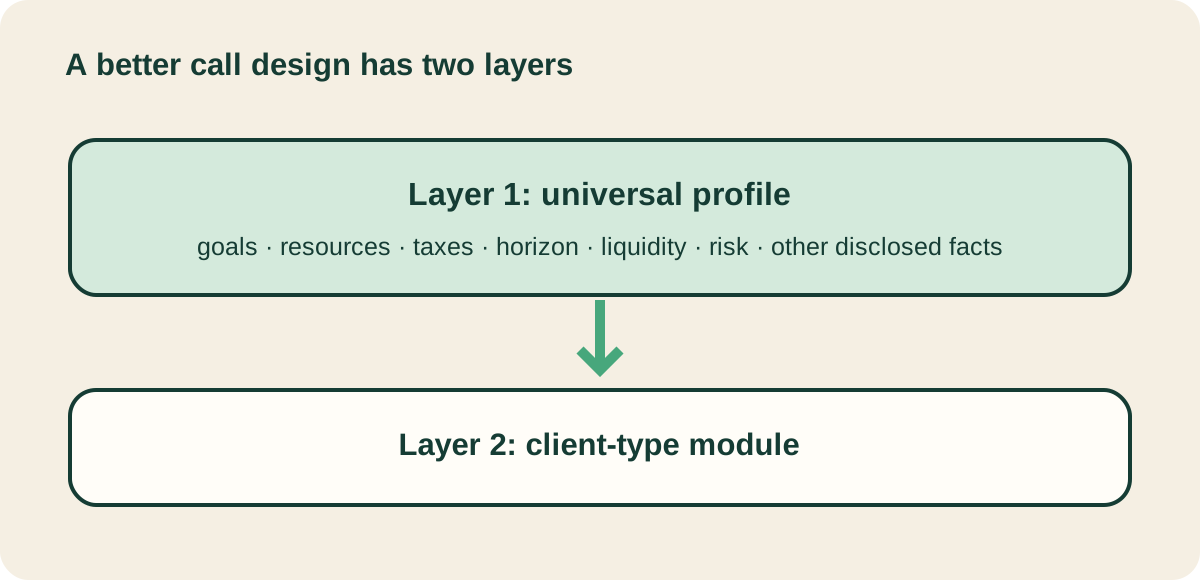
Segment-specific questions are useful only after the shared profile is being gathered.
Layer one: the baseline question set
You do not need to read these as a checklist in a stiff order. You do need a way to capture the answers, uncertainties, and follow-ups.
- What prompted you to take this conversation now, and what would make it useful?
- Who is involved in financial decisions, and who else should be included before any planning discussion continues?
- What does a successful outcome look like in the next year, five years, and longer term?
- What assets, liabilities, income sources, insurance, and other investments should be part of the picture?
- What cash needs, planned expenses, debts, or liquidity events are likely to matter?
- What is your tax situation, and which CPA or tax professional is involved?
- What experience have you had with investing and financial advice? What has felt useful or unhelpful?
- What time horizon applies to each important goal, and how flexible is it?
- How do you tend to respond when markets or income change? What risks concern you most?
- Is there anything else (family, work, health, legal, or timing-related) that would change how we should understand your goals?
The final question earns its place. In our test, “any other information the customer may disclose” was absent from both unprimed AI outputs, even though it is explicitly included in the investment-profile definition.
What our AI coverage audit found
We asked Claude Sonnet 5, in one run per prompt style, to write a generic discovery list and then question sets for five client types. We scored whether the generated questions would surface the ten baseline profile factors listed in Reg BI and FINRA Rule 2111. It does not measure all models, real advisor behavior, or legal compliance; treat it as a reproducible warning about an ordinary prompt.
The generic run covered 4 factors, partially covered 3, and omitted 3. The segmented run covered 3, partially covered 2, and omitted 5. A third prompt asking for a set that would stand up to later scrutiny covered all 10, despite never naming Reg BI or Rule 2111. The model had many of the ideas; it did not volunteer a complete baseline when asked naturally.
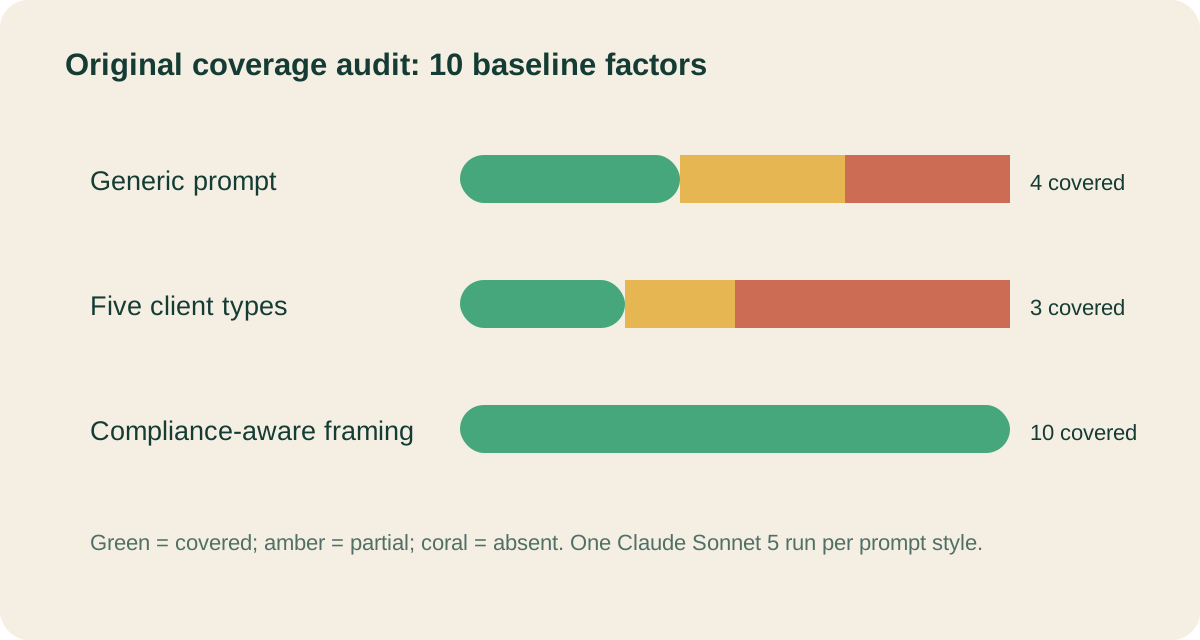
Original one-model, one-run audit, August 19, 2026. It shows prompt framing changes coverage; it does not certify an AI workflow.
The result argues for a simple operating rule: put the baseline in the template, then let AI help generate the module. Do not ask AI to remember the template for you.
Module one: business owner nearing an exit
An exit conversation should surface both deal facts and life-after-the-deal facts. The Exit Planning Institute’s 2023 owner-readiness report found that formal personal planning after exit was more common than in its earlier survey, but not universal; use that as a reason to ask, not as a prediction about an individual client. Exit Planning Institute report
Ask:
- What would need to happen for you to regard an exit as successful beyond the sale price?
- Is there a target date, buyer conversation, valuation, or deal structure already in motion?
- What portion of family income, identity, and decision-making is tied to the business today?
- What role would you want after a sale: transition support, a new venture, philanthropy, or time away?
- Is your personal post-exit plan written down anywhere, or is it still a working idea?
- Which attorney, CPA, valuation professional, and benefits specialist should be part of the next conversation?
If the business or its real estate is held in an LLC or trust, check the public property and entity records before the call, as described in how to research a prospect before the first meeting. Then you can ask how ownership is structured instead of guessing at it.
Do not use the discovery call to infer tax treatment of a sale. The IRS explains that a sale of a business can require allocation among individual assets; that belongs in a CPA and transaction-counsel discussion. IRS sale-of-business guidance
Module two: employee with equity compensation
The goal is to identify the grant, timeline, concentration, and questions that need tax or legal review. Telling the employee to sell is outside the call. Start with “What type of equity do you have?” and “What documents or portal information can we review with your tax professional?”
Then ask:
- Are these ISOs, NSOs, RSUs, restricted stock, or a mix? What are the grant, vest, and expiration dates?
- Have you exercised options or sold shares before? Were any tax estimates or forms prepared?
- Is an early exercise or restricted-stock transfer involved, and has anyone discussed an 83(b) election?
- What employer trading windows, blackout periods, or company policies apply?
- How much of household income, net worth, and near-term spending depends on this employer?
- Who is the CPA or equity-compensation specialist who should verify the tax consequences?
For some restricted-stock transfers, an 83(b) election has a 30-day filing window with no extension. That is precisely why the call should identify the situation and escalate it rather than offer filing instructions from a generic template. IRS Form 15620
Module three: recent inheritor or widow/widower
Grief and administration work make timing and tone part of the question design. Do not ask whether proceeds are “just sitting in cash” as though investing them is the default. Ask what needs attention, who has authority, and which professional is coordinating the estate.
- What has happened already, and what decisions are still pending?
- Who is the executor, trustee, estate attorney, and tax professional?
- Which accounts, properties, insurance proceeds, or business interests are involved, and how are they titled now?
- Do you have date-of-death values, cost-basis records, or an inventory from the executor?
- What near-term bills, family commitments, or decisions cannot wait?
- Who should be in future conversations so the surviving spouse or inheritor is not navigating this alone?
For inherited property, basis is generally its fair market value at the decedent’s death, subject to exceptions. That makes the date-of-death valuation a fact worth locating; the tax conclusion belongs to the tax professional. IRS Publication 559
Module four: pre-retiree
Here, a discovery call should expose the calendar and cash-flow choices behind the word “retirement.” Ask:
- When do you expect earned income to change, and is part-time work possible?
- What pension, stock compensation, deferred compensation, or health benefits change with retirement?
- Have you reviewed your Social Security statement at your earliest claiming age, full retirement age, and age 70?
- What spending is essential, discretionary, or likely to change in the first five years?
- What does health coverage look like before and after Medicare eligibility?
- Which decisions have dates that cannot slip, and who is helping with each?
For people born in 1960 or later, Social Security full retirement age is 67. Delayed retirement credits, work plans, and benefits are facts to model with the client’s actual record rather than assume from age alone. Social Security Administration
Module five: client navigating divorce
Start with scope and conflicts. Ask who the client is, whether both spouses are clients, what communication permissions exist, and which facts should come from the attorney or CPA. CFP Board has published guidance on managing conflicts when married clients divorce; firm policy and the engagement agreement should lead. CFP Board divorce guide
- What is the current legal stage, and which attorney is responsible for the agreement or court process?
- What assets and debts are in discussion, including retirement plans, real estate, business interests, and insurance?
- Are there retirement-plan orders or administrator reviews in progress?
- What cash-flow, housing, education, insurance, or dependent-care decisions have near-term dates?
- What tax records, basis records, and prior returns will the CPA need?
- What communication boundaries and decision-making permissions should the firm document today?
The IRS explains that property transfers incident to divorce and IRA transfers can have specific tax treatment. That supports early CPA coordination, and the discovery list stays a fact-gathering tool. IRS Publication 504
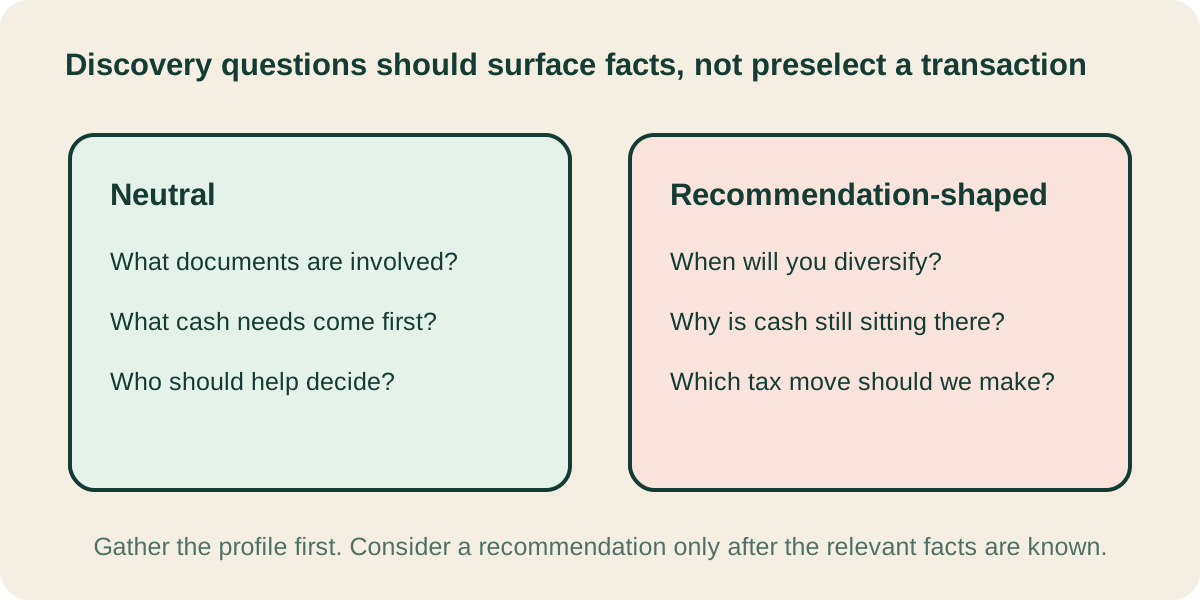
Discovery questions should surface facts and decision-makers before they imply a transaction.
Keep the output reviewable
The call is only useful if the record separates three things: facts the client supplied, documents still needed, and questions that belong with another professional. Store that record in the firm-approved system. SEC Rule 204-2 includes written communications relating to advice and recommendations, with minimum retention requirements; ask compliance how the firm applies its policy to AI-assisted call preparation and notes. Advisers Act Rule 204-2
For a neutral way to organize an internal research brief before a conversation, try the prospect research brief. Plotbook can help organize public-record and prospect-research context, but it does not automate outreach or replace your firm’s discovery, suitability, fiduciary, privacy, or recordkeeping processes. You can also review Plotbook’s compliance information, research methodology, and resources.
Questions advisors ask
Can AI write my discovery call script?
It can draft a question bank and adapt a client-type module. Keep a human-owned baseline template, review the questions for neutral phrasing, and make sure the client record captures the answers and open items.
Do I need every question on the first call?
Not necessarily. Scope, urgency, and the client’s circumstances affect pacing. The point is to know which profile facts remain unknown before a recommendation is considered, and to document why a factor is not relevant when that is the case.
Are client-type modules compliant by themselves?
No. A module is a conversation aid. The applicable rules, firm supervision, engagement scope, and records process still govern.
How should I ask about a recently deceased spouse?
Lead with permission, decision-makers, immediate needs, and the client’s pace. Avoid urgency tactics or questions that assume cash must be invested. Route estate and tax questions to the attorney and tax professional.
The call should leave fewer assumptions behind
Segmentation earns its place when it keeps an owner’s exit plan, an employee’s grant type, an inheritor’s records, or a pre-retiree’s dates from disappearing inside a generic conversation.
Use AI for the drafting work. Keep the baseline, the judgment, and the final record under human control.