

An AI can turn a 40-page trust into a first-pass issue list. It cannot tell a client what a clause means for their estate plan, decide whether a beneficiary designation is right, or prepare a tax position. A useful workflow starts from that limit.
For the broader operating model, see how financial advisors use AI. This page is narrower: how an advisor can use an approved tool to organize an existing trust, will, Form 706, Form 709, or K-1 for a human reviewer without quietly turning a summary into legal or tax advice.
unknown nodeThe useful job: make the source easier to review
The strongest use case is a request like this: “Build a traceable inventory of what this document says, what it does not say, and what the attorney or CPA should confirm.” Compare that with “review this trust and tell me what to do.”
The narrower request changes the output. A useful extraction can identify successor trustees, distribution ages, named charities, a stated governing-law clause, and whether a schedule is actually attached. It can also say not stated in document rather than inventing a plausible answer. That gives an advisor a cleaner meeting-prep sheet and a better handoff to counsel.
It is especially helpful when several documents must be compared: a trust amendment against the base trust, a beneficiary form against a planning memo, or a K-1 against the client’s prior-year tax organizer. The output should still be a map back to the originals, not a substitute for them.
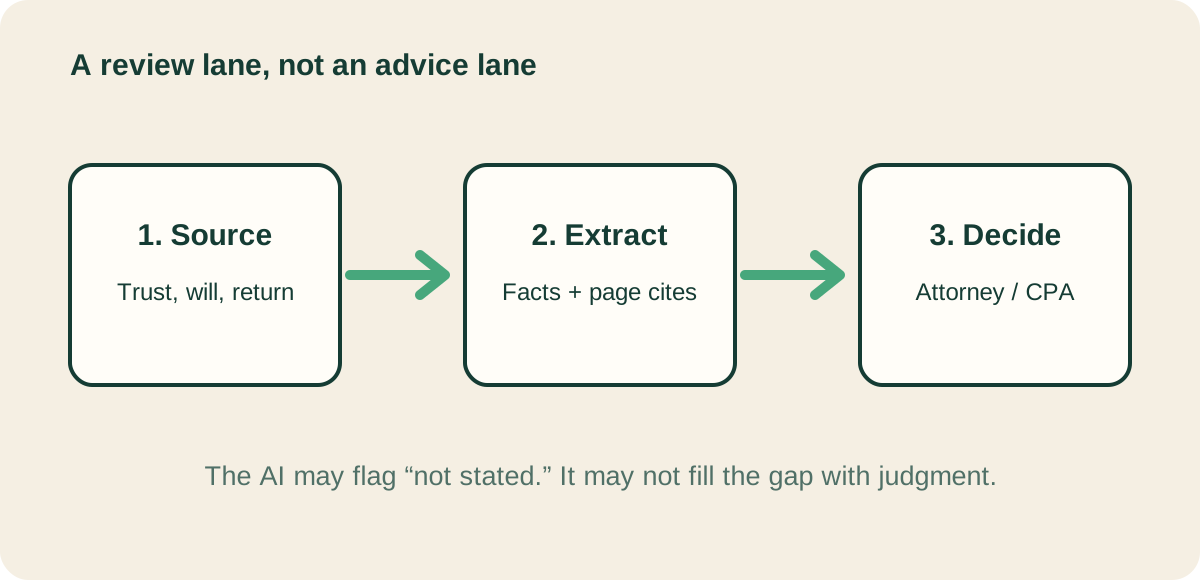
AI belongs in the extraction lane. Legal and tax judgment remains with the qualified human reviewer.
Use that same separation in client communication. An advisor can say, “Here is a list of items we noticed for your estate attorney to review.” An advisor should not say, “This trust clause accomplishes your intended tax result,” unless the appropriate professional has independently reached that conclusion.
The trap in a normal “summarize this” prompt
We tested this on a synthetic trust excerpt with 15 scored facts, including four facts deliberately absent from the document. One Claude Sonnet 5 run received a thin request to summarize; another received a structured field list; a third was asked every scored question directly. This was one model, one document, and one run per prompt style. It is neither a product benchmark nor a general hallucination study.
The thin prompt correctly addressed 13 of 15 items, but silently omitted two absent facts: whether a third-tier successor trustee existed and the value of the trust estate. The structured prompt correctly covered or flagged all 15. No run invented a dollar value, a third trustee, or missing will language. The thin output did, however, add examples of personal property while saying the document did not state them. That is a quieter failure: an unmarked inference that can look like a source fact when skimmed.
The practical lesson is simple. A long narrative summary is a poor review checklist because it only answers questions someone remembered to ask. A schema forces the model to inspect the fields that can be missing.
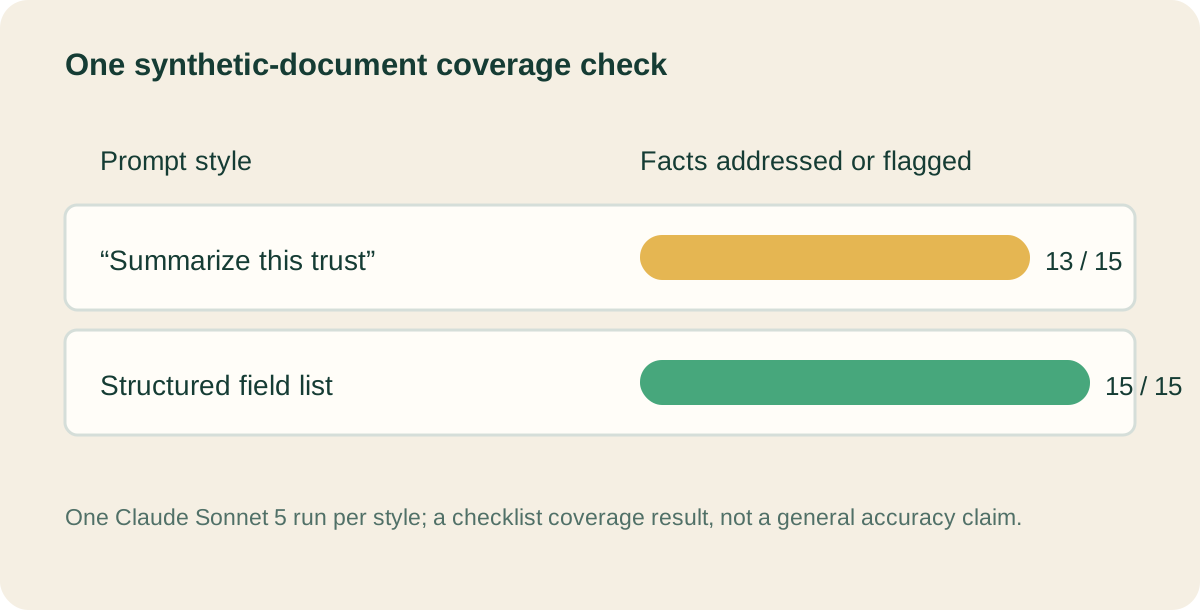
Original one-document test, run August 19, 2026. It measures coverage of a prewritten checklist, not general AI accuracy.
Use a field list, source locations, and an explicit “not stated” column
Start with a task small enough to audit. Do not upload a stack of estate files and ask for “anything important.” Ask for a table with a fixed set of fields and a source location for every affirmative answer.
For a trust or will, useful fields include:
- grantor, trustee, successor trustee, and any stated disqualification;
- beneficiaries, contingent beneficiaries, and distribution conditions;
- revocability, powers of appointment, spendthrift language, and governing law;
- referenced schedules, exhibits, amendments, and documents that were not supplied;
- stated asset values, tax elections, filing deadlines, and information that is absent;
- questions that need an attorney, CPA, or client answer.
For a tax document, change the fields rather than pretending every form is the same. A K-1 review may need entity name, tax year, income and deduction categories, whether the form references attached statements, and questions for the preparer. A Form 706 review may need filing date, portability election status, schedules referenced, and the professional responsible for each open item. IRS instructions say Form 706 is generally due nine months after death, with a possible extension; deadline handling deserves a human confirmation, not an AI assumption. IRS Form 706 instructions
Here is the shape of a safer request:
Create an internal extraction table from the supplied document only.For each field: state the answer, cite article/section/page, quote no morethan the needed supporting text, or write NOT STATED IN DOCUMENT.Do not infer missing facts. Do not draft or revise legal language. End withquestions for the client’s attorney or tax professional. This is a workingdraft for human review, not advice.
The phrase “from the supplied document only” matters. It reduces the chance that the model blends general knowledge with the text in front of it. The phrase does not create a guarantee; it creates an output that is easier to check.
Why estate and tax work has harder boundaries than ordinary note-taking
Estate documents are not merely dense. They define rights, control, and family relationships. Tax documents can contain filing positions and taxpayer information. A readable AI summary may make a reviewer feel more certain than the source warrants.
Bar authorities also draw a line around preparation and explanation. An Illinois State Bar Association advisory opinion looked at a nonlawyer financial planning company that gathered client information, explained estate-planning options, and prepared documents such as revocable living trusts and pour-over wills before sending them to the client’s attorney for review. The committee concluded that the attorney may be aiding the unauthorized practice of law, and that the later attorney review did not cure the problem because the advice and drafting had already happened. That is one state’s opinion, not a nationwide rule. Still, it shows that state rules matter and that “AI wrote the draft” does not remove the issue. ISBA Advisory Opinion 91-10
The tax boundary is similarly practical. An advisor can coordinate with a CPA and organize client-provided information. Telling a client how to complete a return, what tax position to take, or how a specific trust transaction should be treated needs the appropriate tax professional. The IRS describes practice before it as including matters connected with a taxpayer’s rights and liabilities; the exact scope and who may perform it are not something a generic AI answer should decide. IRS guidance on Circular 230
Privacy, vendor approval, and records are part of the workflow
A trust, return, or K-1 can include names, addresses, taxpayer identification details, family relationships, account data, and sensitive instructions. Do not paste that material into a consumer tool merely because the prompt is good. First ask the firm’s privacy, cybersecurity, and compliance process whether the vendor, account tier, contract, retention setting, and data handling are approved for this document type.
SEC amendments to Regulation S-P require covered institutions, including registered investment advisers, to maintain written incident-response policies and procedures for unauthorized access to or use of customer information. The amendments also address safeguarding information maintained by service providers. Treat that as a reason to route the workflow through the firm’s real process, since a blog post cannot serve as an approval checklist. SEC Regulation S-P release
Tax practitioners have an analogous security obligation. The IRS points preparers to Publication 4557 and a written data-security plan to protect taxpayer data. IRS data-security guidance
If an AI output informed advice, retain it according to the firm’s books-and-records policy alongside the version of the source document used. SEC Rule 204-2 includes written communications relating to advice or recommendations and has a minimum five-year retention period. Whether a particular prompt transcript is required in a specific case is a compliance question for the firm; the safe operational posture is not to treat a relied-on summary as disposable scratch work. Advisers Act Rule 204-2
For a broader explanation of how Plotbook treats research outputs as reviewable evidence, see our trust and security information and the compliance overview. Plotbook is a research tool, not an estate-planning or tax-preparation system.
A five-step review workflow
- Classify the file. Identify document type, date, version, source, and whether the necessary approvals permit it to enter the chosen tool.
- Extract, do not interpret. Use the fixed field list, document citations, and not-stated column.
- Compare against an adjacent record. For example, compare listed trustees with the client’s planning inventory, or compare a K-1 question list with the CPA’s organizer. Do not decide that a difference is an error without the professional who owns that decision.
- Route the questions. Send legal-language and beneficiary questions to the attorney; filing and tax-position questions to the CPA/EA; client facts back to the client.
- Preserve the review trail. Keep the source version, output, reviewer, unresolved items, and final disposition under the firm’s records policy.
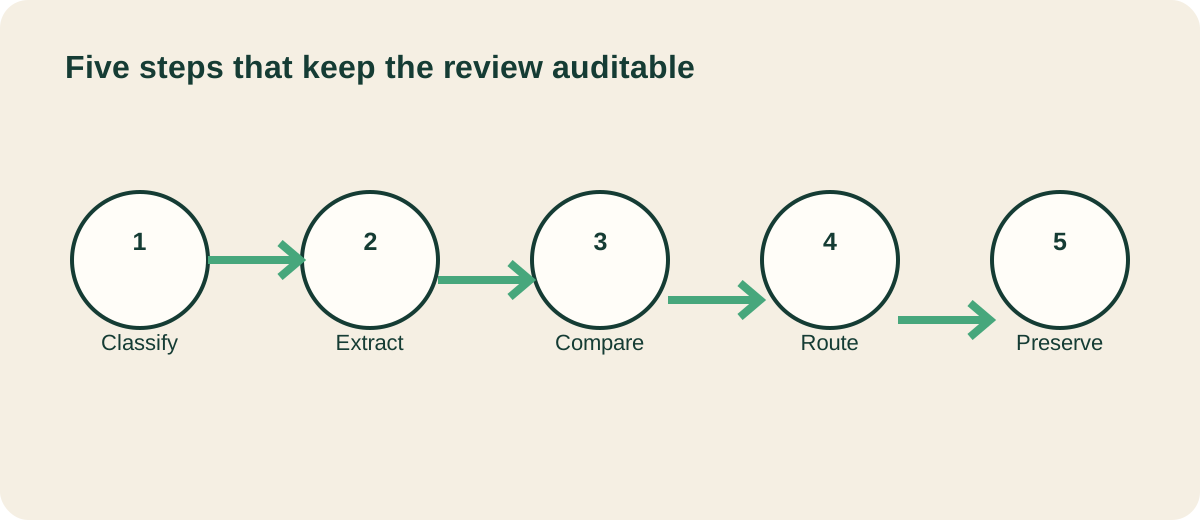
The workflow turns an AI response into a review artifact instead of a final answer.
This process is useful for advisors who need a clearer agenda before an estate-attorney or CPA meeting. It is not a shortcut around that meeting. For adjacent preparation work, see how to research a prospect before the first meeting, the AI claim auditor, and our resources page.
Questions advisors ask
Can AI review a trust for mistakes?
It can extract stated terms and flag mismatches or missing fields for review. It cannot reliably determine legal effect or certify that a trust has no mistakes. Ask the attorney who represents the client to make that determination.
Can I upload a client tax return to ChatGPT?
Do not assume that a consumer account is approved. The answer depends on the firm’s vendor review, contract, data controls, retention, and the client information involved. Use the firm’s security and compliance process before uploading any nonpublic personal information.
Should the AI output go in the client file?
If the output informed advice or a recommendation, do not treat it as throwaway. Follow the firm’s records policy and ask compliance how to retain the source, output, and reviewer notes.
Does a disclaimer make AI-produced estate advice safe?
No. A disclaimer does not transform legal drafting or client-specific tax advice into an approved activity. Keep the task to extraction and question generation, then use the relevant licensed professional for advice.
The standard to keep
The best AI estate-document review ends with fewer assumptions, a visible list of unknowns, and a cleaner question set for the professionals who own the decision. If a response cannot point back to the document, label the gap or leave it for human review.
That is slower than treating a polished chat response as an answer. It is also the version an advisor can explain to a client, an attorney, and a compliance reviewer.