
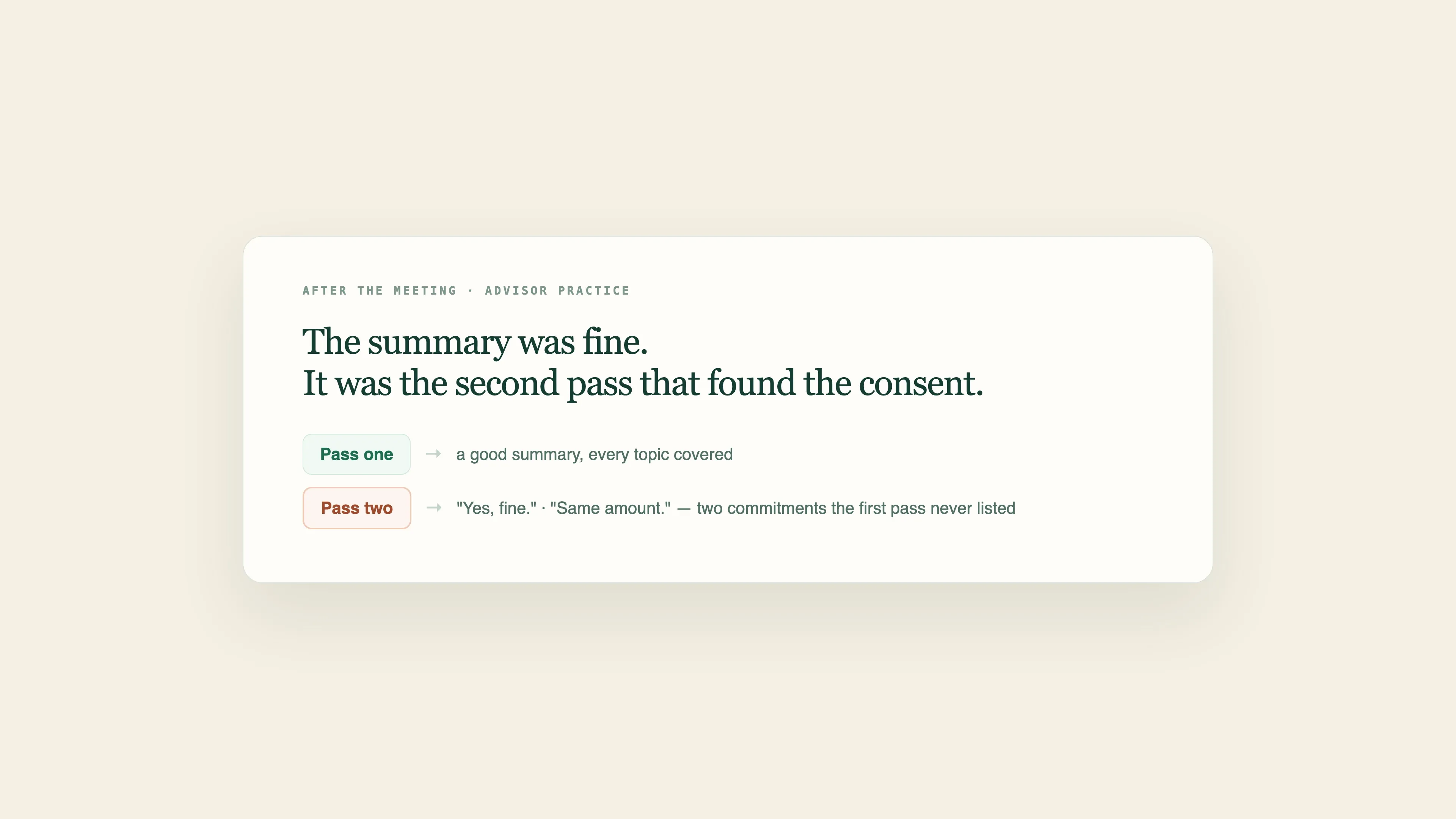
Meeting notes are the single most-adopted AI task among advisors. In the only published task-level breakdown, 31% report using AI for meeting notes, more than CRM updates, meeting prep, or client email (Advisor360° / FUSE Research Network, n=300, released 2026-01-13; vendor-published, labelled here because it sells software to advisors).
The note is also the least valuable thing to come out of a client meeting. A clean paragraph describing what was discussed is a nice-to-have. What matters is what the meeting produces downstream: who committed to what, what has a deadline and what doesn't, and what got raised and quietly dropped because nobody wrote it down. The note is the byproduct. The cascade (CRM entry, follow-up email, action items, and an honest list of what's still open) is the job.
We wanted to see what a single AI pass actually catches and misses, so we built one fictional meeting and ran it four ways, in one context, on one model, in one day.
unknown nodeMeeting notes are the easy part of a harder problem
The Advisor360° breakdown is the only survey in the 2026 season that asked advisors what they actually do with AI, rather than whether they use it at all: notes lead at 31%, CRM updates at 28%, meeting prep at 26%, routine communications at 25%. It comes from one vendor and 300 people, and should be read as directionally right rather than precise: a pattern Schwab described in words but never put a number on, in a separate survey of its own (Charles Schwab Advisor Services, n=533, released 2026-01-22).
But even at face value, "summarize this meeting" differs from "produce everything this meeting owes the file, the client, and the calendar." A summary is prose. A cascade is four artifacts with four failure modes: a CRM note accurate enough for a colleague who wasn't in the room, an email that can't promise anything not actually agreed to, an action-items list with an owner and a source quote per row, and (the part almost nobody asks for) an honest accounting of what got raised and never closed. Most AI notetakers already produce something like the first three. Almost none surface the fourth on their own.
A fictional meeting, run four ways
Before any of the findings: everything below is fictional. We wrote a client meeting transcript for this test (advisor, client, account numbers, family details, all invented) because we did not want to run real client data through a public AI model. Every run used Claude Sonnet 5, on 2026-08-18, in a single context, so later outputs may be mildly influenced by earlier ones. We tested one model on one day, not GPT-5, Gemini, or Copilot.
The transcript is built to look like a normal, moderately dense annual review, not a stress test: advisor Ray and client Marguerite Osei, about 90 lines, mostly in order, one number the advisor corrects mid-sentence. It covers her account value, a pending business-sale offer she declines to name a dollar figure for out loud, a tax question her accountant flagged but couldn't explain, an old 401(k) she almost rolled over by mistake, a completed transfer, a charitable distribution, and two family matters raised and explicitly tabled.
We ran four prompts against it in order: a plain summarize instruction, a structured four-output cascade prompt, a second narrow pass asking only for commitments, and a jargon-risk pass. Nothing was edited after generation.
The thin prompt: a good-looking summary that flattens the meeting
The first run was the prompt most advisors actually type: "Summarize this client meeting." Nothing else. What came back was genuinely fine as prose: five clean paragraphs covering the account value, the acquisition offer and its tax question, the 401(k) rollover trap, the completed transfer, the distribution, and both family items, with nothing invented. If your bar for "AI wrote a good meeting summary" is "did it cover the content," this passes.
What it did not do is distinguish a resolved item from a deferred one. The mother-moving-in topic and the Nathan-on-the-account topic were both described as "tabled for a future conversation". True, but flattened into the same sentence structure as everything else, with no signal that one needs a due date and a next-meeting slot while the other is fully closed. Nothing in a one-line prompt tells the model that separating "done" from "open" from "dropped" is the actual job.
The structured prompt did better by design, not luck. Instead of "summarize this," it specified four outputs (a CRM note, a follow-up email confirming only what was agreed, an action-items table with an owner, a due date, and a source quote per row, and a fourth output for what might have been missed), plus two rules: don't invent a fact, and mark anything sensitive rather than softening it.
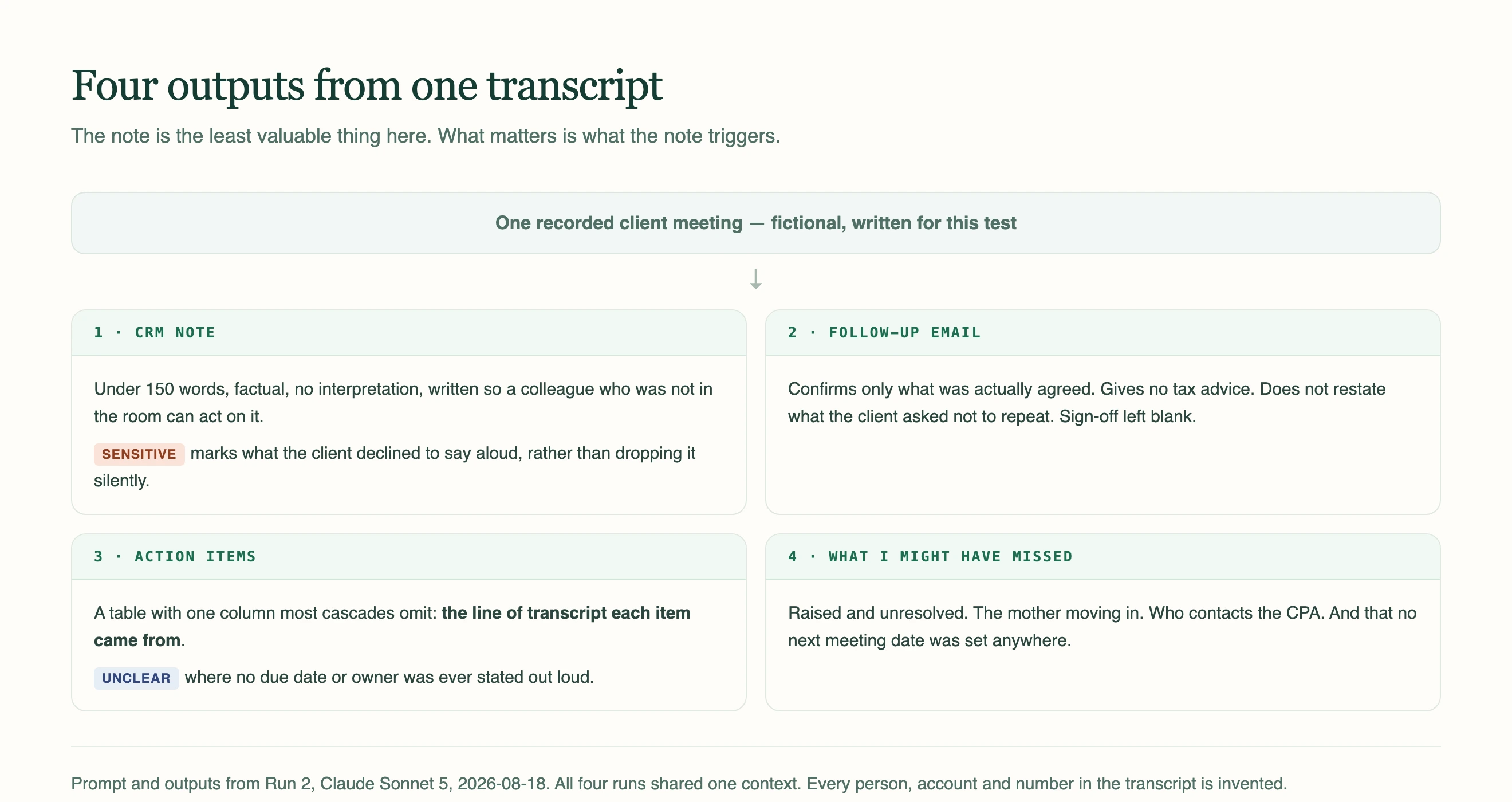
Same transcript, same model. The difference between Run 1 and Run 2 is whether the prompt asks for a summary or a cascade.
The CRM note came back accurate and dense, correctly marking the deal amount [SENSITIVE] and the share-issue date [UNCLEAR: 2018 or 2019] rather than guessing either. The follow-up email confirmed only what was agreed (don't sign the rollover, hold off on Dawson's, same QCD amount) and left the sign-off blank rather than inventing a closing. That's the same discipline we found testing pre-meeting research briefs: a model told to flag what it doesn't know does it reliably; asked only to be helpful, it fills the gap instead.
One pass is not enough
Here's the part that mattered most. In the same context, we asked one more question: "Go back through the transcript one more time, looking only for commitments. A commitment is anything either person said they would do, including things phrased as a question that were answered yes."
The model found ten commitments. Eight matched the action-items list from the structured pass. Two did not: Marguerite's confirmation that she was fine being recorded, at the very top of the transcript ("Yes, fine."), a documented consent with no obvious slot in a prompt built around "what does someone need to do next"; and her confirmation that the charitable distribution should match last year ("Same amount."), a commitment the first pass folded into Ray's action item as context, so it existed only inside someone else's row rather than as its own fact.
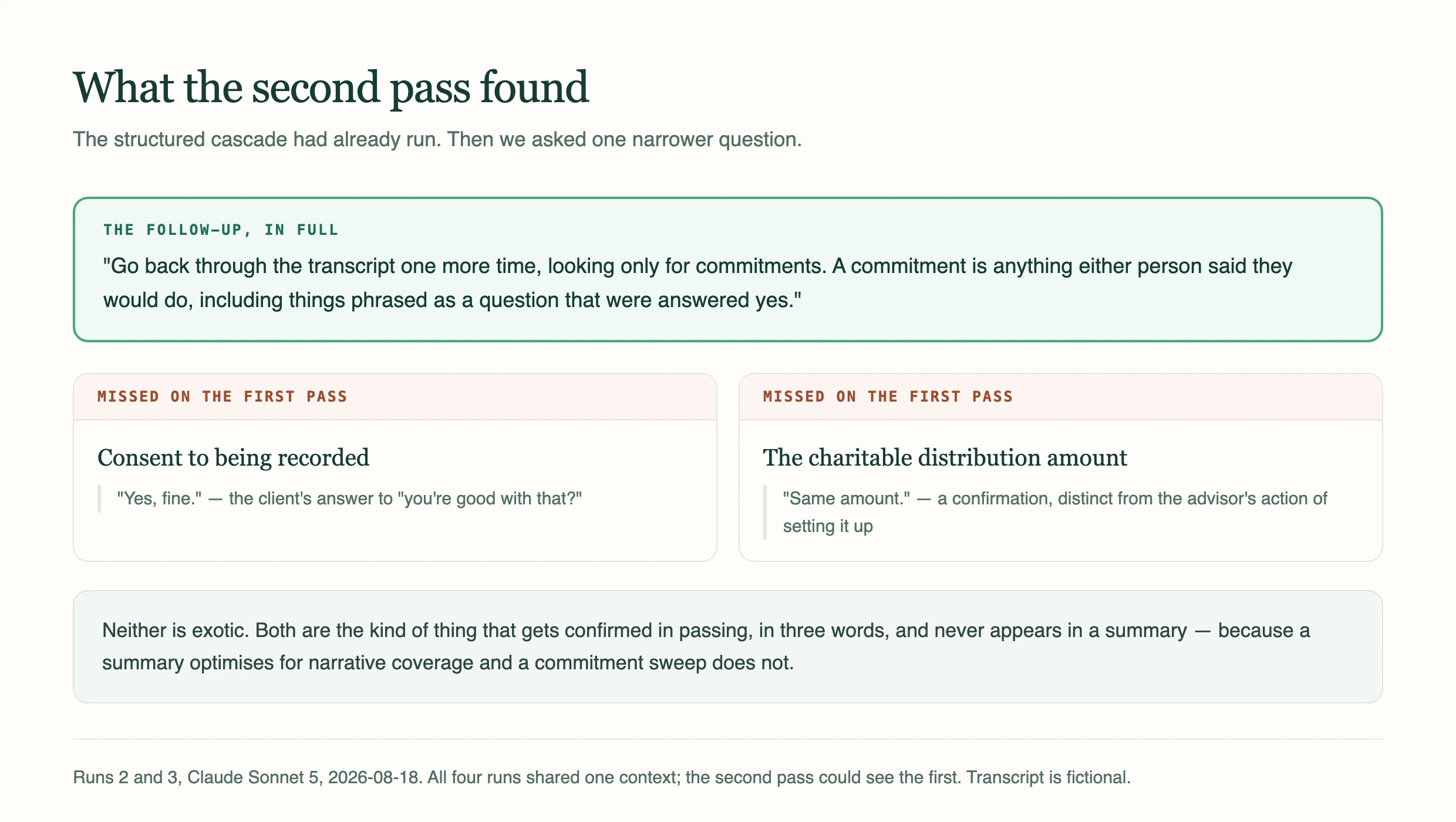
The four-output structure is built to catch tasks. A second, narrower pass asking only "what did someone commit to" catches commitments a task-shaped prompt doesn't have a place for.
The reason isn't that the first pass was careless. A prompt built around four specific outputs optimizes for those four: narrative coverage, an action table, an email. Commitments that don't read as forward-looking tasks have nowhere obvious to land, so they get absorbed into whatever section is closest instead of surfaced on their own. Asking the same model to look for one thing, and only that thing, found what the broader pass missed.
That's the rule this post ships: run the structured cascade, then one more narrow pass asking only for commitments, on the same transcript, same session. It costs one extra prompt:
Go back through the transcript one more time, looking only for commitments.A commitment is anything either person said they would do, including thingsphrased as a question that were answered yes. List every one you find,including any you did not include the first time.
What the first pass got right
This isn't an argument against the structured cascade. Its fourth output, "what I might have missed," did real work of its own.
It correctly flagged that the acquisition offer's dollar figure was never stated, marked it [SENSITIVE], and preserved the fact that the client declined to say it out loud rather than silently leaving a gap. That's the behavior worth wanting from anything handling what a client withholds: not a guess, but the withholding itself recorded as a fact. That is close to what we describe in our note on human-in-the-loop review, where the useful failure mode is the one that flags itself.
It caught that several open items had no owner and no due date: who contacts the CPA, and when the share-issue documentation is needed by. Both sit in the action-items table as [UNCLEAR: no date given] rather than a fabricated deadline, correctly, but they will sit there indefinitely unless someone reads the table and assigns them by hand.
It flagged that the mother-moving-in topic was raised and explicitly tabled ("let's not get into it today but put a pin in it") with nothing downstream resolved, and that no next-meeting date was set anywhere in the transcript, a fact an advisor reading only the CRM note would miss. None of that required a second pass, just asking the model, as its own numbered output, what it might have missed, which most one-line prompts never do.
The jargon problem, honestly framed
The fourth run asked a different question: which financial terms would a general-purpose transcription system most likely get wrong, and what would it write instead?
The model ranked eleven terms (S&P, QSBS, Section 1202, C-corp, 401(k), NUA, ACAT, QCD, RMD, cap table, bond ladder) by predicted mis-transcription risk, putting ACAT first: "a cat" is a real, common phrase, and nothing in the sentence ("the ACAT from Schwab finally cleared") forces a financial reading the way "Section 1202" or "401(k)" do. Predicted output: "the a cat from Schwab finally cleared." NUA ranked close behind, for the same reason: a three-letter acronym with no common-word anchor.
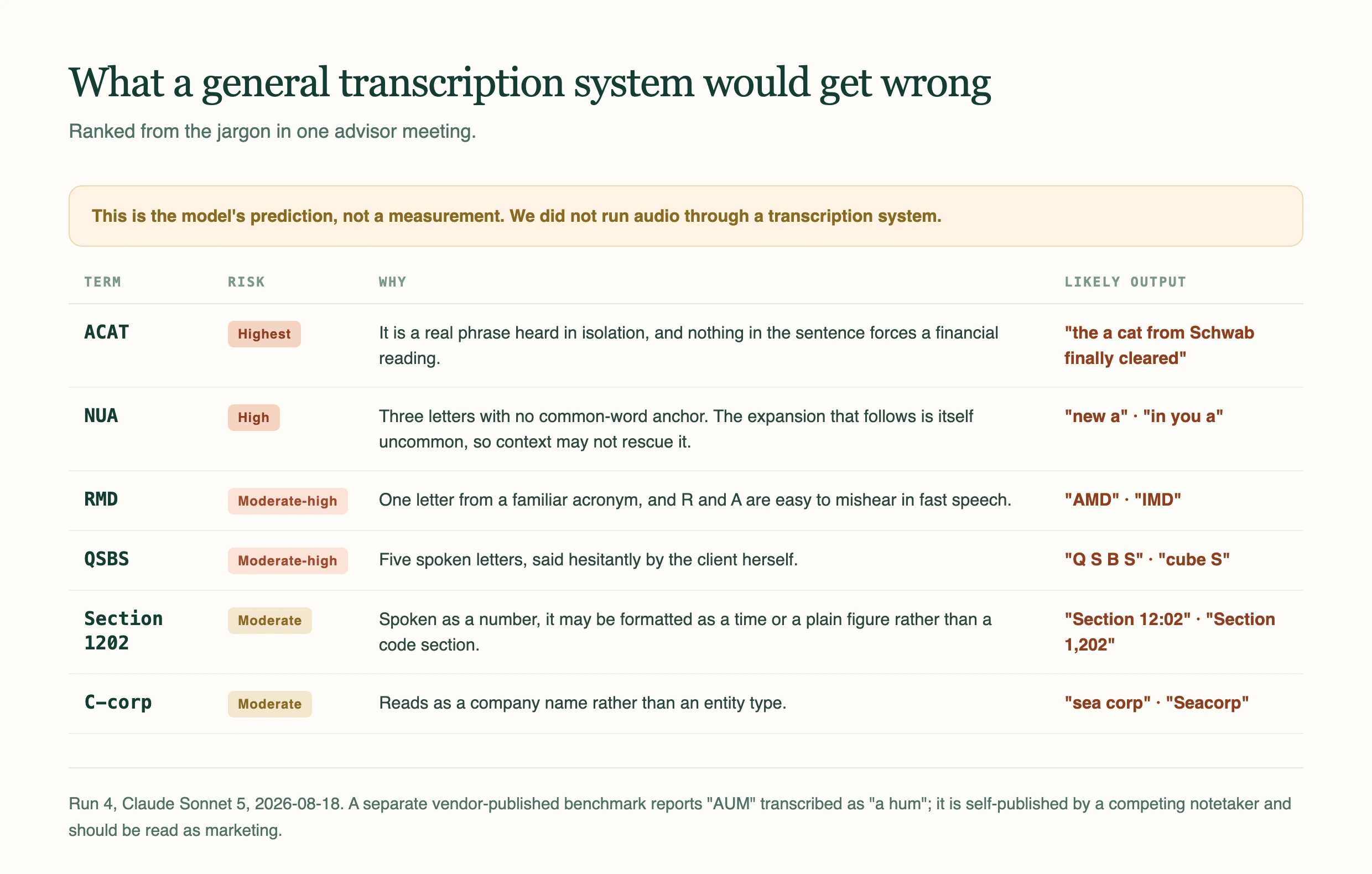
A prediction, not a measurement. We asked the model to reason about transcription risk; we did not run this transcript through a transcription system to check.
State this plainly, because it's the honest limit of the finding: this is a prediction of what a transcription system would do, not a measurement. We did not feed audio into one and compare the output.
Consent and record-keeping come first
The first line of our fictional transcript is the advisor asking whether he can record, and the client saying yes. That line belongs in every real meeting too. Federal law allows recording with one party's consent, but a number of states, including California, Florida, Illinois, Maryland, Massachusetts, Pennsylvania and Washington, require the consent of everyone on the call (Kilpatrick, wiretap laws in the United States). When a client is in a different state, the stricter rule is the safe one. Ask before the notetaker starts, and keep the answer in the record, which is exactly why the commitment sweep's catch of "Yes, fine." matters.
The outputs are records, too. Registered investment advisers keep books and records under SEC Rule 204-2, which covers written communications relating to advice and recommendations for at least five years. Broker-dealers keep them under FINRA Rule 4511 and SEA Rule 17a-4. Whether a given transcript, AI summary or recording must be retained is a call for your compliance team, so settle it before the first recorded meeting rather than after.
How this compares to what enterprises already built
The post-meeting cascade isn't a new idea. Morgan Stanley built one for its wirehouse advisors before most independent advisors had a name for the category. AI @ Morgan Stanley Debrief, launched in 2024, records a meeting with the client's consent, then "summarizes key points, creates an email for an Advisor to edit and send at their discretion, and saves a note into Salesforce": the same shape (note, email, action items, review before sending) this post describes, built into the firm's CRM (Morgan Stanley, June 2024; corroborated by OpenAI's case study). In the same release, Morgan Stanley said 98% of its advisor teams had adopted its earlier internal tool, the AI @ Morgan Stanley Assistant.
Most advisors don't have an internal engineering team, which is why the category filled in from outside. Jump raised an $80 million Series B in February 2026, bringing total funding to $105 million, and reported 27,000 advisors on the platform in under two years (WealthManagement.com, 2026-02-19). Native versions now ship inside tools advisors already use: Kitces reported in August 2025 that Nitrogen, Wealthbox and Altruist all had notetakers built into their existing platforms (Kitces, #AdvisorTech August 2025). This cascade is becoming something advisors get by default.
Tool choice doesn't fully explain quality, though. Kitces Research's Fall 2024 survey found Zoom's AI Companion ranked first in adoption and last in satisfaction, in the same dataset (Kitces.com, 2025-03-17). Whatever drives that gap, it is closer to what this post is about: whether the tool, or the prompt, separates a resolved commitment from a dropped one, the same standard whether the output lands in a saved profile or a plain CRM note.
What to paste into your own notetaker
The structured cascade prompt, reproducible from the transcript above. Paste your meeting transcript below it:
From the transcript below, produce four separate outputs under four headings.1. CRM NOTE: under 150 words, factual, no interpretation, written so a colleague who was not in the room can act on it.2. FOLLOW-UP EMAIL to the client: under 200 words, confirms only what was actually agreed, does not restate anything the client said she did not want repeated, does not give tax advice, and leaves my sign-off blank.3. ACTION ITEMS: a table with columns: item, owner, due, source (quote the line of the transcript it came from).4. WHAT I MIGHT HAVE MISSED: things that were raised and not resolved, or implied and never stated out loud.Rules: do not invent a fact. If something is unclear in the transcript,write [UNCLEAR: what] rather than resolving it. Do not soften or omitanything sensitive; mark it [SENSITIVE] and keep it.
Then run the commitment sweep above, in the same conversation, against the same transcript. Read its fourth output as carefully as the action-items table: it is the one place in this cascade designed to surface what nobody assigned an owner to. Before any of it reaches a client's inbox or a compliance file, it still needs a human read, the same way a pre-meeting research brief does before a first call: it cannot verify a fact it wasn't given, and the only thing between an [UNCLEAR] bracket and a confident guess is whether you asked for it.
Frequently asked questions
Does AI meeting-note software actually replace manual notetaking for advisors?
For the note itself, largely yes. Even a one-line prompt handles a readable summary reasonably well. The harder part is separating resolved from deferred and catching commitments that don't read as tasks, which took a structured prompt plus a second targeted pass in our test, not one instruction.
What's the biggest risk in using AI for post-meeting follow-up?
Not invented facts: a well-instructed model reliably bracketed what it didn't know instead of guessing. The risk is omission: a thin prompt can produce accurate, readable output that still drops commitments with no owner, no due date, or no place to land, without ever looking wrong.
Should a financial advisor send an AI-drafted follow-up email without editing it?
No. Every output here (the CRM note, the email, the action items) needs a human read before it reaches a client or a file, the same discipline Morgan Stanley built into Debrief by having an advisor edit and send the drafted email "at their discretion" rather than auto-sending it. Flagging what it's unsure of isn't a substitute for that review; it just makes review faster.
Is a jargon or mis-transcription risk ranking from an AI model reliable?
Treat it as a hypothesis, not a finding. The model predicted which financial terms a transcription system would likely mis-hear, based on reasoning about how the words sound. It did not run audio through a transcription system to check. Any claim that a notetaker correctly (or incorrectly) transcribes specific jargon should be checked against the original source, especially when a company selling the notetaker published it.